Jim Rogers: Career, Investment Philosophy, and Global Macro
Global markets often swing between paper assets and physical resources, which can create large gaps in returns. To understand these multi-decade rotations, it helps you to study investors who lived through inflationary spirals and long bear markets. Jim Rogers is a global macro investor best known for co-founding the Quantum Fund with George Soros and for his long-running bullish views on commodities. His market views are opinions, and commodity and macro calls can take years to play out or may not play out at all.
Quick Takeaways
- Rogers co-founded the Quantum Fund with George Soros in 1973. Widely cited figures say its portfolio gained 4,200% from 1973 to 1980, versus about 47% for the S&P 500.
- His investment philosophy centers on tangible commodities, supply-demand analysis, and patience rather than speculative intraday trading.
- Rogers has praised India’s potential. In 2024, he said he does not like to buy expensive markets at all-time highs. He often recommends holding real assets such as gold and silver.
Who Is Jim Rogers?
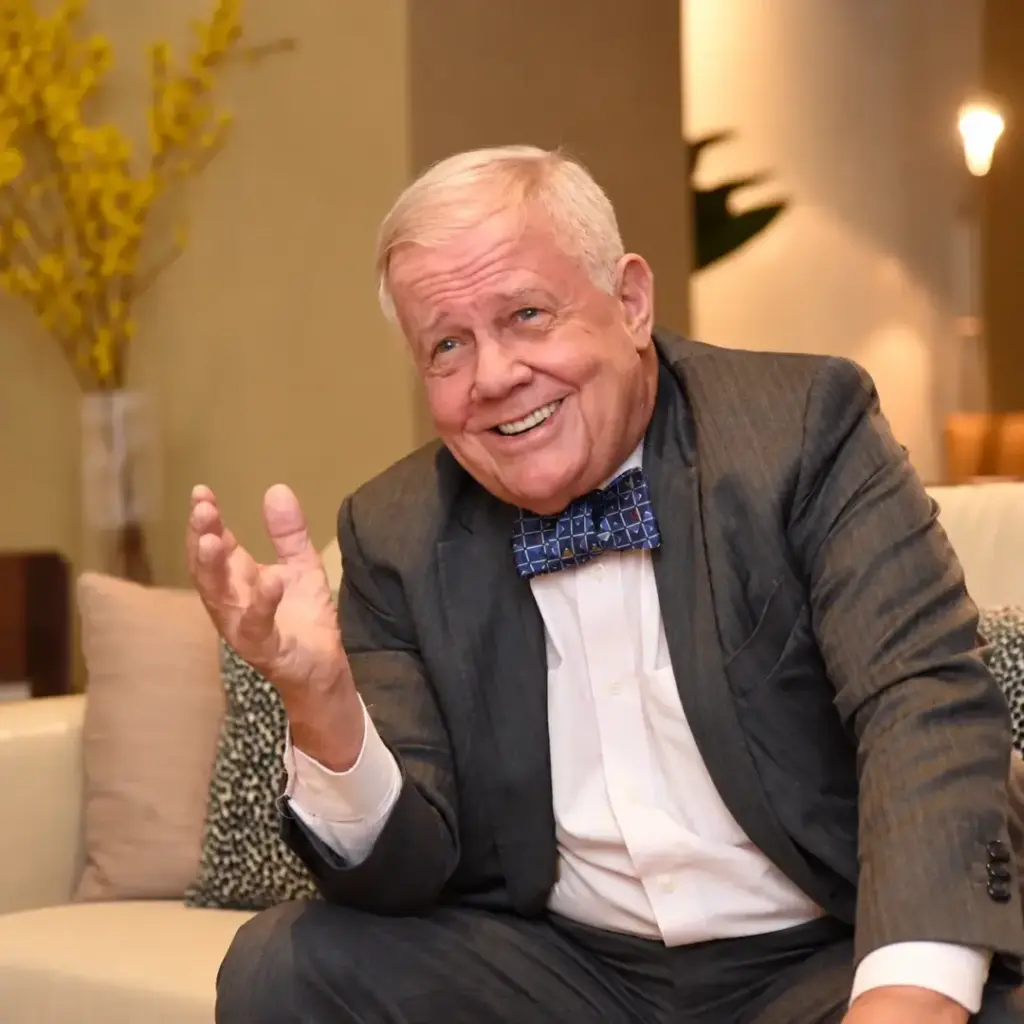
- Current Position: Chairman of Beeland Interests, Inc., international investor, and financial author based in Singapore.
- Estimated Net Worth: Estimates vary. Motley Fool and Traders Union put it at about $300 million (2026).
- Core Focus: Global macroeconomics, agriculture, industrial and precious metals, and long-term currency cycles.
Image source: japantimes.co.jp
“I would rather invest in a country where things are moving from terrible to mediocre than in a country where things are moving from good to great.” — attributed to Jim Rogers
History
Rogers was born in 1942 in Baltimore and raised in Demopolis, Alabama. He earned a bachelor’s degree in history from Yale University in 1964 and later studied Philosophy, Politics, and Economics (PPE) at Balliol College, Oxford.
His Wall Street career began at Dominick & Dominick, followed by Arnhold and S. Bleichroeder, where he worked with George Soros. In 1973, the two men founded the Quantum Fund, an offshore fund built to exploit international currency and commodity gaps. Rogers stepped back from daily fund management in 1980 at age 37 and invested his own capital independently.
Achievement
Rogers is best known for the Quantum Fund, which he and Soros ran together. Widely cited figures say its portfolio gained 4,200% from 1973 to 1980 versus about 47% for the S&P 500, though some sources describe the period as a decade. That figure is a fund-level result, not Rogers’ personal return, and past performance does not guarantee future results.
In 1998, he launched the Rogers International Commodity Index (RICI) to track global consumption baskets weighted toward physical raw materials. Rogers also set two Guinness World Records. The first came from a motorcycle trip across six continents between 1990 and 1992, covering more than 100,000 miles. The second came from the Millennium Adventure, a drive across 116 countries in a custom Mercedes-Benz between 1999 and 2002 to see emerging economies firsthand.
The Commodity Supercycle and Real Assets Thesis
Financial markets tend to swing between paper claims, such as growth equities and sovereign bonds, and physical resources like farm produce, energy, and metals. Rogers argues that years of underinvestment in exploration, refining capacity, and farming infrastructure can eventually cause multi-year shortages that monetary policy cannot fix quickly.
Unlike software, a new copper mine or productive farmland takes a long time to develop, often a decade or more. When demand outpaces capacity, commodity prices can rise until supply catches up.
| Asset Class | Performance in Low Inflation | Performance in High Inflation / Stagflation | Structural Vulnerability |
|---|---|---|---|
| Equities (Growth & Consumer) | Often outperform; multiple expansion | P/E compression; margin erosion | Vulnerable to rising discount rates and input costs |
| Physical Commodities (Raw Materials) | Underperforms; rangebound pricing | Often outperform; supply-side pricing power | High carrying costs and cyclical demand contractions |
| Sovereign Debt (Bonds) | Stable yield; capital appreciation | Real capital losses | Inflation erosion of purchasing power |
Warning: Commodity markets can fall sharply in cycles. If you ignore how supply responds over several years, you may see long periods of poor returns.
Core Investment Philosophy: Contrarian Macro Rules
Rogers avoids quantitative high-frequency trading models, relying instead on fundamental global macro research and behavioral discipline.
- Invest in what you can observe: Put money only into businesses and sectors you understand from direct evidence, not from tips.
- Wait for money in the corner: Patience can be better than constant activity. Some investors hold cash or defensive assets until a clear opportunity appears.
- Catalysts for structural change: Position ahead of major demographic shifts, policy deregulation, or infrastructure bottlenecks rather than reacting to daily news cycles.
- Differentiate price from value: High-flying momentum assets often carry hidden downside risks once sentiment shifts away from peak optimism.
To understand this framework, compare it with the principles in our guide What Is Contrarian Investing? There, capital is deployed against prevailing market sentiment to capture long-term mean reversion.
Jim Rogers on the Indian Market: Caution vs. Structural Expansion
Rogers’ comments on India mix praise with caution.
In 2017, he called the goods and services tax (GST) a major positive, according to Business Standard. In 2020, he told Business Standard that India should drop protectionist rules and open its agricultural and financial markets. In March 2024, he said he would prefer agriculture to stocks in India for the next five years, according to BusinessToday.
In April 2024, he told Business Standard that he did not own Indian shares and saw too much exuberance developing in Indian stocks. In July 2025, he said India could become “the new China” if Delhi commits to pro-growth reforms, according to BusinessToday. To see how valuation levels are measured, read our guide on the Nifty PE ratio.
For Indian market participants, his comments do not mean you must abandon domestic equities, but they highlight why some investors diversify:
- Precious metals allocation: Some investors hold gold and silver through physical markets, gold ETFs, or existing Sovereign Gold Bonds (SGBs) traded on the National Stock Exchange (NSE) and BSE Limited (BSE). The government has not issued a new SGB tranche since February 2024.
- Cross-border exposure: Under the Reserve Bank of India (RBI) Liberalised Remittance Scheme (LRS), resident individuals can send up to $250,000 per financial year abroad. Rules limit what the money may be used for. This can reduce reliance on one country.
- Exchange-traded commodities: Commodity trading on exchanges like the Multi Commodity Exchange of India (MCX) is overseen by the Securities and Exchange Board of India (SEBI). Leverage can force sudden margin liquidation, so manage it strictly.
Tips: Indian investors can mirror global macro balance by keeping disciplined equity exposure while holding some non-paper assets, such as gold ETFs or commodity ETFs.
Monetyra’s Take: Jim Rogers’ framework is a useful reminder of how real assets and commodity shortages can matter in cycles. Rotating fully out of Indian equities would ignore long-term earnings growth in the domestic economy. For Indian retail investors, the takeaway is not to abandon domestic equities but to avoid concentrating in one asset class. A barbell approach that pairs core Indian equities with real assets such as gold may reduce the damage when one asset class falls, though it cannot remove losses.
Conclusion
Jim Rogers’ market career highlights the value of independent thinking over following momentum. He argued that supply-side limits can shape long-term returns and that real assets can protect against inflation at times. For investors facing volatile markets, his focus on tangible value, patience, and risk control offers one framework for building a portfolio, though no framework guarantees results.
Deepen your macro market knowledge with institutional data and asset cycle analysis.
FAQs
Jim Rogers is an American investor, author, and financial commentator who co-founded the Quantum Fund with George Soros in 1973. He is widely recognized for his expertise in global macro investing, commodities, and international economic trends, currently managing his private investments from Singapore.
Estimates put Jim Rogers’ net worth at about $300 million, according to Motley Fool and Traders Union (2026). Sources do not break down how his wealth was built, but his early earnings came from the Quantum Fund and he later invested privately.
Rogers is best known for co-founding the Quantum Fund with George Soros, whose portfolio is widely reported to have gained 4,200% from 1973 to 1980. He also created the Rogers International Commodity Index (RICI) and set Guinness World Records by crossing the globe on a motorcycle and in a car.
Rogers made his money primarily as a global macro fund manager and private investor. He took large positions in commodities, international equities, and currencies, and he also shorted assets he considered overvalued. His reported returns came before several macroeconomic shifts.
Rogers’ widely cited rules include investing only in assets you understand, waiting patiently for a clear asymmetric risk-reward setup, watching supply-demand imbalances, and resisting popular consensus during speculative retail euphoria.
Disclaimer: This article was written with the help of AI and reviewed by the Monetyra editorial team. It is for educational purposes only and should not be considered financial advice. Trading and investing in financial instruments involve significant risk of loss and are not suitable for all investors, and past performance of any investor or fund does not guarantee future results. Please consult a licensed financial advisor before making any investment decisions.
In India, equity, commodity, and currency derivative trading are strictly regulated by the Securities and Exchange Board of India (SEBI) and the Reserve Bank of India (RBI). Readers are advised to verify regulatory rules, adhere to Foreign Exchange Management Act (FEMA) parameters, and assess personal risk tolerance before entering volatile asset classes.