Ray Dalio: Macro Strategy & All Weather Framework
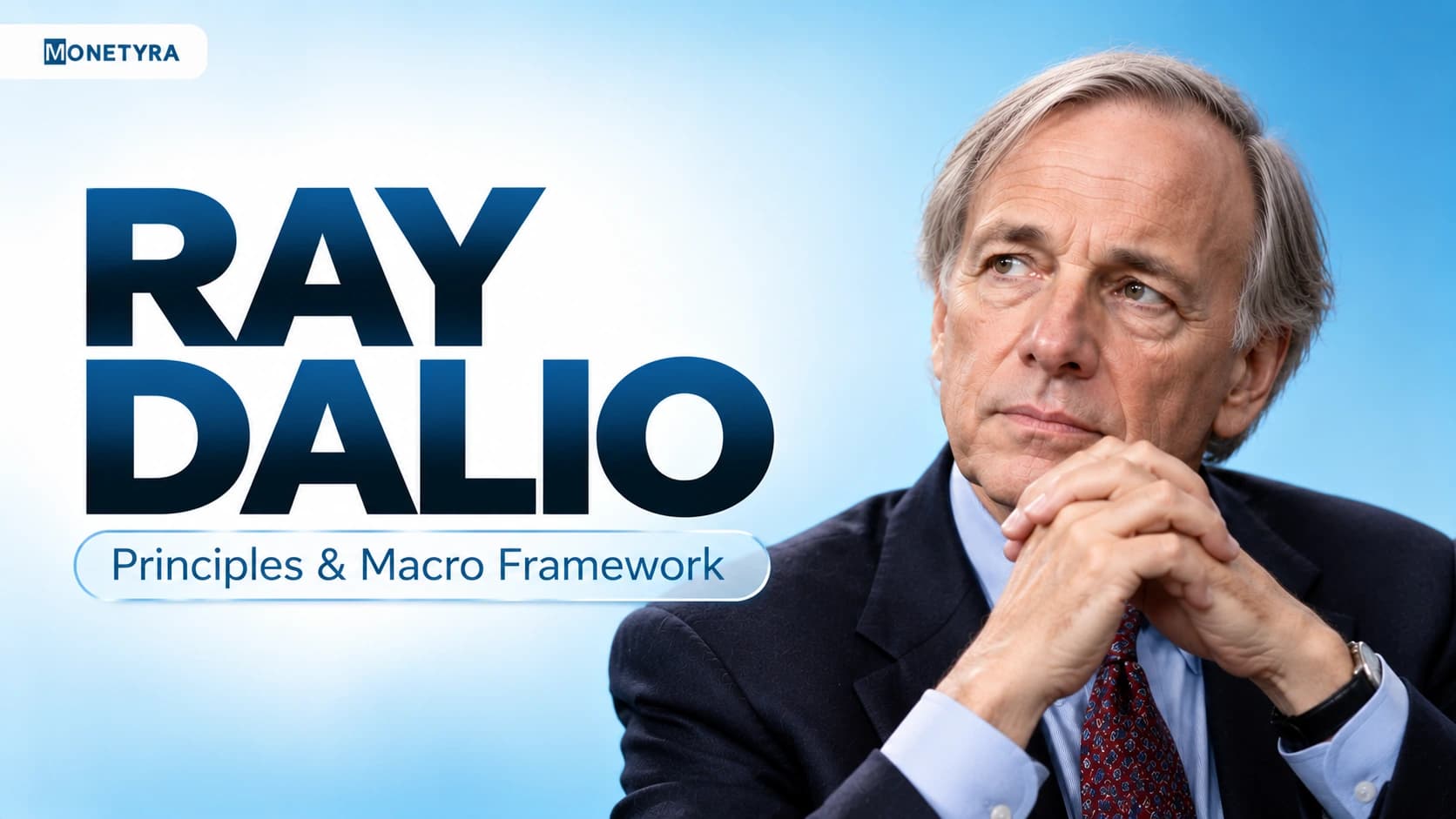
Navigating global financial markets requires a consistent framework rather than short-term market timing. Ray Dalio, founder of Bridgewater Associates, revolutionized modern portfolio theory by shifting the focus from picking individual securities to managing macroeconomic risk drivers. Understanding his core principles—from short- and long-term debt cycles to the All Weather asset allocation model—provides investors with a structural roadmap to preserve and grow capital across inflationary spikes, rate hikes, and economic contractions.
Who Is Ray Dalio?

- Founder: Bridgewater Associates (1975).
- Net Worth: Approximately $20 billion.
- Core Contribution: Pioneer of “Risk Parity” and the “All Weather Portfolio” framework.
- Key Concepts: Radical Transparency, Economic Machine Framework, Long-Term Debt Cycles.
- Famous Work: Author of Principles: Life & Work and Principles for Dealing with the Changing World Order.
Image source: bridgewater.com
Pain + Reflection = Progress — Raymond Dalio
History
Born in Queens, New York, in 1949, Ray Dalio began his investment journey at age 12 by purchasing shares of Northeast Airlines. After completing his MBA at Harvard Business School in 1973, he worked on Wall Street trading commodities before founding Bridgewater Associates out of his two-bedroom apartment in 1975.
In 1982, Dalio made a high-profile prediction that a global debt crisis originating in Mexico would cause a massive depression. Instead, the stock market surged into a historic bull run. The resulting losses forced Bridgewater down to zero employees, requiring Dalio to borrow $4,000 from his father to pay basic family expenses. This humbling event birthed his core mantra: “Pain + Reflection = Progress,” prompting him to replace subjective emotional bets with systematic, stress-tested investment frameworks.
Achievement
Under Dalio’s leadership, Bridgewater grew into the world’s largest hedge fund, managing over $150 billion in assets at its peak. His flagship Pure Alpha fund generated decades of industry-leading risk-adjusted returns, while his All Weather strategy revolutionized modern institutional asset allocation by introducing Risk Parity.
Core Philosophy & Framework
Ray Dalio’s strategy centers on understanding the economy as a complex, repeating mechanical system driven by productivity growth and debt cycles.
How the Economic Machine Works
Dalio views economic activity as the sum of total transactions powered by money and credit. He divides economic movement into three core forces:
- Productivity Growth: The foundational, long-term upward trend in living standards.
- Short-Term Debt Cycle: The 5-to-10-year business cycle managed primarily by central banks through interest rate hikes and cuts (e.g., RBI repo rate adjustments).
- Long-Term Debt Cycle: A 75-to-100-year cycle where total debt accumulation reaches levels that interest rate cuts can no longer service, leading to structural deleveraging, money printing, or currency devaluation.
Radical Transparency and Idea Meritocracy
At Bridgewater, Dalio instituted an organizational culture where decisions are made by evaluating the objective quality of ideas rather than hierarchy, driven by open critique and systematic feedback.
Ray Dalio Methodology
Dalio’s investment methodology separates portfolio construction into two distinct components: Beta (passive exposure to asset class risk premiums) and Alpha (active market timing and selection).
The All Weather Portfolio (Risk Parity)
Traditional 60/40 equity/bond portfolios allocate weight by dollar value, leaving them heavily exposed to stock market volatility. Dalio’s Risk Parity framework balances investments by volatility risk weight across four environmental quadrants:
- Rising Growth: Equities, Commodities, Corporate Bonds.
- Falling Growth: Nominal Government Bonds, Inflation-Linked Bonds.
- Rising Inflation: Commodities, Gold, Inflation-Linked Bonds.
- Falling Inflation: Equities, Nominal Government Bonds.
Standard All Weather Model vs. Indian Market Model
| Asset Class | Standard All Weather Weight | Indian Proxy Asset Equivalent | Strategic Function |
|---|---|---|---|
| Equities | 30% | Nifty 50 ETF / Flexi-Cap Mutual Funds | Growth & Capital Appreciation |
| Long-Term Bonds | 40% | Long-Term Indian G-Secs / Gilt Mutual Funds | Deflation & Falling Growth Hedge |
| Intermediate Bonds | 15% | Short-Term Debt Funds / RBI Floating Rate Bonds | Stable Income & Liquidity |
| Gold | 7.5% | Sovereign Gold Bonds (SGB) / Gold ETFs | Currency Devaluation & Inflation Hedge |
| Commodities | 7.5% | Commodity ETFs / Multi-Asset Allocation Funds | Supply Shock & Inflation Hedge |
Tip: Indian retail investors looking to build an All Weather structure can utilize Multi-Asset Allocation Mutual Funds, which automatically rebalance across Indian equities, debt, gold, and international exposure.
Modern Market Adaptation
Dalio’s framework continually evolves to address emerging global macro risks:
- Monetary Debasement & Inflation: Dalio highlights the risks of expanding sovereign debt levels worldwide. To hedge against persistent fiat currency devaluation, he advocates holding physical assets and hard monetary alternatives.
- Gold and Digital Assets: Dalio holds a strategic allocation in Gold and has publicly acknowledged Bitcoin as a secondary digital asset store of value, warning that investor portfolios holding 0% gold or alternative stores of value ignore historical macroeconomic risks.
- Geopolitical Shifts: Dalio emphasizes analyzing long-term historical cycles to navigate changing global economic leadership, capital flow shifts, and trade restructuring.
Essential Books/Works
- Principles: Life & Work (2017): NYT #1 Bestseller detailing Dalio’s personal management rules, radical transparency, and decision-making framework.
- Principles for Navigating Big Debt Crises (2018): A comprehensive study analyzing historical deleveraging episodes, hyperinflationary panics, and debt liquidations.
- Principles for Dealing with the Changing World Order (2021): An examination of historical reserve currency life cycles, macroeconomic shifts, and empire dynamics over 500 years.
- How Countries Go Broke (2025): Dalio’s analysis on sovereign fiscal management, national balance sheets, and long-term debt sustainability.
Ray Dalio’s Key Risk
While Dalio’s framework offers robust protection against standard market volatility, it presents specific vulnerabilities:
- Correlated Downside in Rising Interest Rates: The high fixed-income weighting (55%) in the standard All Weather strategy can suffer mark-to-market drawdowns during sharp, rapid central bank interest rate hikes.
- Underperformance During Strong Equity Bull Runs: Because the strategy prioritizes drawdown protection over maximum yield, it underperforms concentrated 100% stock portfolios during prolonged economic expansions.
- Macro Forecasting Complexity: Tactical Alpha adjustments require precise macro models. Misjudging central bank pivot timing can drag down overall portfolio performance.
Warning: Blindly copying US-based asset ratios without accounting for local interest rates, domestic inflation differentials, and Indian tax structures (e.g., debt mutual fund tax amendments) can introduce unintended portfolio drag.
Monetyra’s Take: Ray Dalio’s All Weather philosophy provides a vital lesson for Indian retail investors often over-concentrated in domestic equities. While Indian growth dynamics remain strong, adopting a Risk Parity mindset—allocating across Nifty 50 equities, sovereign debt, and Gold ETFs—helps protect wealth against unexpected global shocks, currency swings, and inflationary spikes without sacrificing long-term compounding.
Conclusion
Ray Dalio’s legacy lies in demystifying complex macroeconomic forces into actionable, principles-driven frameworks. By balancing equity upside with fixed-income and commodity hedging, investors can construct resilient portfolios designed to survive diverse economic climates.
Understand how institutional investors build wealth across global market cycles.
FAQs
Ray Dalio is an American billionaire investor, author, and founder of Bridgewater Associates, the world’s largest hedge fund. He is renowned for creating the All Weather Portfolio strategy and developing macroeconomic frameworks based on debt cycles.
The All Weather Portfolio is an asset allocation model designed to perform stably across all economic environments (rising/falling growth and rising/falling inflation) by balancing asset classes based on volatility risk rather than dollar amount.
Ray Dalio’s net worth is estimated at approximately $20 billion [VERIFY: Bloomberg/Forbes 2026], built primarily through management and performance fees at Bridgewater Associates as well as his personal investments.
Indian investors can implement Dalio’s principles by building a diversified portfolio across Indian equities (Nifty 50), debt instruments (G-Secs/Fixed Income), and gold (Sovereign Gold Bonds/Gold ETFs), or by investing through Multi-Asset Allocation Funds.
Dalio believes that investors must be defensive and aggressive simultaneously. By balancing uncorrelated asset classes using Risk Parity, investors can reduce overall portfolio risk without proportionally sacrificing expected returns.
Disclaimer: This article was written with the help of AI and reviewed by Monetyra’s editorial team. It is for educational and informational purposes only, detailing historical investment frameworks and educational concepts of prominent financial leaders. It does not constitute financial, investment, or trading advice. Asset allocation models discussed (e.g., All Weather Portfolio) are theoretical frameworks and may not suit every individual’s financial situation, tax status, or local market conditions. Past performance is no guarantee of future results. Always conduct your own research and consult with a licensed financial advisor before making any investment decisions.