Arbitrage Fund: Meaning, Taxation & Investment Guide
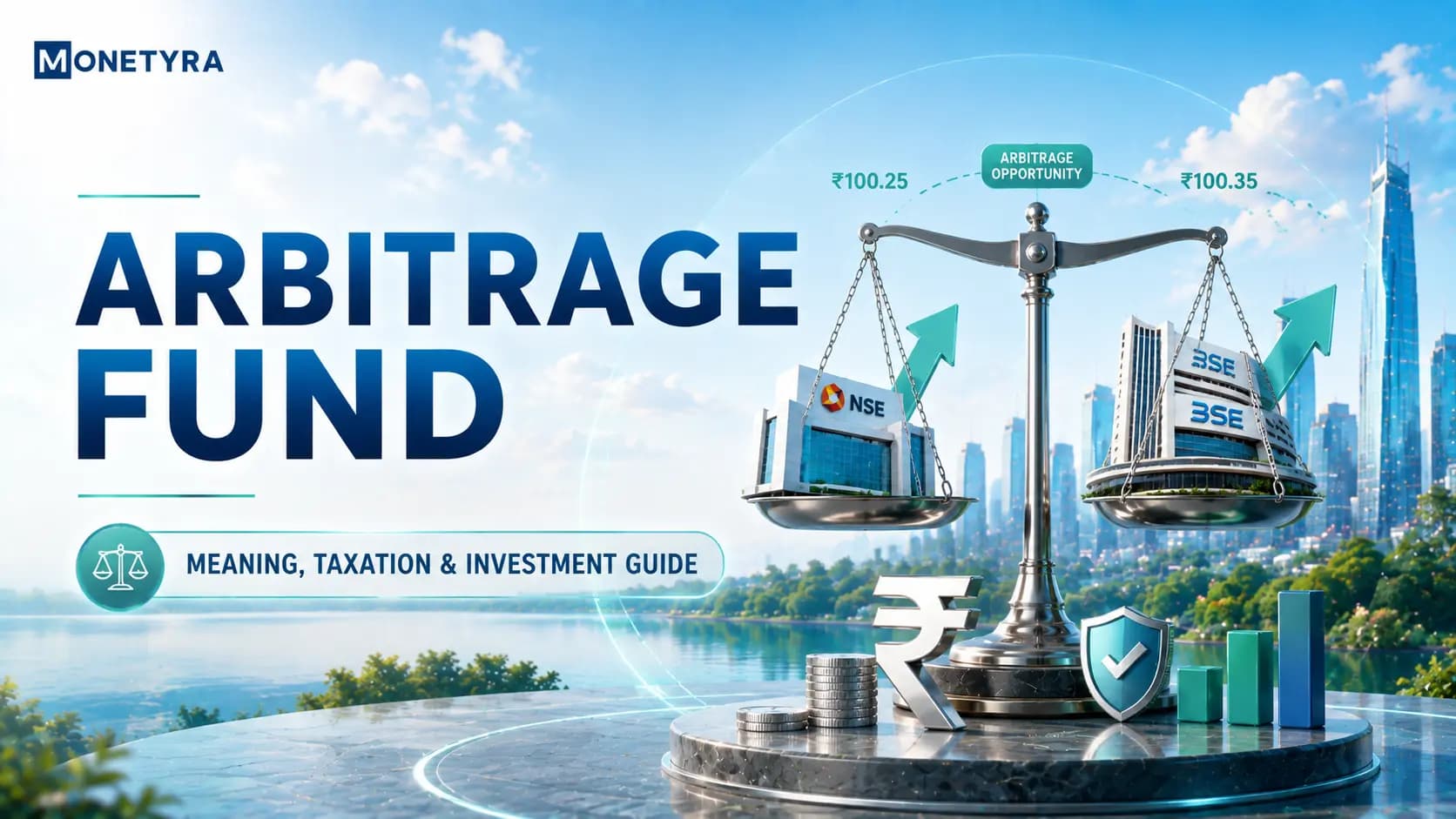
Short-term market volatility often creates temporary price discrepancies across different exchange segments in the Indian financial market. While retail investors may view intraday price fluctuations as unpredictable noise, institutional fund managers leverage these price gaps through structured market-neutral strategies.
An arbitrage fund serves as a specialized equity-oriented hybrid mutual fund designed to capture these brief price differentials between the cash (spot) market and the derivatives (futures) market. By maintaining a fully hedged portfolio, these schemes allow conservative investors to park short-term capital while enjoying equity taxation benefits under Indian tax laws.
Quick Takeaways
- Core Definition: This SEBI-regulated equity-oriented hybrid mutual fund generates returns by simultaneously buying securities in the spot market and selling them in the futures market to lock in the spread.
- Primary Mechanism: Because every cash equity position is matched by an offsetting short futures contract, performance depends on the cost of carry rather than directional stock price movements.
- Primary Risk / Limit: During prolonged bear markets or periods of dull trading activity, cash-futures spreads narrow sharply, causing annual yields to compress toward overnight liquid debt fund levels.
What Is an Arbitrage Fund and How Does It Work in India?
It is a category of hybrid mutual fund that exploits temporary price inefficiencies between two related financial markets to generate low-risk returns. Understanding the arbitrage fund meaning requires looking at how institutional fund managers deploy capital across the National Stock Exchange (NSE) and Bombay Stock Exchange (BSE).
Under regulations established by the Securities and Exchange Board of India (SEBI), it must maintain at least 65% gross allocation to equities and equity-related derivative instruments. The remaining portion (up to 35%) is parked in high-quality debt securities, Treasury Bills, and money market instruments to maintain liquidity and provide baseline yield.
The Cash-Futures Arbitrage Mechanism
To answer what is arbitrage fund execution in practice, consider a standard cash-futures trade:
- Spot Market Purchase: The fund manager identifies Stock ABC trading at ₹100 per share in the cash market and buys 1,000 shares for a total outlay of ₹1,00,000.
- Futures Market Sale: Simultaneously, the manager sells one lot of Stock ABC futures (1,000 shares) expiring in 30 days at ₹100.80 per share.
- Locking in the Spread: The fund locks in a gross price difference (cost of carry) of ₹0.80 per share, or ₹800 (0.80% return over 30 days).
- Expiry Settlement: On expiry day, spot and futures prices naturally converge to the exact same price. The fund manager closes both positions, securing the pre-determined ₹800 gain regardless of whether Stock ABC traded up to ₹150 or down to ₹50.
Tips: Look for schemes with a strong institutional execution track record, as swift order placement minimizes execution drag during sudden market swings.
Key Factors Driving Arbitrage Fund Returns
Because market-neutral funds do not depend on stock price rallies, their overall annualized yields are driven by broader macroeconomic and trading environment factors.
- Market Volatility and Turnover: Higher trading volume and market sentiment expand the price difference between spot and futures prices, increasing gross spreads.
- Short-Term Interest Rates: The baseline spread in derivatives contracts reflects short-term borrowing costs; when repo and money market rates rise, arbitrage spreads expand accordingly.
- Fund Size and Assets Under Management (AUM): Unusually large AUM can occasionally limit a fund’s ability to deploy cash into high-yield spreads without driving down market spreads.
- Annual Expense Ratio: Scheme management fees directly reduce net returns; choosing low-cost direct plans helps preserve compounding yields.
Top Arbitrage Funds in India: AUM & Expense Ratios
When reviewing market options via official disclosures from the Association of Mutual Funds in India (AMFI), investors assess scheme size, past performance, and expense structures, such as total AUM and direct plan expense ratios.
| Scheme Name | AUM (₹ Cr) | Direct Expense Ratio (%) | 1Y Return (%) | 3Y CAGR (%) |
|---|---|---|---|---|
| Kotak Arbitrage Fund | ~74,398 | ~0.39% | ~7.04% | ~7.80% |
| SBI Arbitrage Opportunities Fund | ~45,923 | ~0.45% | ~6.88% | ~7.12% |
| ICICI Prudential Equity Arbitrage Fund | ~32,298 | ~0.42% | ~6.83% | ~7.05% |
| Invesco India Arbitrage Fund | ~6,500+ | ~0.38% | ~6.75% | ~6.95% |
| Tata Arbitrage Fund | ~4,200+ | ~0.35% | ~6.70% | ~6.90% |
Note: AUM, expense ratios, and historical annualized returns vary across market cycles. Investors should review the latest Scheme Information Document (SID) on AMFI or individual AMC portals before committing capital.
Arbitrage Fund vs Liquid Fund vs Bank Fixed Deposit
Investors managing short-term cash reserves frequently evaluate how market-neutral funds compare to conventional debt and fixed income avenues.
| Feature | Arbitrage Fund | Liquid Debt Fund | Bank Fixed Deposit (FD) |
|---|---|---|---|
| Primary Asset Focus | Hedged Equities (65%+) & Debt | Short-term Debt Instruments | Bank Term Deposit |
| Market Risk | Low (Market-neutral) | Low (Credit/Interest rate sensitivity) | Zero (Insured up to ₹5 Lakh by DICGC) |
| Tax Classification | Equity Fund (Section 112A) | Specified Mutual Fund (Debt) | Interest Income (Other Sources) |
| STCG Tax Rate | 20% (Holdings ≤ 12 months) | Income Tax Slab Rate | Income Tax Slab Rate |
| LTCG Tax Rate | 12.5% (Exceeding ₹1.25L/yr) | Income Tax Slab Rate | Income Tax Slab Rate |
| Exit Load | Typically 0.25% if < 15–30 days | Graduated exit load (7 days) | Penalty on premature withdrawal |
Investors planning short-term capital deployment alongside commodity hedges—such as a best gold etf in india or best silver etf in india—often utilize market-neutral funds to earn yields on surplus cash while maintaining broad portfolio diversification.
Taxation Rules for Arbitrage Funds in India
Tax treatment is one of the primary reasons high-income retail investors select equity-oriented market-neutral funds over standard debt instruments.
According to statutory guidelines issued by the Income Tax Department, because these funds maintain an average equity exposure above 65%, they are taxed under the equity fund framework under Section 112A.
- Short-Term Capital Gains (STCG): If units are redeemed within 12 months of purchase, capital gains are taxed at a flat rate of 20% (plus applicable surcharge and health/education cess).
- Long-Term Capital Gains (LTCG): If units are held for more than 12 months, gains are taxed at 12.5% on amounts exceeding the annual threshold of ₹1.25 lakh per financial year.
- Dividend Distribution: Dividends distributed by the scheme are added to the investor’s total income and taxed at their applicable individual tax slab rate.
Warning: Redeeming units within the exit load window (usually 15 to 30 days) triggers a 0.25% exit load charge that can erode short-term net yield.
Conclusion
This tax-efficient, market-neutral vehicle serves investors parking short-term capital over a 3-to-12-month horizon. By locking in cash-futures spreads across Indian stock exchanges, these schemes offer stable returns, low directional equity risk, and favorable equity taxation treatment for conservative portfolios.
Expert Insights
Deepen your portfolio knowledge with data-led macro analysis and strategic allocation guides.
FAQs
It is an equity-oriented hybrid mutual fund that exploits price differences between spot and futures markets to deliver low-risk, market-neutral returns.
Fund managers buy stocks in the cash market and simultaneously short equal quantities in the futures market, locking in the spread until contract expiry when prices align.
They are taxed as equity funds: Short-Term Capital Gains (held ≤ 12 months) are taxed at 20%, while Long-Term Capital Gains (held > 12 months) above ₹1.25 lakh are taxed at 12.5%.
For investors in higher income tax brackets (30%+), they often deliver higher post-tax yields due to 20% STCG and 12.5% LTCG tax rates compared to slab-rate taxation on FDs.
The main risks include spread compression during low market volatility, exit load charges on redemptions within 15–30 days, and annual fund expense ratios reducing net yield.
Disclaimer: This article was written with the help of AI and reviewed by the Monetyra editorial team. It is for educational purposes only and should not be considered financial advice. Trading and investing in financial instruments involve significant risk of loss and are not suitable for all investors, and past performance of any strategy does not guarantee future results. Please consult a licensed financial advisor before making any investment or trading decision.
In India, mutual funds are regulated by SEBI and AMFI. Readers are advised to verify the regulatory status of their fund house and review scheme information documents before investing.