SGB vs Gold ETF: Returns, Tax, and Liquidity Compared
Comparing an SGB vs Gold ETF helps Indian investors choose the right non-physical gold vehicle without storage or purity risks. While both track domestic gold prices, their structures differ sharply: Sovereign Gold Bonds (SGBs) are government-backed debt securities paying fixed annual interest, whereas Gold Exchange-Traded Funds (ETFs) are mutual fund units backed by physical bullion.
More importantly, the Sovereign Gold Bond vs Gold ETF decision changed after the Indian government halted fresh SGB tranches in February 2024. New buyers can now acquire SGBs only on secondary stock exchanges, which alters their liquidity and maturity tax exemptions compared to original subscribers.
Quick Takeaways
- SGBs pay 2.50% per annum fixed simple interest on the initial issue price and carry zero annual management fees, whereas Gold ETFs generate no coupon and charge an expense ratio.
- Primary SGB subscribers receive 100% tax-free capital gains upon 8-year maturity, while Gold ETFs and secondary-market SGB buyers pay 12.5% long-term capital gains tax after 12 months.
- Because the government has issued no new SGB tranches since February 2024, new investors face limited secondary-market volume and wider bid-ask spreads on SGBs compared to continuous daily liquidity on Gold ETFs.
SGB vs Gold ETF: Key Differences at a Glance
When you put SGBs and Gold ETFs side by side, you will see they differ mainly in what backs them, whether they pay you regular income, who regulates them, and whether you can still buy them at issue. A Gold ETF is an open-ended mutual fund scheme regulated by the Securities and Exchange Board of India (SEBI) that holds 99.5% pure physical gold bullion in audited vaults. In contrast, an SGB is a sovereign security issued by the Reserve Bank of India (RBI) on behalf of the Ministry of Finance, denominated in grams of 999 purity gold without physical vault backing (read our guide on how Sovereign Gold Bonds work for full scheme mechanics).
As of November 2026, the RBI has not announced any fresh primary SGB tranches since Series IV of FY 2023–24 closed in February 2024. Consequently, new investors can enter SGBs only through secondary listings on the National Stock Exchange (NSE) and Bombay Stock Exchange (BSE), whereas Gold ETF units remain continuously available for creation and purchase during market hours.
| Parameter | Sovereign Gold Bond (SGB) | Gold ETF |
|---|---|---|
| Issuer & Regulator | Issued by RBI on behalf of Government of India | Issued by SEBI-registered Asset Management Companies (AMCs) |
| Underlying Backing | Sovereign credit guarantee linked to the India Bullion and Jewellers Association (IBJA) 999 gold price | 99.5% pure physical gold bullion held in custodian vaults |
| Fixed Interest / Yield | 2.50% per annum fixed simple interest on initial issue price (as of Nov 2026) | None (returns track domestic spot gold prices minus expenses) |
| Tenure & Lock-in | 8-year maturity; RBI premature redemption window after Year 5 | No lock-in; open-ended daily exchange trading |
| Primary Issuance Status | Halted since Feb 2024 (no new tranches announced as of Nov 2026) | Continuous daily trading on NSE and BSE; new units are created by the AMC through Authorized Participants |
| Annual Recurring Cost | Zero management fee | Expense ratio of 0.30% to 0.80% p.a. (as of Nov 2026, per individual AMC scheme disclosures) |
| Maturity / Exit Tax | 100% tax-free LTCG at 8-year maturity for original RBI subscribers only; secondary buyers taxed at 12.5% LTCG (>12 months) | 12.5% LTCG without indexation if held >12 months; slab rate STCG if held ≤12 months |
Returns and Costs: Fixed Interest vs Expense Ratio
SGBs might outperform Gold ETFs on gross pre-tax yield when bought near par, because they combine gold price appreciation with a 2.50% annual coupon, while Gold ETFs experience minor tracking drag from annual fund expenses. Both instruments reflect movements in domestic spot gold prices, meaning a 10% rise in underlying gold prices lifts the base capital value of both assets proportionally, while a 10% fall reduces it by the same proportion and could leave you with less than your original capital.
However, SGB holders receive semi-annual interest credited directly to their bank accounts at 2.50% per annum calculated on the original issue price, not the fluctuating market value. Gold ETF investors receive no periodic payouts and incur an annual expense ratio covering vault storage, insurance, and fund administration.
To illustrate how cash flows and costs diverge, consider a hypothetical 5-year holding scenario on a ₹1 lakh investment assuming a flat 8% annual gold price appreciation, a 0.50% annual Gold ETF expense ratio, and a 30% income tax slab on interest:
| Return Component (Hypothetical 5-Year Example) | SGB (Secondary Market Purchase at Par) | Gold ETF (0.50% Expense Ratio) |
|---|---|---|
| Initial Capital Invested | ₹1,00,000 | ₹1,00,000 |
| Gross Capital Value at Year 5 (8% CAGR) | ₹1,46,933 | ₹1,43,563 (after 0.50% annual fee drag) |
| Cumulative Gross Interest (2.50% p.a. simple) | ₹12,500 (₹2,500/year) | ₹0 |
| Tax on Interest (30% Slab) | −₹3,750 | ₹0 |
| LTCG Tax on Exit (12.5% on Gains >12 Months) | −₹5,867 (on ₹46,933 gain) | −₹5,445 (on ₹43,563 gain) |
| Estimated Net Post-Tax Value | ₹1,49,816 | ₹1,38,118 |
Note: Figures above are hypothetical illustrations assuming secondary-market SGB entry at par value; actual secondary SGB yields vary depending on whether units are bought at a discount or premium to spot gold. Gold prices can also stay flat or fall over any five-year period, which would reduce the capital value of both instruments and could result in a loss of principal.
Taxation Rules: Primary SGBs, Secondary SGBs, and Gold ETFs
Your tax bill depends on how you bought your SGB, because Income Tax Department provisions as of November 2026 treat original subscribers differently from secondary-market SGB buyers and Gold ETF investors. While SGBs historically held a universal tax advantage at maturity, recent statutory clarifications restrict the sovereign capital gains exemption strictly to primary-market subscribers.
Primary vs Secondary Market SGB Taxation
Under Section 70(1)(x) of the Income Tax Act, 2025 (effective April 1, 2026), capital gains on SGBs redeemed at 8-year maturity are 100% tax-exempt. This exemption applies only to individual investors who subscribed directly during the RBI primary issuance and held the bonds until maturity. Regardless of holding route, the 2.50% annual interest payout is taxable every year under “Income from Other Sources” at the investor’s marginal income tax slab rate.
For investors buying existing SGB units on the NSE or BSE today, the maturity exemption does not apply—even if they hold those units until the RBI’s final redemption date. Secondary-market SGB buyers are taxed on capital gains upon maturity or exchange sale under standard capital asset rules:
- Long-Term Capital Gains (LTCG): Units held for more than 12 months are taxed at a flat 12.5% rate without indexation benefits.
- Short-Term Capital Gains (STCG): Units sold within 12 months are added to total taxable income and taxed at the investor’s slab rate.
Gold ETF Taxation in India
Gold ETFs are taxed identically to secondary-market SGBs as non-equity capital assets. Units held for more than 12 months qualify for LTCG taxed at 12.5% without indexation, while units redeemed within 12 months attract STCG at your applicable income tax slab rate. For a deeper breakdown across fund structures, review our guide on gold mutual fund and ETF taxation rules.
Warning: Buying an SGB on the stock exchange does not grant tax-free maturity; your capital gains at redemption will be taxed at 12.5% LTCG if held for over 12 months.
Liquidity, Lock-in, and Market Access
If you value quick access to your money, Gold ETFs usually give you better intraday liquidity and tighter pricing, whereas SGBs come with an 8-year maturity structure and thin secondary-market trading volumes. Because SEBI mandates Authorized Participants (APs) and Market Makers to provide continuous two-way quotes for Gold ETFs, investors can enter or exit large positions on the NSE or BSE close to real-time spot gold prices.
In contrast, SGB liquidity is fragmented across dozens of individual bond series listed on exchanges. With primary issuance paused since February 2024, new buyers must rely on exchange order books where low daily turnover often creates wide bid-ask spreads. Depending on market demand and remaining tenure, secondary SGB units may trade at either a discount or a premium to the India Bullion and Jewellers Association (IBJA) reference rate.
Investors holding SGBs also have an official exit route directly through the RBI via premature redemption windows, which open after the fifth year from the issue date on semi-annual interest payment dates. If you prefer accumulating small amounts regularly without demat order-book friction, you can also compare how Digital Gold vs Sovereign Gold Bond structures handle fractional purchases.
Tip: Always check the prevailing IBJA 999 gold rate against the live NSE/BSE quote before placing a limit order for a secondary-market SGB so you do not overpay on an illiquid series.
Which Paper Gold Option Suits Your Goal?
Choosing between an SGB and a Gold ETF depends on your investment horizon, liquidity requirements, and whether you already hold primary-issue bonds. Neither vehicle is universally superior once secondary-market pricing and tax rules are factored in.
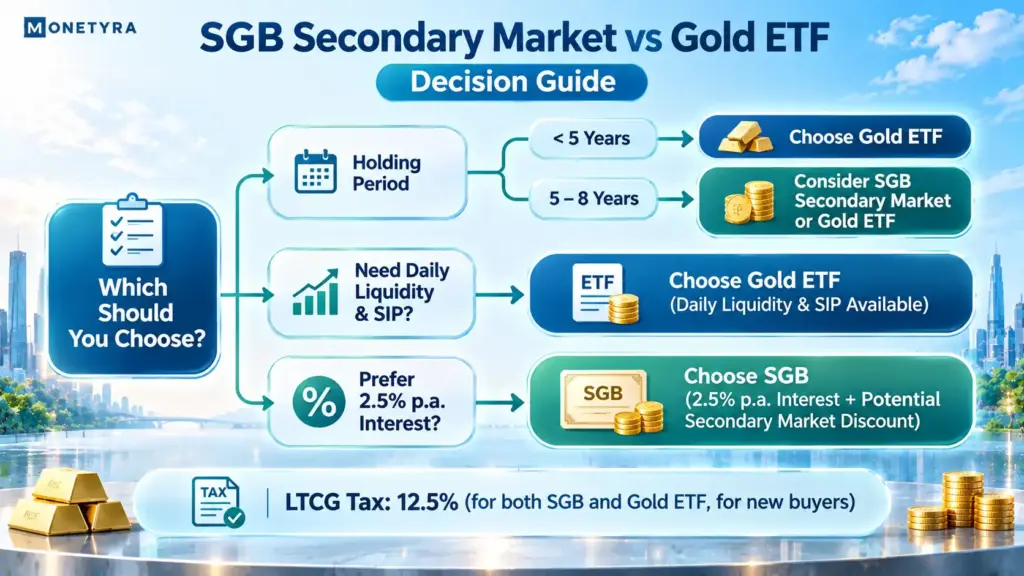
- Short-to-Medium Horizons (Under 5 Years) or Tactical Rebalancing: Gold ETFs fit investors who need instant market exit, low bid-ask spreads, or automated Systematic Investment Plans (SIPs) via mutual fund feeder routes. You can explore top-screened schemes in our review of the best Gold ETF options in India.
- Long-Term Buy-and-Hold Investors (5 to 8 Years) Seeking Coupon Income: Secondary-market SGBs suit investors willing to hold until an RBI premature redemption date or final maturity to capture the 2.50% annual interest on face value—provided the bond can be purchased near or below spot gold parity.
- Existing Primary SGB Holders: Investors who subscribed during RBI tranches on or before February 2024 retain the 100% LTCG tax exemption if they hold until the 8-year maturity, making early exchange sale tax-inefficient unless urgent liquidity is needed.
Monetyra’s Take
With fresh SGB issuances paused since February 2024 and secondary-market buyers ineligible for tax-free maturity gains, the automatic advantage SGBs once held over Gold ETFs has narrowed considerably. Today, buying an SGB on the exchange is essentially a trade-off between earning 2.50% annual taxable interest and accepting lower liquidity with 12.5% LTCG tax at exit. For most investors building gold exposure gradually or rebalancing a multi-asset portfolio, Gold ETFs offer cleaner execution and transparent spot-price tracking without order-book friction.
Conclusion
Evaluating an SGB vs Gold ETF requires looking beyond headline features to current market access and post-tax net returns. While Sovereign Gold Bonds still pay 2.50% annual interest on face value, the halt in new RBI tranches means new buyers must use the secondary market—where liquidity is thinner and capital gains face 12.5% LTCG tax after 12 months. Gold ETFs charge an annual expense ratio and pay no interest, yet they provide reliable daily exchange liquidity and flexible portfolio rebalancing. Matching the instrument to your holding period and liquidity needs might help your gold allocation work more efficiently within your broader financial plan.
Track regulatory shifts, asset allocation frameworks, and emerging investment vehicles in India.
FAQs
1. SGB vs Gold ETF: which is better for a new investor?
Neither is universally better; picking the SGB vs Gold ETF option which is better suited to you depends on your holding horizon and liquidity needs. Gold ETFs suit investors who want daily exchange liquidity, tight pricing, and flexible entry or exit. Secondary-market SGBs suit buy-and-hold investors willing to hold for 5 to 8 years to collect 2.50% annual interest, provided the bond is purchased near spot gold value.
2. Is SGB discontinued in India, or are new tranches coming?
The Indian government has issued no fresh SGB tranches since Series IV of FY 2023–24 closed in February 2024, and no new issuance calendar has been announced as of November 2026. Existing SGB series remain active, continue paying semi-annual interest, and can be bought or sold on the NSE and BSE until their respective maturity dates.
3. Is SGB capital gains tax-free for secondary market buyers?
No, SGB capital gains tax on secondary market purchases is not waived at maturity. Under Section 70(1)(x) of the Income Tax Act, 2025, the 100% capital gains tax exemption at 8-year maturity applies strictly to individual investors who subscribed directly in the RBI primary issue. Investors who purchase SGBs on the secondary stock exchange pay 12.5% LTCG tax (without indexation) if held for over 12 months, even if held until final maturity.
4. How are Gold ETFs taxed in India?
Gold ETFs held for more than 12 months are classified as long-term capital assets and taxed at a flat 12.5% LTCG rate without indexation benefits. If you sell Gold ETF units within 12 months of purchase, the profits are treated as Short-Term Capital Gains (STCG) and taxed at your applicable income tax slab rate.
5. Can we sell SGB before 8 years of maturity?
Yes, SGB units are listed in demat form on the NSE and BSE and can be sold on the secondary market at any time, though low trading volume can result in wide bid-ask spreads. Alternatively, investors can opt for official premature redemption directly with the RBI after completing 5 years from the issue date on semi-annual interest payment dates.
Disclaimer: This article was written with the help of AI and reviewed by the Monetyra editorial team. It is for educational purposes only and should not be considered financial advice. Trading and investing in financial instruments involve significant risk of loss and are not suitable for all investors, and past performance of any strategy does not guarantee future results. Please consult a licensed financial advisor before making any investment or trading decision.
In India, gold investment products are regulated by SEBI (for Gold ETFs) and issued by the RBI on behalf of the Ministry of Finance (for SGBs). Readers are advised to verify the regulatory status, secondary market liquidity, and current tax provisions before investing.