Forex Signals Explained: Free vs Paid Trade Alerts
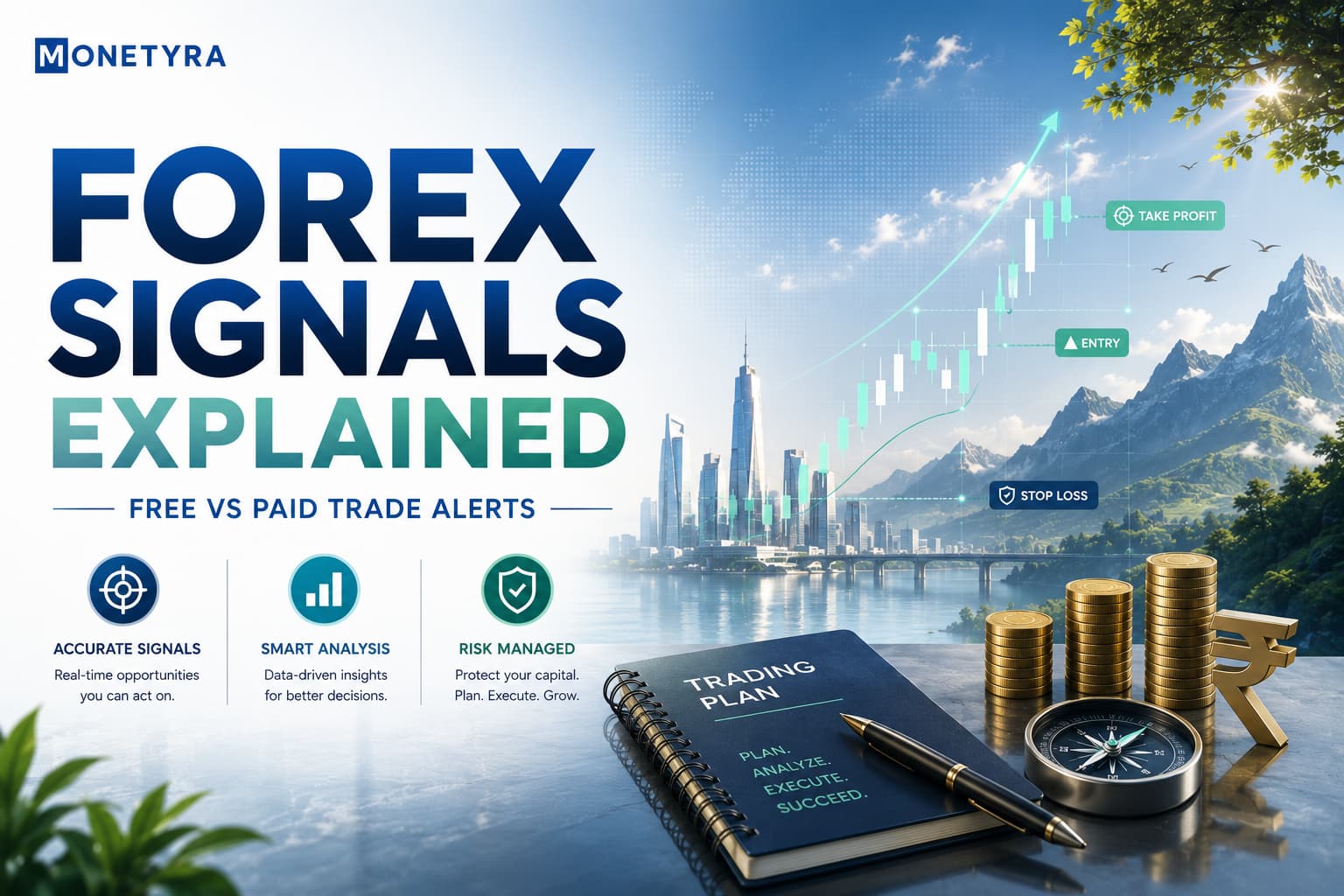
Receiving a forex signal is like getting a delivery notification for a package. The alert gives you the tracking details—the entry price, the stop-loss, and the profit target—but it does not guarantee that what is inside will be valuable. In the fast-moving currency markets, a forex trading signal is simply a technical trade idea. Knowing how to evaluate these alerts, understand their limitations, and manage the underlying capital risk is what separates disciplined traders from victims of online scams.
Quick Takeaways
- A forex signal is an actionable technical trade alert that specifies an exact asset, entry price, stop-loss, and take-profit level.
- Free forex signals often come with hidden costs, including affiliate lead-generation traps, unverified track records, or high-risk trading systems like martingale strategies.
- Signal alerts are technical trade ideas rather than guaranteed outcomes—every signal must be evaluated against strict position sizing and personal risk tolerance.
What Are Forex Signals and How Do They Work?
Forex signals are real-time trade ideas or execution triggers containing predefined technical parameters sent by an analyst, automated program, or signal provider to help you make entry and exit decisions.
Instead of spending hours monitoring currency charts, you receive an instant notification when specific market conditions line up. Signals generally fall into two categories:
- Manual Signals: Created by experienced market analysts who study technical price action, chart patterns, and fundamental economic releases.
- Automated Signals: Generated by quantitative algorithms or Expert Advisors (EAs) programmed to trigger alerts based on specific mathematical rules.
Delivery methods range from direct broker platform integrations and email alerts to push notifications in social channels like Telegram or WhatsApp.
Tip: Treat any trade alert as a secondary confirmation for your own technical analysis rather than an automatic execution trigger.
Key Components of a Forex Trade Alert
To execute a trade alert correctly, you must understand each element of the notification:
- Currency Pair: Identifies the specific asset, such as EUR/USD or exchange-traded currency contracts.
- Action & Order Type: Specifies whether to Buy (Long) or Sell (Short), using either a market order or a pending limit/stop order.
- Entry Price: The exact price level where the trade setup becomes active.
- Stop-Loss (SL): A non-negotiable exit level designed to automatically close the position and limit loss if the market moves against you.
- Take-Profit (TP): Target exit levels designed to secure gains when price reaches a predicted objective.
- Risk Reward Ratio: The proportion balancing potential loss against expected return, ideally aimed at 1:2 or better.
Warning: Never enter a signal trade that lacks a defined stop-loss price; open-ended setups expose your entire balance to sudden market spikes.
Free Forex Signals vs Paid Alerts: The Hidden Costs
While “free forex signals” sound appealing, free public signal groups frequently operate on alternative business models that introduce direct conflicts of interest. Below is a table that shows different functions of these signals:
| Feature | Free Forex Signals | Paid Signal Services |
|---|---|---|
| Monetization Model | Affiliate commissions via offshore broker sign-ups | Subscription fees paid directly by the user |
| Verification | Unverified social media screenshots | Third-party audited track records (e.g., Myfxbook) |
| Risk Strategy | Often relies on grid or martingale strategy models | Controlled risk per trade with transparent drawdown statistics |
| Execution Speed | Prone to manual signal delays and social lag | Low-latency direct API or automated signal alerts |
The “Free Signal” Trap
Many free Telegram and WhatsApp channels make money by acting as affiliate lead generators. They require users to open accounts with unregulated offshore brokers through custom links before gaining access. Because these affiliates earn commissions based on trading volume or user deposits, they are incentivized to promote frequent trading rather than consistent capital preservation.
Furthermore, free providers often artificially inflate their short-term win rates by employing dangerous martingale systems—doubling trade size after a loss—which can wipe out an account during a prolonged trend.
How to Evaluate a Signal Provider Safely
Before trusting any trade alert service with real money, evaluate their operations using these criteria:
- Verified Third-Party Audits: Ignore promotional profit screenshots. Insist on independent third-party performance verification via platforms like Myfxbook or FXBlue.
- Drawdown Metrics: Examine the Maximum Drawdown (DD) figure. A high win rate with a 60% peak-to-trough equity drop signals extreme account vulnerability.
- Consistent Position Sizing in Trading: Confirm that the provider risks a fixed percentage per trade rather than escalating lot sizes recklessly.
Using Forex Signals in India: Regulatory & Risk Boundaries
As an Indian trader, you need to keep regulatory boundaries in mind when considering currency signals:
- Legal Instruments: In India, retail foreign exchange trading is permitted strictly on recognized domestic exchanges—such as the National Stock Exchange (NSE) and Bombay Stock Exchange (BSE)—for INR-paired currency contracts (USD/INR, EUR/INR, GBP/INR, JPY/INR) and select cross-currency pairs via regulated brokers under Reserve Bank of India (RBI) and Securities and Exchange Board of India (SEBI) rules.
- FEMA Provisions: Direct spot forex trading on unregulated offshore broker platforms violates Foreign Exchange Management Act (FEMA) guidelines.
- Advisory Regulations: Offering paid trade recommendations or signal advisory services in India requires registration as a SEBI Registered Investment Advisor or Research Analyst. Unregulated offshore Telegram sellers operate outside these investor protection frameworks.
Conclusion
Forex trading signals can serve as useful educational tools to help you identify technical chart setups, provided you treat them as trade ideas rather than automatic paths to profit. By prioritizing audited track records, strictly implementing stop-loss rules, and understanding the risks associated with unverified “free” alerts, you can protect your capital while developing your own trading framework.
Master currency pair mechanics, technical tools, and risk management frameworks to build your own trading discipline.
Disclaimer: This article was written with the help of AI and reviewed by the Monetyra editorial team. It is for educational purposes only and should not be considered financial advice. Trading and investing in financial instruments involve significant risk of loss and are not suitable for all investors, and past performance of any strategy does not guarantee future results. Please consult a licensed financial advisor before making any investment or trading decision.
In India, foreign exchange trading is strictly regulated by SEBI and the RBI under FEMA regulations. Retail traders should only operate on recognized domestic exchanges through registered brokers and ensure full compliance with Indian laws.
FAQs
Forex signals are technical trade alerts that specify entry prices, stop-loss levels, and profit targets. They are generated manually by analysts or automatically by algorithms and sent to traders via notifications.
Many signal alerts are advertised as free, but they often carry hidden costs such as mandatory sign-ups with affiliate brokers, unverified track records, or high-risk trading systems.
Using signals is permissible provided you execute trades through SEBI-regulated domestic brokers on approved exchange-traded currency pairs (like USD/INR) on the NSE or BSE in compliance with FEMA guidelines.
Accuracy varies wildly. Unverified free signals frequently advertise high historical win rates by hiding large equity drawdowns or using dangerous martingale recovery strategies.
Look for providers who present audited third-party track records (such as Myfxbook), enforce strict stop-loss rules, disclose clear drawdown statistics, and avoid requiring sign-ups with unregulated brokers.
While beginners can use trade alerts to learn technical entry models, relying on signals without personal risk management, disciplined position sizing, and technical verification often leads to capital losses.