Revenge Trading: Meaning, Triggers, and How to Stop It
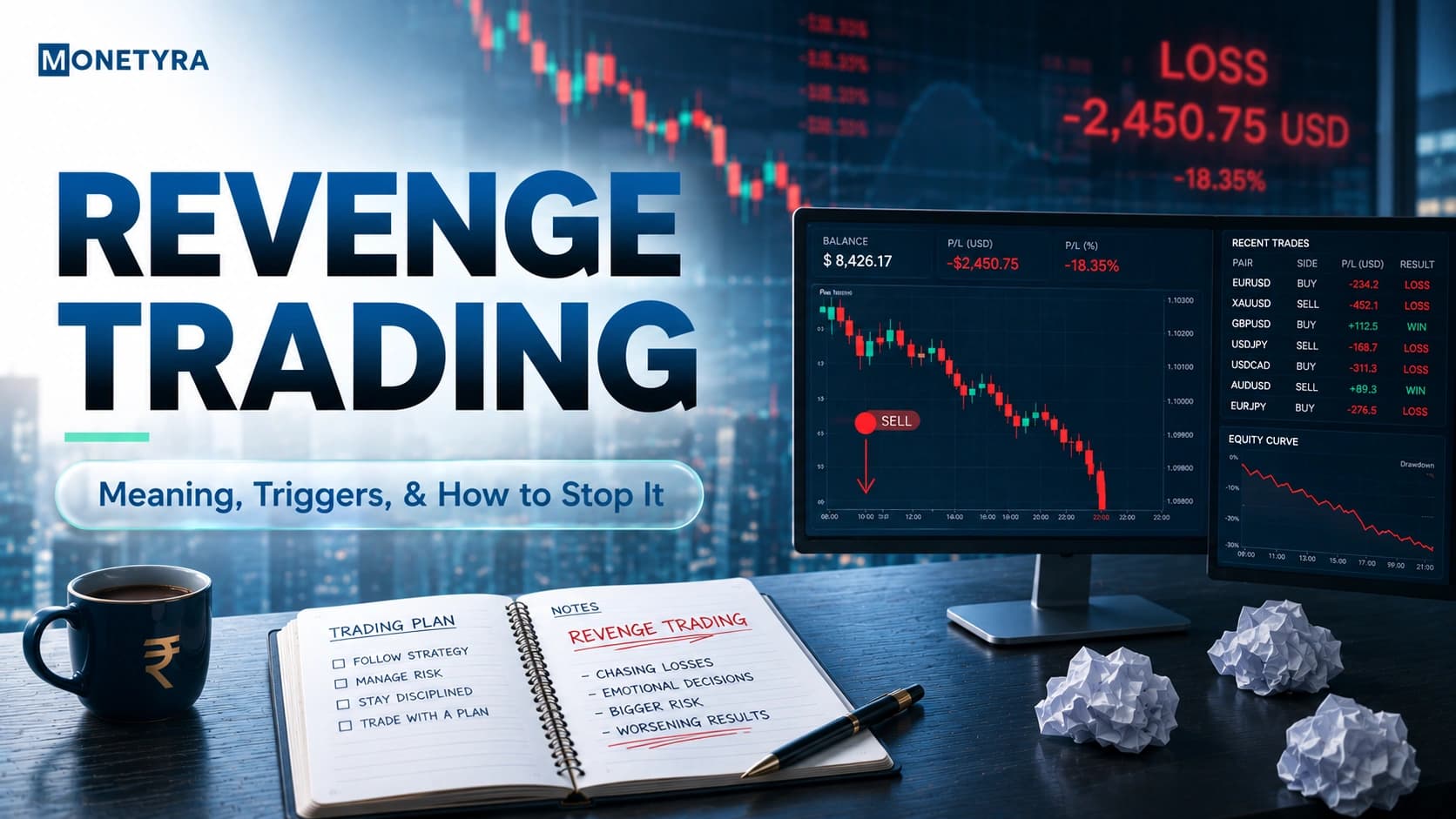
Getting stopped out of a trade during morning volatility on the NSE or BSE often triggers an intense urge to strike back at the market. Instead of accepting the loss as a normal operational cost, many retail traders instantly double their position size on an unvetted setup just to force their balance back to breakeven before the closing bell.
This emotional trap is known as revenge trading—an impulse where frustration and loss aversion rapidly escalate minor setbacks into significant portfolio drawdowns.
Quick Takeaways
- Revenge trading occurs when a trader enters aggressive, emotional positions to immediately recover losses from a failed trade.
- Attempting to force quick profits causes traders to enlarge position sizes and abandon risk parameters, accelerating account drawdowns.
- Imposing mandatory cooling-off periods and hard daily loss caps helps interrupt impulse execution, though disciplined execution cannot eliminate underlying market volatility.
What Is Revenge Trading?
Revenge trading is the emotional urge to enter aggressive, unplanned trades to quickly recover lost capital immediately after a losing trade.
When you engage in revenge trading, market analysis gives way to frustration. Instead of waiting for confirmed technical setups on the National Stock Exchange (NSE) or Bombay Stock Exchange (BSE), position entry becomes an emotional battle against the market to force account balances back into positive territory.
It is critical to separate emotional trade re-entries from valid technical re-entries:
- Disciplined Re-Entry: Opening a new position because the underlying asset presents a distinct technical signal aligned with a pre-planned strategy and strict risk-to-reward parameters.
- Revenge Trading: Opening an immediate position out of anger, often doubling trade size, removing stop-loss orders, and taking unvetted setups simply to recover funds.
What Causes Revenge Trading in the Stock Market?
Revenge trading stems from psychological biases that compromise decision-making during active market sessions:
- Loss Aversion: According to behavioral finance principles, the psychological pain of losing capital feels significantly more intense than the satisfaction of an equivalent gain, driving traders to eliminate losses immediately.
- Bruised Ego and Pride: Viewing a market stop-out as a personal failure rather than a normal operational cost, leading to an irrational attempt to prove the market wrong.
- Impatience and FOMO (Fear of Missing Out): Expecting to recoup daily drawdowns instantly within the same trading session instead of accepting natural daily equity variance.
- Emotional Trading: Letting anger, fear, or frustration dictate position sizing instead of adhering to predefined risk management limits.
Warning: Entering positions purely to recover earlier session losses often leads to larger drawdowns as emotional bias overrides stop-loss discipline.
What Are the Signs of Revenge Trading?
Recognizing the behavioral warning signs early allows traders to step away from the terminal before major capital depletion occurs:
- Sizing Up After a Loss: Doubling or tripling trade volume (lot sizes or share quantities) on a follow-up order to recoup lost funds in a single move.
- Moving or Removing Stop-Losses: Disabling risk parameters or widening stop distances mid-trade to prevent taking a confirmed loss.
- Rapid-Fire Execution: Opening new market positions within seconds or minutes of being stopped out without waiting for a valid entry setup.
- Physical Emotional Distress: Experiencing a racing heart rate, muscle tension, or visceral anger while placing orders.
The Cost of Revenge Trading in Indian Markets
In active intraday trading, chasing losses introduces heavy financial friction. Every emotional trade executed incurs clearing fees, transaction charges, and statutory taxes. Even if gross recovery trades break even, total trading capital decreases due to mandatory execution expenses.
| Execution Behavior | Financial Impact | Risk Exposure Level | Recovery Difficulty |
|---|---|---|---|
| Position Doubling | Exposes account to exponential margin drawdowns | Extremely High | Requires higher future win rates to break even |
| Skipping Stop-Losses | Converts manageable trade risk into unbounded loss potential | Critical | Threatens core account equity balance |
| High Trade Frequency | Accumulates transaction friction, clearing fees, and turnover taxes | High | Consumes gross profits through mandatory platform fees |
| Mid-Day Over-Trading | Trades low-liquidity market hours with wider bid-ask spreads | Moderate to High | Increases slippage on market orders |
Tip: Review your daily contract notes to track how much of your daily gross P&L is being consumed by turnover taxes and execution fees.
Overtrading vs Revenge Trading
While both behaviors involve reckless trade execution and lead to account drawdowns, they differ in execution style and primary psychological drivers:
| Characteristic | Revenge Trading | Overtrading | Direct Risk |
|---|---|---|---|
| Primary Motivation | Anger and loss recovery after a failed position | Boredom, excitement, overconfidence, or FOMO | Emotional breakdown vs. structural strategy drift |
| Position Sizing | Scaled up aggressively (doubling down) | Inconsistent, often arbitrary | Sudden sharp loss vs. steady capital erosion |
| Execution Velocity | Immediate rapid-fire trades following a stop-out | High order frequency distributed across the session | Concentrated account drawdown during peak emotional spikes |
| Terminal Habits | Hyper-fixation on recovering exact rupee amounts | Continuous trading across all market hours | Bypassing pre-planned risk caps and daily limits |
How to Fix Revenge Trading in Intraday Trading
Overcoming impulse loss-chasing requires implementing structural execution boundaries that operate independently of emotional states.
- Enforce Mandatory Cooling-Off Periods: Step away from the trading terminal for at least 30 minutes immediately following any stopped-out position.
- Set Non-Negotiable Daily Loss Limits: Pre-define an absolute maximum daily drawdown limit (e.g., 2% of total trading capital). Once hit, close the platform.
- Use a Structured Trading Journal: Log setup criteria, emotional triggers, and entry reasons in a trading journal to maintain objective performance records.
- Address Overtrading Habits: Recognize how frequency-driven execution feeds emotional instability by understanding overtrading.
Rules for Trading Discipline in Indian Markets
Aligning execution frameworks with regulatory standards and strict operational schedules helps protect long-term capital.
- Adhere to Margin Frameworks: Maintain fixed position sizing under peak margin rules set by the Securities and Exchange Board of India (SEBI) rather than seeking excessive leverage to chase losses.
- Implement Scheduled Execution Windows: Trade primarily during peak liquidity sessions, such as 9:15 AM to 11:30 AM Indian Standard Time (IST), while avoiding erratic midday price action.
- Practice Systemic Trading Discipline: Cultivate structural consistency by following established trading discipline guidelines.
Conclusion
Revenge trading is a dangerous psychological trap where ego and loss aversion replace rational risk management. Attempting to force quick profits from the market right after a stop-out usually leads to oversized positions, abandoned stop-losses, and compounding financial losses.
Building a sustainable trading career requires accepting that losing trades are an inevitable operational cost of market participation. By enforcing mandatory cooling-off periods, adhering to strict daily loss limits, and logging every trade systematically, you can break the emotional feedback loop and preserve your capital for valid technical setups.
Logging your trades systematically provides objective data on whether emotional loss-chasing is damaging your performance.
Disclaimer: This article was written with the help of AI and reviewed by the Monetyra editorial team. It is for educational purposes only and should not be considered financial advice. Trading and investing in financial instruments involve significant risk of loss and are not suitable for all investors, and past performance of any strategy does not guarantee future results. Please consult a licensed financial advisor before making any investment or trading decision.
In India, market activities fall under regulatory oversight from the Securities and Exchange Board of India (SEBI) and Reserve Bank of India (RBI). Readers are advised to verify the regulatory status of their broker and ensure compliance with applicable Indian financial regulations.
FAQs
Revenge trading is the practice of placing aggressive, unplanned trades immediately after a losing trade to quickly win back lost capital. It is driven by emotions like anger and frustration rather than technical analysis.
Revenge trading is caused by psychological biases including loss aversion, bruised pride, reluctance to accept market losses, impatience to achieve daily profit targets, and lack of emotional trading discipline.
You can fix revenge trading by enforcing mandatory 30-minute cooling-off periods after a loss, setting hard daily loss limits, using platform lockout tools, keeping a trade log, and sizing positions conservatively.
Common signs include doubling trade volume after a loss, removing or widening stop-loss orders, placing rapid-fire orders within seconds of being stopped out, and feeling intense anger or anxiety during terminal execution.
The psychology behind revenge trading centers on loss aversion and ego protection. Losing money triggers a visceral stress response that compels traders to eliminate the deficit instantly to avoid accepting defeat.
Overtrading refers to executing excessive positions throughout the session due to boredom or FOMO. Revenge trading is a specific emotional reaction where a trader opens oversized positions explicitly to recover losses from a previous trade.