Trading Discipline: Rules, Traps & Capital Protection
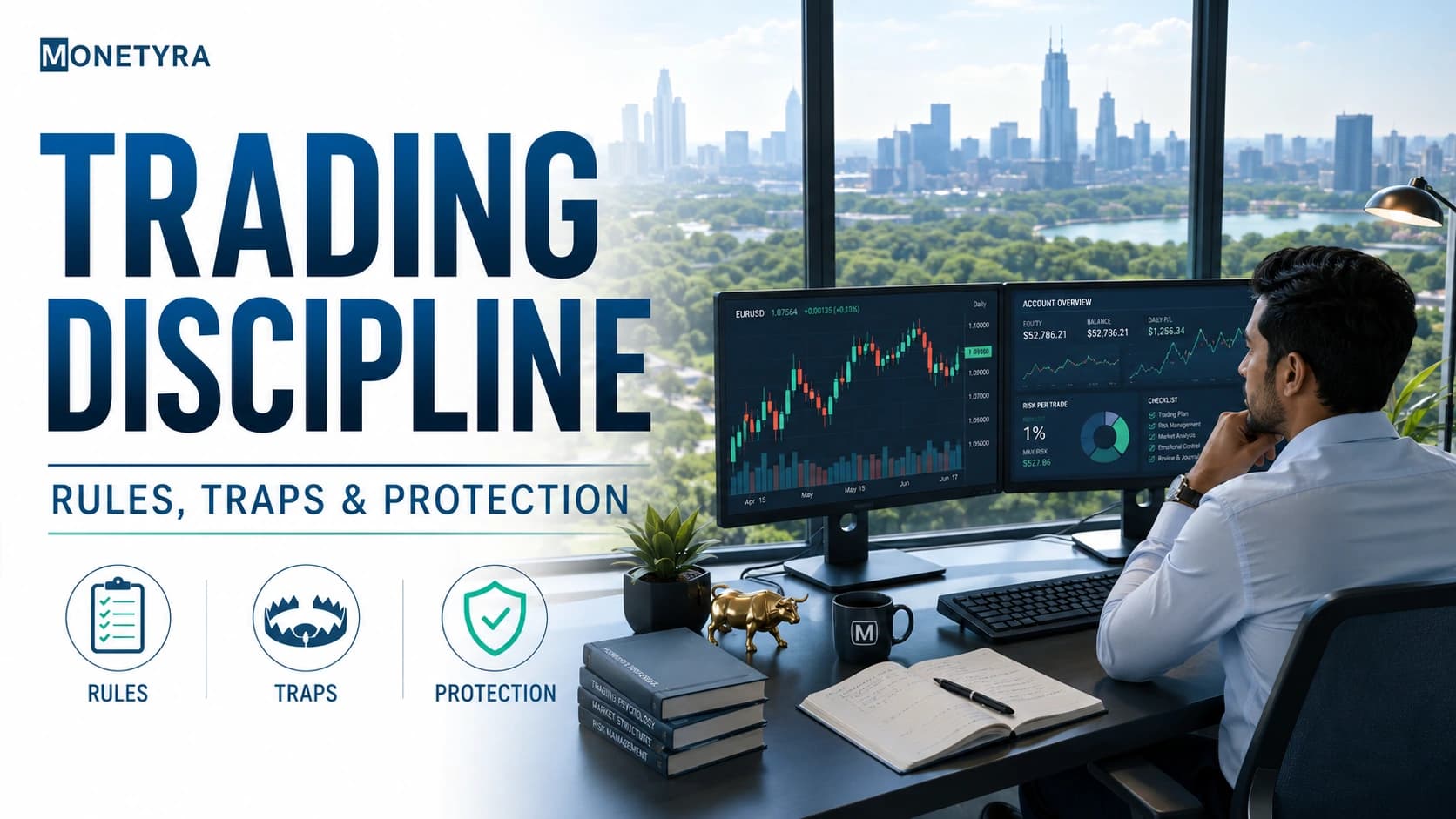
Imagine a professional athlete walking onto the field for a championship game and completely ignoring their team’s playbook. They might make an exciting play through sheer luck, but over an entire season, reckless instincts will cost them the championship.
In financial markets, execution works the same way. Many retail traders in India spend hundreds of hours searching for a secret technical indicator, only to watch their trading account balance erode due to impulsive entries and emotional decisions. Trading discipline is the bridge between a theoretical strategy on paper and consistent, long-term capital preservation.
Quick Takeaways
- Trading discipline is the psychological ability to execute a predefined trading plan consistently without letting emotions dictate entry, exit, or risk decisions.
- Implementing strict pre-trade checklists, daily loss caps in ₹, and automated stop-loss orders helps neutralize market-induced anxiety.
- Rigid over-discipline that leads to hesitation or analysis paralysis is an operational risk that can cause missed setups.
What Is Trading Discipline?
Trading discipline is the operational framework and psychological self-control that enables a trader to follow a predefined set of risk management rules and setup criteria consistently across all market conditions.
Developing discipline in trading means treating market participation as an operational process rather than a series of emotional bets. It requires executing your strategy with precision—taking valid trades when your entry triggers align, cutting losses immediately when stop-loss levels are hit, and staying on the sidelines when market conditions do not match your system.
Without discipline, even a strategy with a strong statistical edge will fail because emotional execution alters the risk-to-reward dynamics of your positions.
Why Is Trading Discipline Important?
In active trading, capital preservation is your top priority. While market direction is always uncertain, your execution and risk exposure are entirely within your control.
- Capital Protection: A single disciplined stop-loss keeps an adverse market move from undoing months of accumulated gains.
- Statistical Validity: Your trading strategy requires a large sample size of trades to prove its statistical edge. Deviating from your rules distorts your performance data.
- Psychological Longevity: Following a structured routine reduces daily stress, decision fatigue, and emotional burnout during high-volatility market sessions.
Common Causes of Emotional Trading
Lapses in discipline usually occur when cognitive biases override mechanical planning. Identifying these behavioral traps helps you build safeguards against them.
Psychological Traps
- Discipline in trading: Chasing extended price candles out of fear that a market rally will leave you behind without securing a proper entry.
- Revenge Trading: Taking rapid, unplanned positions immediately after a losing trade to get back lost capital, which frequently leads to compounded losses.
- Overtrading: Entering low-probability setups due to boredom, impatience, or an urge to stay active in the market.
| Emotional Trap | Behavioral Trigger | Market Consequence | Disciplined Solution |
|---|---|---|---|
| FOMO (Fear of Missing Out) | Sudden price volatility, social hype | Buying near resistance / Selling near support | Wait for a pullback or next valid setup |
| Revenge Trading | Emotional frustration after a loss | Doubling position size and ignoring stop-loss | Enforce a mandatory cool-off break |
| Overtrading | Boredom during low-volatility sessions | Over-leveraging and paying excessive fees | Stick to a strict maximum daily trade cap |
Core Trading Discipline Rules for Beginners
Establishing concrete trading discipline rules helps remove ambiguity during fast-moving market hours.
- Rule 1: Define Risk Parameters Before Entry: Establish your exact stop-loss level, profit target, and exit conditions before placing an order with your broker.
- Rule 2: Enforce Maximum Daily Loss Caps: Set a hard drawdown limit in Rupees (e.g., 2% of total capital). If hit, close all terminals and stop trading for the day.
- Rule 3: Maintain Strict Position Sizing: Calculate your lot size based on your stop-loss distance rather than your emotional conviction on a trade. See our guide on position sizing in trading for step-by-step sizing models.
- Rule 4: Avoid Trading External Noise: Ignore unverified social media stock tips or market rumors and rely strictly on your analytical framework.
Tip: Write your core trading rules on an index card and place it next to your monitor as a visual reminder before opening any orders.
How to Build Discipline in Trading: Step-by-Step
Building behavioral discipline is a habit formed through repetition and structured routines.
Step 1: Document Your Written Trading Plan
Define your trading universe (e.g., Nifty equities, Bank Nifty options, or major FX pairs), specific chart setups, timeframe triggers, and risk limits in a written document.
Step 2: Utilize a Pre-Trade Checklist
Before entering an order, verify that the setup satisfies all entry conditions and maintains a favorable risk reward ratio.
Step 3: Maintain a Standardized Log
Track every trade in a trading journal format to record setup parameters, net P&L, and rule adherence.
Step 4: Perform Weekly Performance Audits
Review your trade log every weekend to calculate your win rate and identify any instances of impulsive rule-breaking.
Warning: Hesitating to execute valid setups due to recent losses is a sign of analysis paralysis, which can be as harmful to your account performance as impulsive entries.
Trading Discipline in Indian Markets
Indian retail traders navigating volatile sessions on the National Stock Exchange (NSE) or Bombay Stock Exchange (BSE) require session-specific discipline controls.
Market-Specific Risk Scenarios:
- Index Options Expiry Volatility: Rapid decay in option premiums during NSE/BSE expiry days often lures retail traders into impulsive bets. Enforcing hard stop-loss orders helps protect your capital from sudden, sharp losses..
- Macroeconomic Events: Major events like Union Budget announcements or RBI monetary policy meetings cause sudden volatility spikes. Setting strict INR daily loss limits protects capital against unexpected market gaps.
Conclusion
Mastering trading discipline is an ongoing process of aligning your behavior with risk management controls. By replacing impulsive emotional entries with structured pre-trade checklists, clear risk limits, and regular performance auditing, you move away from speculative gambling and build a sustainable trading discipline routine.
Refine your strategy and explore core trading psychology concepts with Monetyra.
Disclaimer: This article was written with the help of AI and reviewed by the Monetyra editorial team. It is for educational purposes only and should not be considered financial advice. Trading and investing in financial instruments involve significant risk of loss and are not suitable for all investors, and past performance of any strategy does not guarantee future results. Please consult a licensed financial advisor before making any investment or trading decision.
In India, financial market activities are overseen by the Securities and Exchange Board of India (SEBI) and the Reserve Bank of India (RBI). Readers are advised to verify the regulatory status of their broker and ensure compliance with applicable Indian laws before investing.
FAQs
Discipline in trading refers to the ability to follow your trading plan and risk rules consistently, regardless of short-term market volatility or emotional pressures like fear and greed.
You can document a clear trading strategy, use a pre-trade checklist, set hard stop-loss levels, track every trade in a journal, and conduct regular performance audits.
Key rules include pre-defining risk parameters before entry, setting a maximum daily loss limit in Rupees, sizing positions according to stop-loss distance, and avoiding trades based on social media noise.
Market volatility triggers emotional impulses such as fear of missing out (FOMO) or a desire to recover losses quickly (revenge trading), causing traders to abandon their written rules.
A trading journal creates accountability by tracking whether you followed your plan on every trade, helping you identify recurring emotional mistakes and measure your execution quality over time.