What Is CAGR Meaning in Mutual Fund: How to Calculate It
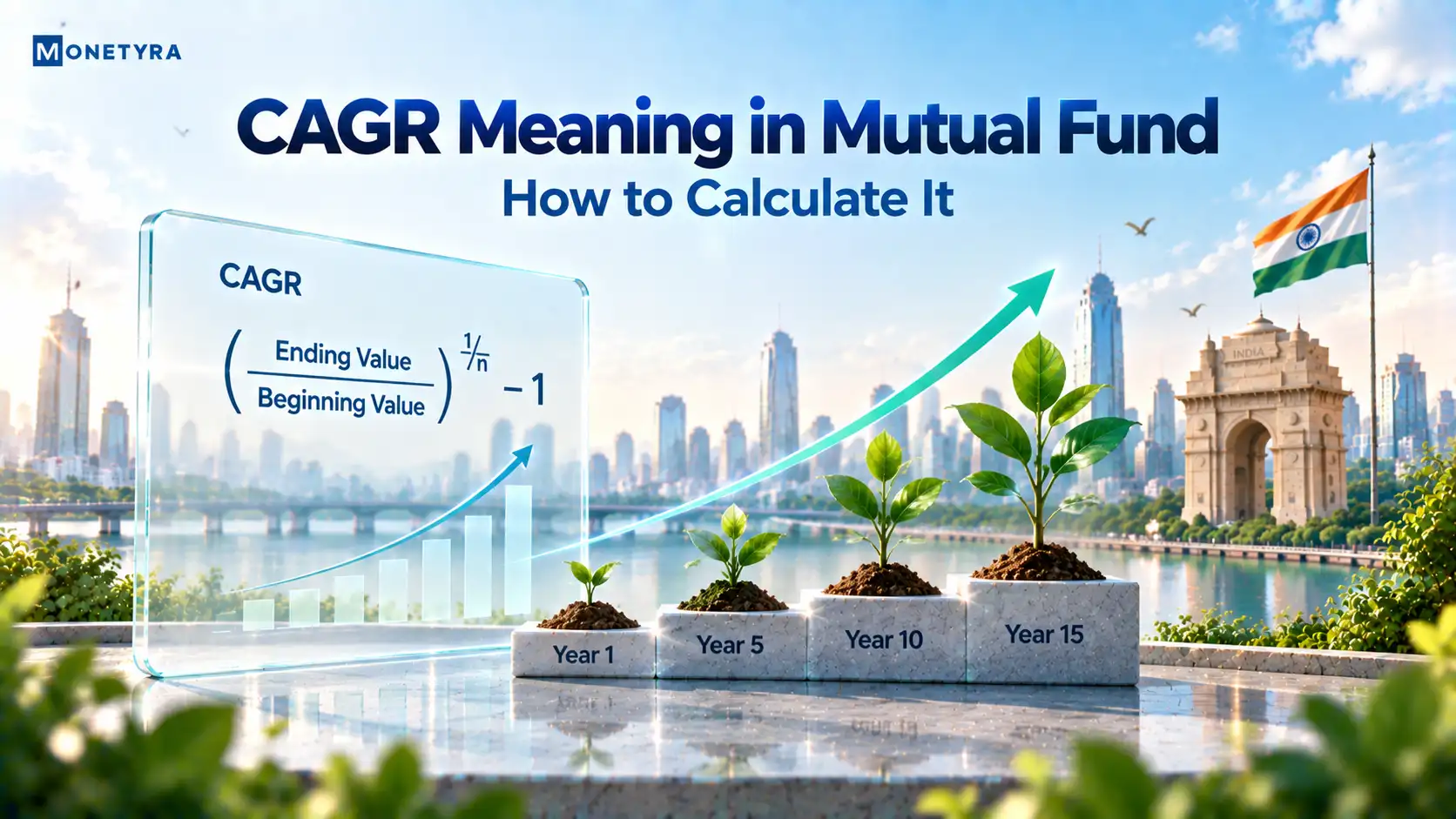
Evaluating a mutual fund’s performance over multiple years requires looking beyond total percentage gains, which is where understanding cagr meaning in mutual fund becomes essential. Short for Compound Annual Growth Rate, CAGR measures the constant annual rate at which a lump-sum investment would have grown if it compounded smoothly over a period longer than one year.
By eliminating interim market volatility, CAGR provides retail investors with a standardized baseline to compare different mutual funds, evaluate fund manager consistency, and project long-term portfolio growth.
Quick Takeaways
- The cagr meaning in mutual fund context refers to Compound Annual Growth Rate—the annualized rate at which a lumpsum investment grows over a holding period longer than one year.
- Unlike simple absolute returns, CAGR smooths out annual market fluctuations to reveal the constant yearly growth rate required to turn your initial principal into your final portfolio value.
- CAGR is mathematically accurate for single lumpsum investments, but systematic investment plans (SIPs) require Extended Internal Rate of Return (XIRR) to account for multiple purchase dates.
What Is CAGR Meaning in Mutual Fund Investments?
The cagr meaning in mutual fund context stands for Compound Annual Growth Rate, which represents the annualized rate of return an investment generates over a period exceeding 12 months, assuming all interim earnings are reinvested.
Regulated under performance disclosure guidelines set by the Securities and Exchange Board of India (SEBI), mutual fund asset management companies (AMCs) use CAGR to show smooth, standardized point-to-point performance for lumpsum investments across 1-year, 3-year, 5-year, and since-inception timeframes.
In simple terms, mutual fund returns rarely move in a straight line—a fund might surge 25% in Year 1, drop 10% in Year 2, and gain 15% in Year 3. The CAGR calculation eliminates this annual volatility, providing a single geometric mean figure that reflects what the constant annual growth rate would have been over the entire holding window.
Tips: Always evaluate CAGR across multi-year cycles (3 to 5 years) rather than trailing 1-year windows to avoid chasing short-term market momentum.
CAGR Formula and Calculation Walkthrough
Understanding how to calculate cagr requires using the standard mathematical compounding formula:
CAGR (%) = [(Ending Value ÷ Beginning Value) ^ (1 ÷ Years)] – 1
Understanding the cagr formula mutual fund application relies on three core variables:
- Beginning Value: The initial principal deployed into the mutual fund scheme.
- Ending Value: The final Net Asset Value (NAV) market value of your holding.
- Years: The exact holding tenure expressed in years (e.g., 36 months = 3 years).
Step-by-Step Calculation Example
Suppose you made a lumpsum investment of ₹1,00,000 in an equity mutual fund on January 1, 2021. On January 1, 2026 (a 5-year tenure), your investment value grew to ₹2,00,000.
- Divide Ending Value by Beginning Value: ₹2,00,000 ÷ ₹1,00,000 = 2.0
- Raise to the Power of (1 ÷ Tenure): 2.0 ^ (1 ÷ 5) = 2.0 ^ 0.2 = 1.1487
- Subtract 1 and Convert to Percentage: (1.1487 – 1) × 100 = 14.87%
The resulting CAGR of 14.87% indicates that your investment compounded at an equivalent annual rate of 14.87% every year over the 5-year period.

CAGR vs Absolute Return vs XIRR
Investors frequently evaluate performance by comparing cagr vs xirr alongside basic absolute return metrics:
| Metric | Primary Use Case | Cash Flow Assumption | Best Suited For |
|---|---|---|---|
| Absolute Return | Short-term holdings (< 1 year) | Single point-to-point transaction | Initial quick gain checks |
| CAGR | Lumpsum investments (> 1 year) | Single initial cash outflow | Single Lumpsum investments |
| XIRR | Recurring investments (SIPs/SWPs) | Multiple installment dates | Recurring SIPs and cash flows |
While absolute return merely measures total gain percentage regardless of time—e.g., a ₹10,000 gain on ₹1,00,000 is a 10% absolute return whether it took 6 months or 6 years—CAGR factors in duration to reflect real annual efficiency.
However, when you invest through regular installments, CAGR fails because each installment has a different holding period. For recurring investments like a What Is Step Up SIP or standard What Is SIP in Mutual Fund plan, financial platforms automatically calculate XIRR instead.
Lumpsum Investment → Use CAGR (Single Purchase Date)
Recurring SIP Investment → Use XIRR (Multiple Purchase Dates)
Investors who balance different entry strategies—such as comparing a recurring plan against a single capital deployment in a SIP vs Lumpsum analysis—rely on these distinct return metrics to evaluate true portfolio performance.
What Does CAGR Meaning in Business Refer To?
Beyond mutual fund evaluation, corporate analysts and business owners frequently apply CAGR to measure company performance over time.
In corporate financial analysis, cagr meaning in business refers to the smoothed annual growth rate of key business metrics—such as total revenue, net profit, subscriber count, or unit sales—across multi-year operating periods.
For example, if an Indian enterprise generates ₹10 crore in revenue in Fiscal Year 2021 and reaches ₹20 crore in Fiscal Year 2026, its 5-year revenue CAGR is 14.87%. Calculating corporate metrics through CAGR allows founders, equity analysts, and venture investors to evaluate long-term business trajectory while neutralizing seasonal spikes, economic downturns, or temporary single-year surges.
Key Limitations of CAGR
While CAGR is a primary benchmark metric endorsed by the Association of Mutual Funds in India (AMFI), it carries specific analytical limitations:
- Ignores Intermediary Volatility: CAGR assumes smooth, linear annual growth. It hides sharp market corrections and drawdowns that occurred during the holding period.
- Inaccurate for SIP Cash Flows: Because CAGR assumes a single initial capital inflow, applying it to recurring monthly SIPs yields an inaccurate performance figure.
- Sequence Risk Masking: Two mutual funds can yield the exact same 5-year CAGR, yet one might have suffered a severe 40% drawdown in Year 2 while the other experienced steady, low-volatility growth.
Warning: High historical CAGR does not guarantee future scheme returns; market conditions, fund manager changes, and shifting sector allocations alter future performance.
Capital Gains Taxation on Compounded Mutual Fund Returns
When you redeem mutual fund units, your compounded capital gains are taxed under rules governed by the Income Tax Department based on asset classification and holding period.
For Equity Mutual Funds:
- Short-Term Capital Gains (STCG): Gains realized on units held for less than 12 months are taxed at 20%.
- Long-Term Capital Gains (LTCG): Gains realized on units held for 12 months or longer are taxed at 12.5% on aggregate net profits exceeding ₹1.25 lakh in a fiscal year.
For Debt Mutual Funds:
- Capital gains realized from debt schemes acquired after April 1, 2023, are added to the investor’s taxable income and taxed at their applicable slab rate, regardless of the holding duration.
Conclusion
Understanding the cagr meaning in mutual fund investing provides a clear, standardized metric to evaluate lumpsum portfolio performance over time. By smoothing out annual market swings, CAGR allows investors to compare scheme efficiency accurately across multi-year periods. However, because CAGR assumes a single capital outlay, investors managing monthly SIP contributions should use XIRR alongside CAGR to maintain an accurate picture of their real wealth accumulation.
Master mutual fund metrics, calculation formulas, and regulatory standards with our clear educational guides.
FAQs
CAGR (Compound Annual Growth Rate) is the annualized rate at which a lumpsum mutual fund investment grows over a period longer than one year, assuming all gains are reinvested.
The formula is CAGR = [(Ending Value ÷ Beginning Value) ^ (1 ÷ Years)] – 1, which calculates the smooth yearly compounding rate over the investment horizon.
CAGR measures annualized returns for a single lumpsum investment made at one time, whereas XIRR measures annualized returns for multiple cash flows made at different dates, such as recurring monthly SIPs.
To calculate CAGR, divide your final investment value by the initial amount, raise the result to the power of 1 divided by the number of years held, and subtract 1 to get the percentage.
In business, CAGR refers to the annualized growth rate of corporate revenue, net profit, or customer sales over multi-year periods, smoothing out single-year fluctuations.
Absolute returns only show total percentage gain without accounting for time, whereas CAGR factors in tenure and compounding, showing the true annualized rate of return across multi-year holdings.
Disclaimer: This article was written with the help of AI and reviewed by the Monetyra editorial team. It is for educational purposes only and should not be considered financial advice. Trading and investing in financial instruments involve significant risk of loss and are not suitable for all investors. Please consult a licensed financial advisor before making any investment decision.
In India, mutual fund operations are regulated by the Securities and Exchange Board of India (SEBI) and trade execution platforms are hosted across exchanges like the National Stock Exchange (NSE). Investors should evaluate scheme documents carefully before committing capital.