Growth vs IDCW in Mutual Funds: Meaning and Key Differences

When you invest in a mutual fund in India, you must pick between two payout structures: the growth vs IDCW option. Both plans hold the exact same portfolio of stocks or bonds and are managed by the same fund manager.
The difference lies in how your gains are handled. The Growth option reinvests all profits back into the fund to build long-term wealth, while IDCW (formerly known as the dividend option) pays out part of the accumulated gains as cash to investors.
Quick Takeaways
- IDCW meaning: Income Distribution cum Capital Withdrawal (IDCW) pays periodic cash from a mutual fund’s accumulated surplus, whereas the Growth option retains all profits inside the scheme.
- Compounding impact: Every IDCW payout reduces the fund’s Net Asset Value (NAV) by the exact distribution amount, which slows down future compounding compared to a Growth plan.
- Key caveat: IDCW payouts are not guaranteed extra income, and they are taxed at your personal income tax slab rate in the year you receive them.
What Is Growth vs IDCW in Mutual Funds?
In a growth vs IDCW choice, the IDCW meaning is Income Distribution cum Capital Withdrawal—a mutual fund option that distributes profits as cash, while Growth reinvests gains.
Before April 2021, asset management companies (AMCs) called this payout structure the “Dividend Option.” Many retail investors mistakenly believed that mutual fund dividends were bonus profits paid on top of their existing investment, similar to corporate stock dividends.
To clear up this confusion, the Securities and Exchange Board of India (SEBI) mandated that all mutual funds rename the dividend option to IDCW. The new name states clearly that any payout comes directly from the scheme’s distributable surplus and your own invested capital.
When you choose a Growth option, the fund manager keeps every rupee of profit inside the scheme. Your unit count stays the same, and those retained profits buy more underlying securities over time.
Growth vs IDCW: Key Differences at a Glance
Choosing between the Growth and IDCW plans changes how your money grows, when you receive cash, and how much tax you pay. The table below compares both options side by side.
| Feature | Growth Option | IDCW Option |
|---|---|---|
| Profit handling | Reinvested automatically inside the fund | Paid out to your bank account or reinvested |
| Effect on NAV | Rises or falls strictly with market performance | Drops by the exact payout amount on the ex-date |
| Cash flow | No regular payouts; you sell units when you need money | Periodic cash payouts when the fund declares a surplus |
| Compounding power | Higher, because 100% of gains stay invested | Lower, because cash exits the fund after each payout |
| Tax timing | Deferred until you redeem (sell) your units | Taxed in the same financial year you receive the payout |
If you pick the IDCW Reinvestment sub-option instead of IDCW Payout, the fund uses your declared distribution to buy additional units of the same scheme. However, that payout is still treated as taxable income in your hands before new units are allotted.
How IDCW Payouts Affect Mutual Fund NAV
Every IDCW distribution is deducted directly from the scheme’s unit price, so understanding how Net Asset Value (NAV) works in a mutual fund helps explain why payouts do not create extra wealth.
When an AMC declares an IDCW payout, the fund’s NAV falls by the exact rupee amount distributed per unit on the ex-dividend date.
- Before the payout: In this hypothetical example, Priya holds 1,000 units of an IDCW fund with an NAV of ₹50 per unit, giving her a total investment value of ₹50,000.
- Payout declaration: The fund house announces an IDCW distribution of ₹2 per unit, which equals ₹2,000 credited to Priya’s bank account.
- After the payout: On the ex-dividend date, the NAV drops by ₹2 to ₹48 per unit. Priya’s 1,000 units are now worth ₹48,000, plus ₹2,000 in cash—still ₹50,000 in total before taxes.
Because ₹2,000 has left the fund, only ₹48,000 remains invested to earn returns during future market gains.

Tax Rules for Growth vs IDCW Options in India
Taxation is often the deciding factor between these two options, as mutual fund taxation rules in India treat distributed income and capital gains differently under guidelines from the Income Tax Department. The rates below reflect the rules in force as of this article’s publication date (November 16, 2026), so you should confirm the current rates on the Income Tax Department website before you invest.
- IDCW taxation (Slab rate): Any IDCW amount you receive is added to your total annual income and taxed at your applicable income tax slab rate. If your total IDCW payouts from a fund house exceed ₹10,000 in a financial year, the AMC deducts 10% Tax Deducted at Source (TDS) before crediting your bank account.
- Growth taxation (Capital gains): In a Growth plan, you owe zero tax while your money stays invested. Tax applies only when you sell units. For equity-oriented mutual funds (holding at least 65% in domestic equities), gains on units held under 12 months face Short-Term Capital Gains (STCG) tax at 20%, while gains on units held for 12 months or more face Long-Term Capital Gains (LTCG) tax at 12.5% above the ₹1.25 lakh annual exemption limit.
For investors in the 20% or 30% income tax slabs, IDCW payouts create an immediate tax drag every year, whereas Growth lets your pre-tax money compound uninterrupted.
Tip: Check your marginal income tax slab before choosing IDCW, because slab-rate tax on regular payouts can exceed long-term capital gains tax rates.
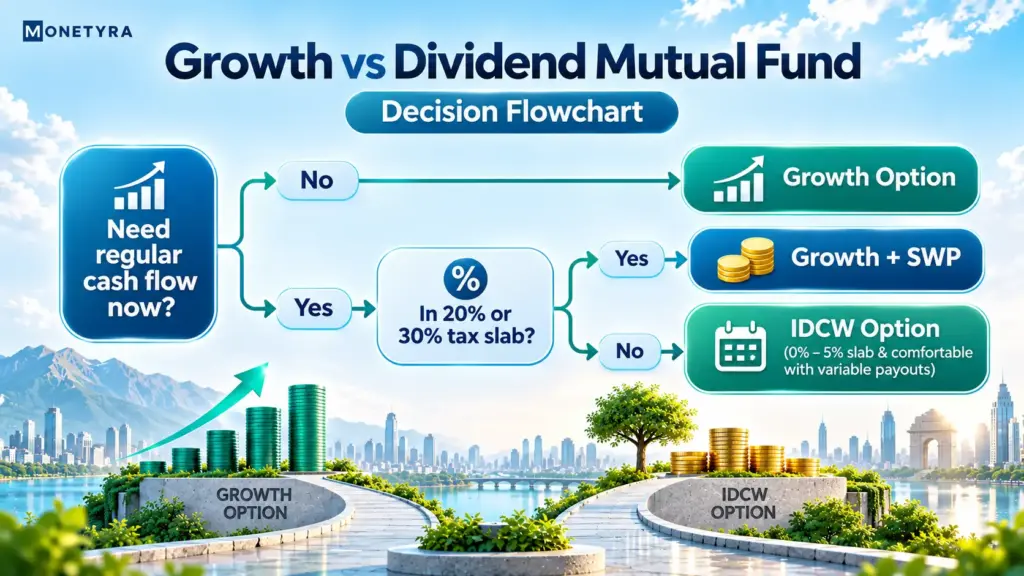
Which Option Should You Choose: Growth or IDCW?
Neither option fits every investor, so your choice should match your cash flow needs, time horizon, and tax bracket.
- When the Growth option fits better: Choose Growth if you are investing for goals five or more years away, such as retirement or a home down payment. Reinvesting all gains maximizes compounding, and deferring taxes until redemption might improve net returns for middle- and high-income earners.
- When the IDCW option fits better: Consider IDCW only if you are in a low or zero tax bracket and prefer receiving occasional cash payouts without manually selling fund units. Keep in mind that the Association of Mutual Funds in India (AMFI) notes IDCW payouts are never guaranteed—if markets fall and the fund has no distributable surplus, payouts can pause entirely.
- A flexible middle path: If you want predictable monthly income in retirement without losing tax control, you can invest in a Growth plan and set up a Systematic Withdrawal Plan (SWP) in mutual funds. An SWP lets you withdraw a fixed rupee amount on a chosen date, and you pay capital gains tax only on the profit portion of each withdrawal.
When placing your order on an investment platform, remember that Growth and IDCW are payout options, which are separate from choosing between Direct vs Regular mutual fund plans. You can select either Growth or IDCW within a Direct plan (lower expense ratio) or a Regular plan (includes distributor commission).
Conclusion
Comparing Growth vs IDCW comes down to whether you want your mutual fund profits reinvested or paid out as cash. The Growth option keeps 100% of your gains working inside the fund, offering stronger compounding and tax deferral until you redeem your units. The IDCW option provides periodic liquidity by deducting payouts directly from your NAV, which slows wealth accumulation and triggers annual slab-rate taxation. Many long-term investors might benefit more from the Growth option, possibly pairing it with an SWP later when regular income is needed.
Build Your Mutual Fund Foundation
Explore mutual fund basics, tax rules, and investment guides in our academy.
FAQs
1. What is the IDCW meaning in mutual funds?
IDCW stands for Income Distribution cum Capital Withdrawal. It is the mutual fund payout option—formerly called the dividend option—where the fund house distributes profits from the scheme’s accumulated surplus directly to investors as cash or additional units, reducing the fund’s NAV accordingly.
2. What is the main difference between Growth vs IDCW mutual funds?
In a Growth option, all profits stay inside the scheme and are reinvested to increase the fund’s NAV over time. In an IDCW option, profits are periodically paid out to unit holders, which reduces the NAV by the exact payout amount on the ex-dividend date.
3. Why did SEBI rename the dividend option to IDCW?
SEBI renamed the dividend option to IDCW so investors clearly understand that payouts are drawn from the fund’s existing NAV and capital, not generated as extra bonus income on top of their investment value.
4. How are Growth and IDCW options taxed in India?
IDCW payouts are added to your taxable income and taxed at your applicable income tax slab rate, with 10% TDS deducted if payouts cross the annual threshold. Growth option gains are taxed only upon redemption as Short-Term or Long-Term Capital Gains depending on the fund type and holding period.
5. Which is better for long-term wealth creation: Growth or IDCW?
The Growth option is generally better for long-term wealth creation because every rupee of profit stays invested to compound over time without annual tax leakage. Investors needing regular cash flow later can use a Systematic Withdrawal Plan (SWP) from a Growth fund.
Disclaimer: This article was written with the help of AI and edited by the Monetyra editorial team. It is for educational purposes only and should not be considered financial advice. Trading and investing in financial instruments involve significant risk of loss, including the loss of your principal, and are not suitable for all investors. Past performance does not guarantee future results. Please consult a licensed financial advisor before making any investment or trading decision.
In India, mutual fund operations are regulated by the Securities and Exchange Board of India (SEBI) and trade execution platforms are hosted across exchanges like the National Stock Exchange (NSE). Investors should evaluate scheme documents carefully before committing capital.