Tracking Error Meaning: Formula, Causes & Rules
Quick Takeaways
- Understanding tracking error meaning involves measuring the annualized standard deviation of excess daily returns between a passive fund and its benchmark index.
- Under Indian regulations, fund houses must publish tracking error disclosures monthly to help investors evaluate index fund management efficiency .
- A low tracking error indicates that an index fund or ETF is replicating its target benchmark with high accuracy and minimal operational drag.
What Is Tracking Error in Mutual Fund?
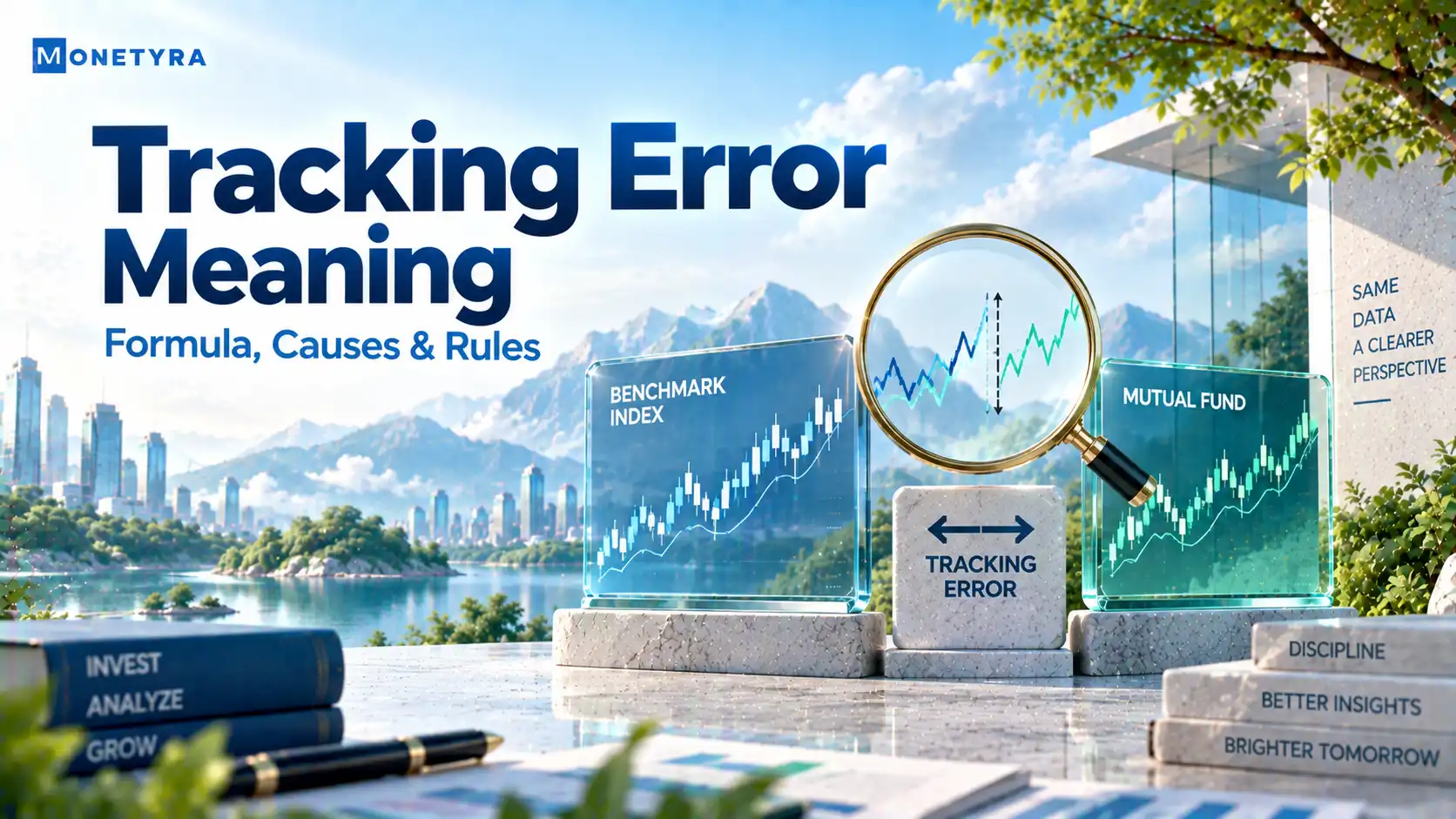
Tracking error is the annualized standard deviation of the daily return differences between a passive mutual fund or ETF and its target benchmark index.
When evaluating tracking error in index fund schemes, retail investors often assume passive funds mirror their underlying indices perfectly. However, real-world portfolio operations create small daily return gaps. Regulated under guidelines set by the Securities and Exchange Board of India (SEBI), AMCs must calculate and disclose tracking error metrics regularly so investors can see how consistently a passive scheme follows its benchmark.
Unlike active portfolios that seek to beat the market, an index fund aims strictly to copy its target benchmark (such as the Nifty 50 or BSE Sensex). Factors like fund management fees, cash holdings, and execution timing cause the scheme’s What Is NAV in Mutual Fund to diverge slightly from index movements. The total operational drag caused by the scheme’s What Is Expense Ratio in Mutual Fund directly influences this performance variance.
Tips: Tracking error does not measure whether a fund generated positive or negative returns; it measures how consistently the fund matched its benchmark’s daily fluctuations.
Tracking Error vs Tracking Difference
Investors frequently confuse tracking error with tracking difference, but they measure distinct aspects of passive fund performance:
| Metric | Tracking Difference | Tracking Error |
|---|---|---|
| Definition | Absolute percentage gap between fund return and index return over a period | Statistical measure (standard deviation) of daily return variations |
| Focus | Quantifies total annualized performance drag | Quantifies day-to-day replication consistency |
| Formula Target | Fund Return (%) – Benchmark Return (%) | Standard deviation of daily return differences annualized |
| Primary Use | Shows exact net yield underperformance | Shows portfolio management execution efficiency |
What Causes Tracking Error in Index Funds?
Several real-world operational factors prevent an index fund from maintaining a 100% perfect match with its target index:
- Cash Drag & Reserves: AMCs hold a small percentage of capital in cash or liquid instruments to manage daily investor redemptions, creating minor cash drag during market rallies.
- Total Expense Ratio (TER): Management fees, custodian costs, and operational expenses are deducted daily from the fund’s NAV, while the benchmark index operates with zero costs.
- Dividend Timing Lags: Dividends paid by underlying index companies take time to receive, clear, and reinvest into additional shares, creating temporary return disparities.
- Corporate Action Delays: When index reconstitutions occur (e.g., semi-annual Nifty 50 rebalancing), AMCs experience short execution delays buying or selling shares on market exchanges.

How to Calculate Tracking Error
Understanding how to calculate tracking error requires reviewing the statistical formula used by risk analysts and fund managers:
Daily Return Difference (Di) = Daily Fund Return – Daily Benchmark Return
Tracking Error = Standard Deviation of Daily Return Differences × Square Root of 252
Suppose an AMC calculates the daily return differences between a Nifty 50 index fund and the actual Nifty 50 Index across 252 trading days:
- Calculate Daily Gaps: Calculate the daily performance gap (Di) for every single trading day.
- Find Standard Deviation: Determine the standard deviation of those 252 daily difference numbers to find daily volatility.
- Annualize the Metric: Multiply the daily standard deviation by √252 (representing the standard number of trading days in a calendar year) to compute the final annualized percentage.
Warning: A sudden spike in tracking error during high-market-volatility periods often indicates execution illiquidity or cash handling friction within the fund house.
How to Select Low Tracking Error Index Fund
Finding a low tracking error index fund ensures that your passive allocation captures true index returns without excessive management drag. When choosing among competing index schemes on CAMS or KFintech platforms, follow these practical evaluation guidelines:
- Prioritize Higher AUM: Schemes with larger asset bases, like a leading Best Index Fund in India, handle daily redemptions smoothly with a lower percentage of overall cash reserves.
- Compare TER and Tracking Error Together: Pick funds that offer both low expense ratios and low annualized tracking error metrics (ideally below 0.20% to 0.50% for broad market indices).
- Evaluate Long-Term Consistency: Check tracking error over 1-year, 3-year, and 5-year periods to verify that the fund house maintains tight replication across different market cycles.
Conclusion
Mastering tracking error meaning empowers passive investors to evaluate index funds and ETFs beyond surface-level expense ratios. By choosing schemes that maintain low tracking error, you ensure your capital captures true index performance with minimal operational drag. Always review monthly AMC tracking error disclosures alongside fund asset size before allocating your capital.
Master mutual fund metrics, calculation formulas, and regulatory standards with our clear educational guides.
FAQs
Tracking error measures how closely an index fund follows its benchmark index. For example, if the Nifty 50 rises 1.0% today and the fund rises 0.98%, the 0.02% difference contributes to the fund’s tracking error over time.
For large-cap equity index funds (like Nifty 50 or Sensex schemes), a tracking error below 0.20% to 0.50% is generally considered low and acceptable.
Tracking error is calculated by taking the standard deviation of daily return differences between the fund and its benchmark index, then multiplying by the square root of 252 (trading days in a year).
Tracking error is primarily caused by fund expense ratios, cash reserves held for redemptions, dividend reinvestment delays, and transaction execution costs during index rebalancing.
Tracking difference is the simple percentage gap in total returns over a specific period, whereas tracking error is a statistical measure of how volatile those return gaps are on a day-to-day basis.
Disclaimer: This article was written with the help of AI and reviewed by the Monetyra editorial team. It is for educational purposes only and should not be considered financial advice. Trading and investing in financial instruments involve significant risk of loss and are not suitable for all investors. Please consult a licensed financial advisor before making any investment decision.
In India, mutual fund operations are regulated by the Securities and Exchange Board of India (SEBI) and trade execution platforms are hosted across exchanges like the National Stock Exchange (NSE) and Bombay Stock Exchange (BSE). Investors should evaluate scheme documents carefully before committing capital.