What Is a Lock in Period? Rules for Funds and IPOs

A lock in period restricts you from selling, redeeming, or transferring your investment units or shares for a fixed duration. Whether you invest in a tax-saving mutual fund or receive shares during a company’s public listing, knowing when your money becomes accessible helps you plan your cash needs.
Understanding these holding rules across mutual funds, government savings plans, and initial public offerings (IPOs) prevents sudden liquidity surprises when you need funds for emergencies.
Quick Takeaways
- A lock-in period is a mandatory timeframe during which investors cannot sell or redeem their units or shares.
- Among Section 123 tax-saving options in India (formerly Section 80C), Equity Linked Savings Schemes (ELSS) carry the shortest lock-in window at 3 years.
- Mutual fund lock-ins block redemptions completely until maturity, whereas exit loads only charge a small fee for early withdrawals.
What Is a Lock in Period in Investing?
A lock-in window is a legally mandated timeframe during which investors cannot sell, redeem, or transfer their mutual fund units or shares.
Regulators such as the Securities and Exchange Board of India (SEBI) enforce these holding windows to promote long-term capital commitment and market stability. In mutual funds and government savings schemes, holding rules prevent investors from withdrawing money early in exchange for tax deductions. In the stock market, lock-in rules stop company founders and early backers from selling large blocks of shares immediately after an IPO.
Tip: Never put your emergency fund into an asset with a mandatory holding window, because fund houses and registrars cannot waive legal lock-in restrictions before the due date.
Lock-In Period in Mutual Funds and Tax-Saving Schemes
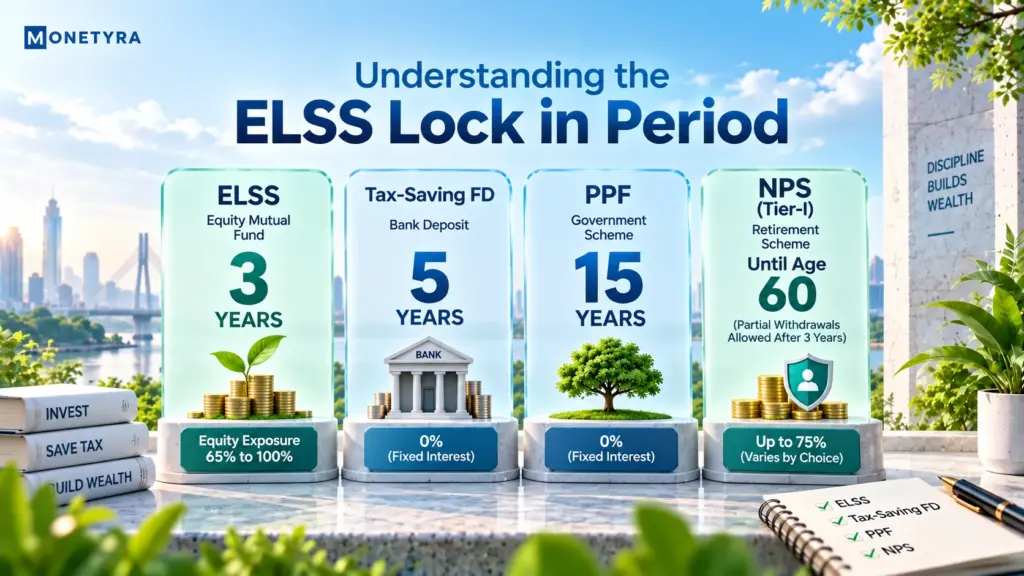
Most open-ended equity, debt, and hybrid mutual funds in India allow you to redeem units on any business day. However, Equity Linked Savings Schemes (ELSS) carry a mandatory 3-year lock-in window.
Under Section 123 of the Income-tax Act, 2025 (formerly Section 80C), investments in ELSS qualify for tax deductions up to ₹1.5 lakh per financial year under the Old Tax Regime. Compared to traditional tax-saving instruments, ELSS requires the shortest commitment.
| Instrument | Category | Mandatory Lock-In Duration | Equity Exposure |
|---|---|---|---|
| Instrument | Category | Mandatory Lock-In Duration | Equity Exposure |
| ELSS Mutual Funds | Equity Mutual Fund | 3 years (36 months) | 80% to 100% |
| Tax-Saving Fixed Deposit | Bank Deposit | 5 years | 0% (fixed interest) |
| Public Provident Fund (PPF) | Government Scheme | 15 years | 0% (fixed interest) |
| National Pension System (NPS Tier-I) | Retirement Scheme | Until age 60 (partial withdrawals allowed after 3 years) | Up to 75% (varies by choice) |
If you prefer fixed-income certainty over stock market swings, review tax-saving fixed deposit rules to see how interest payouts are taxed. For long-term retirement goals, our Public Provident Fund (PPF) guide explains the 15-year maturity cycle and partial withdrawal rules in detail.
Lock-In Period vs. Exit Load
Many beginners confuse a lock-in period with an exit load, though the two work very differently:
- Lock-in period: A strict legal restriction where the fund house blocks any redemption or switch request until the holding clock expires.
- Exit load: A small fee—typically 1% if redeemed within 30 to 365 days—that discourages short-term trading in open-ended funds without blocking your access to cash.
How the Lock-In Period Works for Monthly SIPs
When you invest via a Systematic Investment Plan (SIP) in an ELSS fund, every monthly installment has its own independent 3-year holding clock. Unlike a single lump-sum purchase where the entire amount unlocks on one date, SIP units unlock in stages.
In this hypothetical example of a monthly SIP starting in January 2026, each installment matures exactly 36 months later:
- Installment 1 (January 1, 2026): Unlocks on January 1, 2029.
- Installment 2 (February 1, 2026): Unlocks on February 1, 2029.
- Installment 3 (March 1, 2026): Unlocks on March 1, 2029.
- Installment 36 (December 1, 2028): Unlocks on December 1, 2031.
Once units complete their 36-month window, you can sell them through your fund house portal, registrar platform (such as CAMS or KFintech), or broker app. Redemptions follow a First-In, First-Out (FIFO) rule, meaning your oldest unlocked units are sold first.
Warning: Canceling a monthly SIP stops future bank debits, but it does not release units purchased in earlier months before their individual 3-year dates expire.
IPO Lock-In Period Rules Under SEBI Guidelines
In the equity market, an IPO lock-in restricts company promoters and pre-IPO shareholders from selling their shares for a set period after listing on exchanges like the National Stock Exchange (NSE). These rules prevent sudden supply dumps that could destabilize a newly listed stock.
Under the SEBI (Issue of Capital and Disclosure Requirements) Regulations, holding durations depend on the shareholder category (as of November 2026):
- Minimum Promoter Contribution (up to 20% of post-issue capital): Locked in for 18 months from the date of IPO allotment, or 3 years if the issue proceeds fund capital expenditure projects.
- Promoter Holding Above 20%: Locked in for 6 months from the allotment date, or 1 year if the proceeds fund capital expenditure projects.
- Pre-IPO Non-Promoter Shareholders: Locked in for 6 months from the date of allotment, subject to specific exemptions for registered venture capital funds and alternative investment funds.
Anchor investors face separate 30-day and 90-day holding windows; you can read how institutional allocations to Qualified Institutional Buyers (QIBs) work in our guide on QIB and anchor investor rules in an IPO.
Key Limitations to Consider Before Investing
Before committing money to a locked financial product, weigh three practical trade-offs:
- Zero emergency liquidity: You cannot break an ELSS fund or pre-IPO holding early for medical or personal emergencies.
- No exit during underperformance: If an ELSS scheme lags its benchmark or changes its fund manager, you must stay invested until the 3-year clock ends.
- Reduced tax utility under the New Tax Regime: Because Section 123 deductions (formerly Section 80C) apply only under the Old Tax Regime, investors who opt for the New Tax Regime receive no tax deduction benefit from locking their capital in ELSS.
Monetyra’s Take
A lock-in period acts as enforced patience, preventing panic selling during market dips while offering the shortest holding window among Section 123 options (formerly Section 80C). However, giving up liquidity in an ELSS fund might make sense mainly if you use India’s Old Tax Regime, as Section 123 deductions (formerly Section 80C) do not apply under the New Tax Regime. Keep your emergency fund separate, confirm your tax regime first, and remember that monthly SIP installments unlock individually rather than all at once.
Conclusion
A lock in period acts as a guardrail that aligns investor behavior with tax incentives or post-IPO market stability. Whether you are tracking a 3-year ELSS SIP schedule or checking when pre-IPO shares unlock on the exchange, knowing the exact release date keeps your liquidity plan realistic. Always match the holding duration of an asset with when you actually expect to need the cash.
Explore Mutual Funds Academy
Learn how mutual fund categories, tax rules, and SIP strategies work in India.
FAQs
1. What is a lock-in period in simple terms?
A lock-in period is a fixed duration set by regulations or scheme rules during which investors cannot sell, redeem, or transfer their mutual fund units or shares. Once the period ends, you can hold or sell the investment freely.
2. What is the ELSS lock-in period in India?
Equity Linked Savings Schemes (ELSS) carry a mandatory 3-year (36-month) lock-in period from the date of unit allotment. This is the shortest holding requirement among Section 123 tax-saving instruments (formerly Section 80C).
3. How is the lock-in period calculated for a monthly SIP?
Each monthly SIP installment is treated as a separate purchase with its own 3-year holding clock. For example, an installment invested on March 1, 2026, unlocks on March 1, 2029, while the April 1, 2026 installment unlocks on April 1, 2029.
4. What is the IPO lock-in period for promoters and pre-IPO investors?
Under SEBI (ICDR) Regulations, minimum promoter contributions up to 20% are locked in for 18 months from IPO allotment (3 years for capital expenditure issues), while excess promoter holdings and pre-IPO shares generally carry a 6-month lock-in.
5. Is a lock-in period the same as an exit load?
No. A lock-in period legally blocks you from redeeming your units until the holding window finishes. An exit load does not block withdrawals; it only deducts a small fee if you redeem open-ended fund units within a short timeframe.
Disclaimer: This article was written with the help of AI and edited by the Monetyra editorial team. It is for educational purposes only and should not be considered financial advice. Trading and investing in financial instruments involve significant risk of loss and are not suitable for all investors. Please consult a licensed financial advisor before making any investment or trading decision.