MTF in the Stock Market: Rules, Interest, and Risks
Buying shares for delivery normally requires paying the full trade value upfront. In the Indian stock market, MTF (Margin Trading Facility) lets you purchase approved shares by paying only a portion of the cost while your stockbroker funds the rest.
Regulated by the Securities and Exchange Board of India (SEBI), this facility helps you hold leveraged stock positions beyond a single trading day. Before using borrowed funds, however, you need to understand SEBI margin rules, daily interest costs, and how sudden price drops can trigger forced selling.
Quick Takeaways
- MTF (Margin Trading Facility) allows you to buy SEBI-approved shares and equity ETFs by paying an upfront initial margin while borrowing the remaining amount from your broker.
- Daily interest applies to the funded balance for every calendar day you hold the position, including weekends and market holidays.
- A sharp drop in share price erodes your collateral value and can trigger a margin call or forced square-off if you fail to add funds on time.
What Is MTF in the Stock Market?
MTF (Margin Trading Facility) is a SEBI-regulated facility that lets investors buy eligible delivery shares by paying an initial margin upfront and borrowing the balance.
When you buy shares under standard cash delivery (CNC), you pay 100% of the order value from your own cash balance. With MTF, you contribute an initial margin in cash or approved pledged shares, and your broker pays the rest to complete the exchange settlement.
This structure increases your buying power through how leverage ratios work in stock trading. Unlike intraday orders that close before 3:30 PM IST, MTF positions stay in your demat account as pledged holdings for days or weeks until you sell them or pay off the loan.
Which Stocks Are Eligible for MTF in India?
SEBI restricts MTF to high-liquidity securities so brokers and investors do not take excessive leveraged exposure in thinly traded shares. Under SEBI guidelines (as of November 2026), brokers can offer MTF only on:
- Group I equity shares: Stocks listed on the National Stock Exchange (NSE) and Bombay Stock Exchange (BSE) that meet strict liquidity and impact-cost thresholds set by the exchanges.
- Eligible equity ETFs: Exchange-traded funds that track equity indices and satisfy SEBI liquidity criteria.
Even when a stock belongs to Group I, individual brokers maintain their own approved MTF list. A broker may exclude volatile stocks or require a higher upfront margin based on internal risk checks.
SEBI Rules and Pledge Requirements for MTF
SEBI enforces strict margin, pledge, and broker capital norms under its Master Circular for Stock Exchanges and Clearing Corporations (as of November 2026) to protect retail investors:
- Initial margin formula: For Group I stocks traded in the F&O segment, the minimum initial margin is Value at Risk (VaR) plus 3 times the Extreme Loss Margin (ELM). For non-F&O Group I stocks, the minimum rises to VaR plus 5 times ELM.
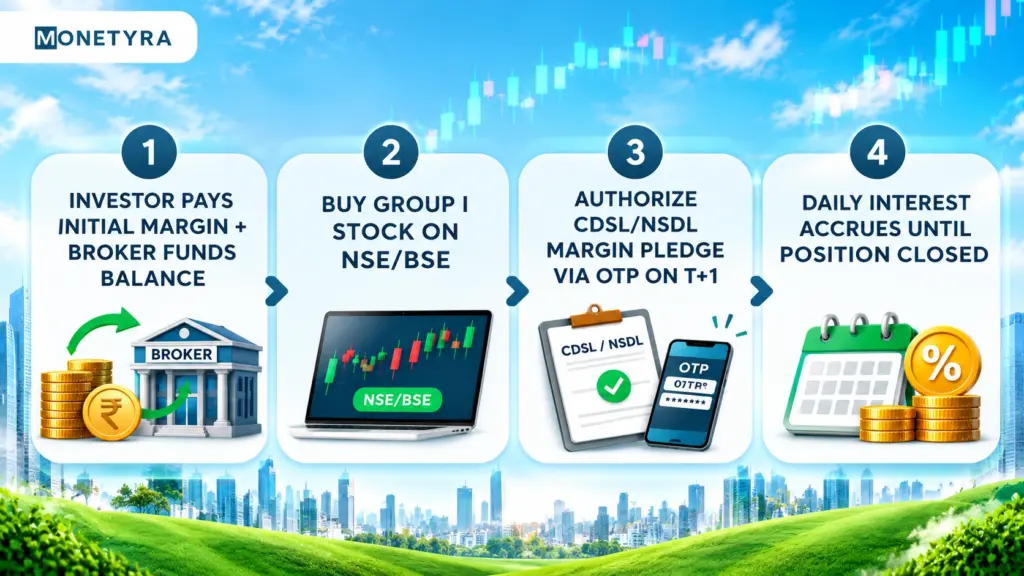
- Mandatory CDSL/NSDL margin pledge: Shares bought through MTF stay in your demat account under a margin pledge tag in favor of the broker. You must authorize this pledge via an OTP link from Central Depository Services Limited (CDSL) or National Securities Depository Limited (NSDL) by T+1 day.
- Broker net-worth threshold: Only corporate brokers with a minimum net worth of ₹3 crore can offer MTF, though SEBI proposed raising this floor to ₹5 crore in its June 2026 consultation paper.
Warning: If you miss the CDSL or NSDL OTP pledge confirmation before the T+1 cutoff, your broker’s risk team will square off your shares to clear the unfunded balance.
MTF Interest Rates and How Borrowing Cost Is Calculated
SEBI requires brokers to disclose MTF borrowing rates transparently, though the regulator does not set a fixed interest cap. Across major Indian stockbrokers, MTF interest rates generally range from 7.99% to 18% per annum depending on the broker’s pricing slab and funded book size (as of November 2026).
Brokers calculate interest daily on the funded amount using calendar days—meaning you pay interest for Saturdays, Sundays, and exchange holidays as well:
Daily Interest = (Funded Amount × Annual Interest Rate) ÷ 365
In this hypothetical example, suppose you buy ₹1,00,000 worth of an eligible Group I stock using ₹25,000 of your own cash (25% initial margin) and ₹75,000 funded by your broker at 14.95% per annum:
| Calculation Component | Hypothetical Value | How It Works |
|---|---|---|
| Total Purchase Value | ₹1,00,000 | Market value of Group I shares purchased |
| Your Initial Margin (25%) | ₹25,000 | Cash or approved collateral you contribute upfront |
| Broker Funded Amount (75%) | ₹75,000 | Principal amount on which interest is charged |
| Daily Interest (at 14.95% p.a.) | ₹30.72 per day | (₹75,000 × 0.1495) ÷ 365 |
| 30-Day Holding Interest | ₹921.58 | ₹30.72 × 30 calendar days (excluding brokerage and taxes) |
If the stock rises 10% (₹10,000) in 30 days, your net gain before brokerage and statutory levies is ₹9,078.42. If the stock falls 10%, your loss widens to ₹10,921.58 because interest still accrues on the ₹75,000 loan.
How MTF Differs From Intraday Margin and Cash Delivery
MTF sits between standard cash delivery and intraday trading in terms of leverage, holding period, and borrowing cost. While intraday margin rules for same-day trades require you to exit before market close, MTF lets you carry positions overnight for a daily interest fee:
| Feature | Cash Delivery (CNC) | MTF (Margin Trading) | Intraday Trading (MIS) |
|---|---|---|---|
| Upfront Capital Needed | 100% of trade value | VaR + 3x or 5x ELM (varies by stock) | Exchange intraday margin (typically 20% minimum) |
| Holding Period | Unlimited | Multi-day (subject to broker terms) | Same day only (auto-closed before 3:30 PM IST) |
| Interest Charges | None | Charged daily on funded amount | None |
| Depository Pledge | Not required | Mandatory CDSL/NSDL OTP pledge | Not required |
| Overnight Gap Risk | Yes (unleveraged) | Yes (leveraged) | No |
Key Risks of MTF and When a Margin Call Happens
Borrowing money to buy equities amplifies losses whenever stock prices move against your position. Two main operational risks govern every MTF trade:
- Margin shortfall and margin call: Brokers mark your pledged shares to market every day. When a price decline reduces your collateral value below the maintenance margin threshold, your broker issues a shortfall alert—which triggers a margin call—requiring you to deposit cash or pledge extra Group I shares.
- Forced RMS square-off: If you do not resolve a margin shortfall within your broker’s cure window (up to 5 trading days under SEBI norms, or sooner if losses breach acute risk limits), the broker’s Risk Management System (RMS) sells your shares at market price.
Tip: Keep an extra cash buffer in your trading account so routine 2% to 3% market swings do not trigger immediate margin shortfall alerts.
How to Place an MTF Trade Step by Step
Placing an MTF order follows a four-step workflow across SEBI-registered brokers:
- Activate the MTF segment: Open your broker’s profile or segment settings and digitally sign the mandatory SEBI MTF Rights and Obligations document.
- Select the MTF order product: Search for an eligible Group I stock on NSE or BSE and choose MTF (or Margin) instead of Delivery (CNC) on the order ticket.
- Fund the initial margin: Confirm that your account holds enough free cash or approved pledged collateral to cover the required upfront margin.
- Approve the depository pledge: Open the CDSL or NSDL link sent via SMS and email on T+1 day and verify the pledge using your OTP before the broker’s deadline.
Conclusion
MTF gives Indian equity investors a regulated way to buy eligible Group I shares and ETFs without paying the full order value upfront. Because daily interest accrues across weekends and price drops can trigger forced liquidation, you should size positions conservatively and monitor your maintenance margin closely.
Explore Stock Academy Guides
Build your foundation in Indian equity rules, order types, and risk management before trading with leverage.
FAQs
1. What is MTF in the stock market?
MTF (Margin Trading Facility) is a SEBI-regulated feature offered by stockbrokers that lets you buy eligible delivery shares by paying an initial margin upfront while borrowing the remaining amount from your broker at a daily interest rate.
2. Which stocks are eligible for MTF in India?
SEBI permits MTF only on highly liquid Group I equity shares and eligible equity exchange-traded funds (ETFs) listed on NSE and BSE. Each broker also applies internal risk filters to decide which Group I stocks it will fund.
3. What is the typical MTF interest rate in India?
MTF interest rates across major Indian brokers generally range from 7.99% to 18% per annum depending on the broker’s pricing slab and your funded amount (as of November 2026). Interest is calculated daily on the borrowed principal.
4. How is MTF interest calculated?
Brokers calculate MTF interest using the formula: Daily Interest = (Funded Amount × Annual Interest Rate) ÷ 365. Interest accrues for every calendar day you hold the position, including Saturdays, Sundays, and stock market holidays.
5. What happens during a margin call in MTF?
If your pledged stock falls in price and your collateral drops below the maintenance margin requirement, your broker sends a margin shortfall alert. You must add cash or eligible shares within the broker’s deadline, or the broker will automatically sell your holdings.
6. What is the difference between MTF and intraday trading?
Intraday trading requires you to close your position before the market closes on the same day and carries no overnight interest. MTF lets you hold pledged delivery shares overnight for days or weeks while paying daily interest on the borrowed amount.
Disclaimer: This article was written with the help of AI and edited by the Monetyra editorial team. It is for educational purposes only and should not be considered financial advice. Trading and investing in financial instruments involve significant risk of loss and are not suitable for all investors. Please consult a licensed financial advisor before making any investment or trading decision.