ROE Meaning: What Is Return on Equity in Stock Market?
Imagine you start a business with ₹10 lakh (₹1 million) of your own savings and earn ₹2 lakh (₹200,000) in profit after twelve months. Your money produced a 20% return.
This link between the equity invested and the profit earned is the idea behind Return on Equity (ROE). In equity investing, understanding the ROE meaning helps you judge how well a company uses shareholder capital. Instead of looking only at revenue or stock price moves, ROE measures how efficiently a company turns equity into profit.
Quick Takeaways
- ROE meaning in simple terms: Return on Equity measures the net profit a company generates for every rupee of shareholder funds on its balance sheet.
- Calculating ROE requires dividing Net Income by Shareholders’ Equity, typically benchmarked against historical averages and industry peers.
- A rising ROE can look impressive, but heavy corporate debt can inflate the ratio and may raise the risk of financial distress.
What Is ROE? Definition and Full Form
ROE (Return on Equity) is a fundamental financial profitability metric that measures the annual net profit generated per rupee of shareholders’ equity. The ROE meaning is simple: it shows how much profit each rupee of shareholder capital produces in a year.
In market analysis, the ROE full form is Return on Equity. The term equity refers to shareholders’ equity. On an Indian company’s balance sheet, it is often labeled “Net Worth” or “Total Shareholders’ Funds” under Securities and Exchange Board of India (SEBI) disclosure guidelines.
When a listed business earns revenue, it pays operational costs, taxes, and loan interest. Whatever remains belongs to the equity owners. ROE shows whether management earns a good surplus on that capital or leaves shareholder funds earning low returns.
How to Calculate ROE: The Formula and Real Example
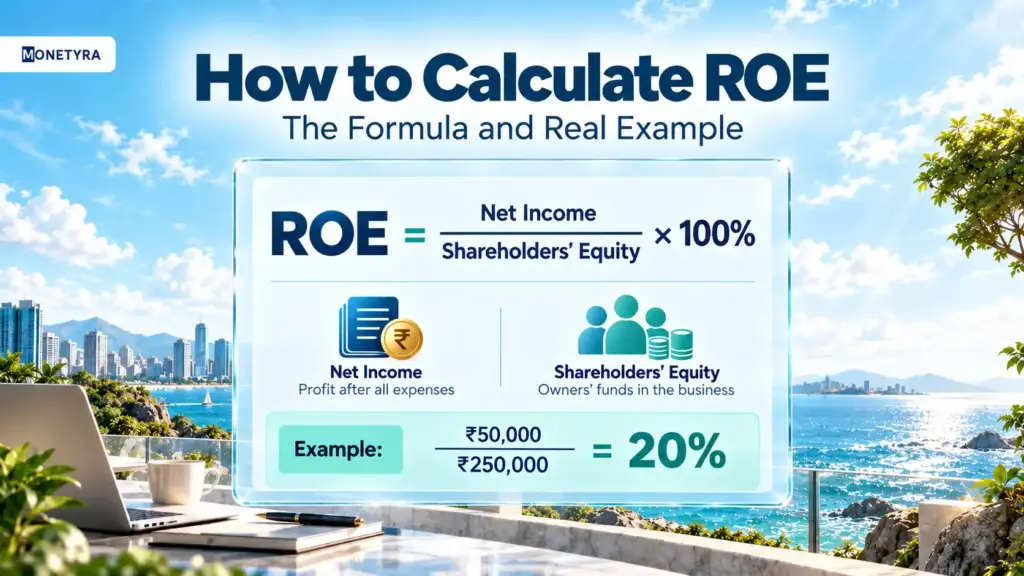
To apply the ROE meaning in practice, calculate Return on Equity from figures taken directly from audited financial statements.
ROE (%) = (Net Income ÷ Shareholders’ Equity) × 100
Understanding the ratio requires inspecting both inputs carefully:
- Net Income (Profit After Tax): Found at the bottom of the Profit & Loss statement. It is the profit left for equity holders after all expenses, interest, and taxes.
- Shareholders’ Equity (Net Worth): Found on the Balance Sheet. It equals paid-up equity share capital plus reserves and surplus, minus accumulated losses.
Consider a practical mid-cap scenario on the National Stock Exchange (NSE):
Hypothetical example (not a real company): An Indian engineering company reports an annual Profit After Tax of ₹120 crore (₹1.2 billion; 1 crore = 10 million). Its audited balance sheet lists an equity share capital of ₹100 crore and retained reserves of ₹500 crore, making its total shareholders’ equity ₹600 crore.
Applying the ROE formula:
ROE = (₹120 crore ÷ ₹600 crore) × 100 = 20%
For every ₹100 of net assets retained inside the business, management generated ₹20 in annual earnings. In equity research, investors track this relationship alongside Earnings Per Share (EPS). Our guide on EPS in stock market explains how it works.
What Is a Good ROE for Indian Stocks?
The ROE meaning becomes useful only when you compare the number with a benchmark. Many investors treat an ROE that stays between 15% and 20% as a sign of solid capital deployment, but this is a rule of thumb, not a regulatory standard.
To judge whether a ratio is strong, compare it with the domestic risk-free rate, which is tracked by the 10-year Indian Government Securities (G-Sec) yield. According to Trading Economics, that yield was around 6.9% in August 2026 and has traded between roughly 6.6% and 7.1% during 2026. Equity investment carries underlying business volatility. Therefore, an Indian enterprise earning an ROE below 10% barely beats debt yields after adjusting for equity risk.
Capital requirements differ widely across sectors in India. The ranges below are rules of thumb, not official benchmarks, and actual ROE varies by company and by year:
| Sector | Indicative ROE Range | Structural Drivers | Capital Intensity |
|---|---|---|---|
| Information Technology (IT) | 22% – 30% | Asset-light models, global billing, zero or low long-term debt | Low |
| Fast Moving Consumer Goods (FMCG) | 20% – 35% | Established consumer brands, high product turnover, fast working capital cycles | Low |
| Infrastructure & Construction | 10% – 15% | High capital expenditure, long gestation periods, heavy equipment loans | High |
| Commercial Banking & Non-Banking Financial Companies (NBFCs) | 13% – 18% | Financial spreads, net interest margins (NIMs), statutory reserve rules | Asset-based |
Tips: Always compare a company’s ROE against its own 5-year rolling average and sector rivals, rather than relying on a single quarterly result.
Using ROE in share market screening tools can help you filter out stagnant businesses before you check entry pricing with the Price-to-Earnings (PE) ratio. Our guide on PE ratio meaning explains it.
The Debt Trap: Why a High ROE Can Be Misleading
A very high ROE does not automatically mean a company runs efficient operations. Another part of the ROE meaning is that a high number can hide risk.
Because equity equals total assets minus total liabilities, a company that funds its assets with loans needs less equity for the same asset base. Net income may grow only modestly, but it is divided by a smaller equity base, so ROE can look high even when operations are average. In a slowdown or when interest rates rise, heavy debt can push a leveraged company toward insolvency.
Management can also raise ROE through share buybacks funded from surplus cash, which reduces equity on the balance sheet. If a company has large accumulated losses, its equity can turn negative. Dividing a net loss by negative equity gives a positive ROE that is misleading.
Warning: A 35% ROE driven by heavy borrowing carries high downside risk and can erase shareholder value when markets contract.
Before trusting an unusually high ratio, verify balance sheet stability by cross-referencing the company’s debt to equity ratio.
ROE vs. ROCE: Key Differences for Stock Investors
Indian investors frequently confuse Return on Equity with Return on Capital Employed (ROCE). While both evaluate balance sheet performance, they measure capital allocation from different angles. Knowing the ROE meaning also helps you see how it differs from ROCE:
| Feature | Return on Equity (ROE) | Return on Capital Employed (ROCE) |
|---|---|---|
| What It Measures | Efficiency in generating profits strictly from equity shareholders’ funds | Efficiency in generating operating returns from all long-term capital combined |
| Formula | (Net Income ÷ Shareholders’ Equity) × 100 | (Operating Profit [Earnings Before Interest and Taxes (EBIT)] ÷ Capital Employed) × 100 |
| Capital Included | Equity share capital plus reserves and surplus | Equity capital plus total long-term debt liabilities |
| Best Used For | Asset-light service industries, FMCG, and financial institutions | Capital-intensive sectors like steel, power, and manufacturing |
ROE shows how well equity capital earns profit. ROCE shows how well the business earns operating profit from all long-term capital, however management finances it.
Conclusion
Return on Equity is a useful tool for judging how well management turns shareholder funds into profit. ROE alone can hide balance sheet risk. A sound approach pairs ROE with operating margins, historical averages, and debt ratios, so you can tell whether profits come from operations or from borrowing. Understanding the ROE meaning gives investors a quick read on how well management uses shareholder capital.
Deepen your market knowledge with clear, step-by-step guides on core valuation metrics.
FAQs
A consistent ROE between 15% and 20% is broadly considered healthy for listed companies in India. This range is above the 10-year G-Sec yield, though capital-intensive sectors like power or infrastructure often operate at lower, sustainable levels between 10% and 14%.
In practical terms, the ROE meaning is operational profitability and capital allocation efficiency. ROE shows how many rupees of net profit management earns from each rupee invested by equity shareholders. It also hints at whether the firm can fund expansion internally without repeatedly issuing new shares.
Yes. ROE turns negative when a company reports a net loss after taxes for the financial year. A negative ratio signals operational stress. Do not read a positive ROE as healthy if it comes from both negative net income and negative net worth.
An unusually high ROE often stems from heavy financial leverage rather than strong operating margins. When a business relies heavily on external debt, its equity base is smaller relative to its assets, which can inflate ROE while raising interest payment burdens and default risk in downturns.
ROE measures net profits generated strictly from equity shareholders’ funds, making it sensitive to debt levels. ROCE evaluates operating earnings against all capital employed, including both equity and long-term borrowed funds, offering a clearer picture for capital-intensive enterprises.
Disclaimer: This article was written with the help of AI and reviewed by the Monetyra editorial team. It is for educational purposes only and should not be considered financial advice. Trading and investing in financial instruments involve significant risk of loss and are not suitable for all investors. Please consult a licensed financial advisor before making any investment or trading decision.
In India, equity disclosures and market operations are overseen by SEBI. Readers are advised to verify the regulatory filings of listed companies through exchange portals and ensure compliance with applicable Indian financial norms before investing.