Trading Account vs Demat Account: What Is the Difference?
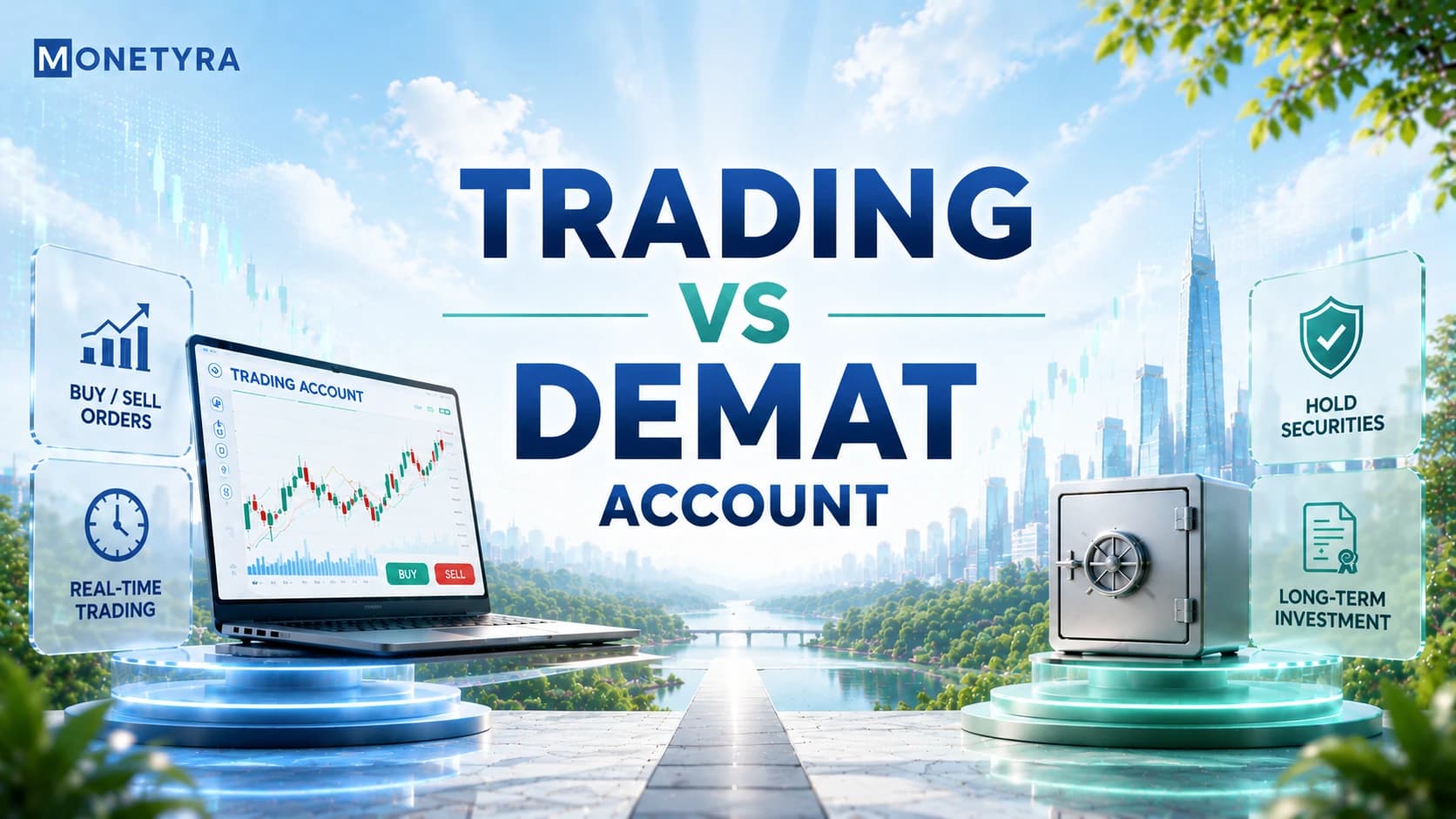
If you have ever decided to invest or trade in the Indian stock market, you have likely encountered two financial accounts: Trading Account vs Demat Account. While these are often opened together as part of a single onboarding process by stockbrokers, they serve two very different functions.
A Trading Account functions as the execution engine used to buy and sell securities on stock exchanges like the National Stock Exchange (NSE) and the Bombay Stock Exchange (BSE). In contrast, a Demat Account operates as a digital repository, securely storing your bought shares, exchange-traded funds (ETFs), and bonds in an electronic format.
Understanding how these two mechanisms interact is essential for managing transaction costs, trade settlements, and custodial security in the stock market.
Quick Takeaways
- Execution vs. Storage: The trading account places and executes orders on the stock exchange, whereas the Demat account holds physical shares converted into electronic form.
- Regulatory Custody: Demat accounts are held directly with national central depositories—either NSDL or CDSL—rather than being stored on the stockbroker’s balance sheet.
- Separation for Short-Term Trades: Intraday equity trading and cash-settled futures & options (F&O) require an active trading account, but they do not require share delivery into a Demat account.
- Distinct Cost Structures: Trading accounts incur variable costs like brokerage fees, Securities Transaction Tax (STT), and exchange turnover charges, while Demat accounts incur fixed or transaction-based depository costs, such as Annual Maintenance Charges (AMC) and Depository Participant (DP) debit fees.
What Is Trading Account vs Demat Account?
Definition
A Trading Account is an execution interface provided by a registered stockbroker that connects an investor’s bank account to stock exchanges such as the NSE or BSE. When you want to purchase a security, your trading account checks for available margin, verifies order parameters, and routes the transaction to the market engine for execution.
A Demat Account (short for Dematerialised Account) is an electronic custody account that holds securities in a digitalized state. Before 1996, Indian stock purchases relied on physical share certificates, which were vulnerable to loss, theft, and forgery. Demat accounts eliminated paper by converting physical certificates into secure electronic entries managed by central depositories.
To understand the difference using a standard banking analogy:
- Trading Account: Acts like a mobile banking interface or credit/debit card rail that facilitates the movement and execution of transaction orders.
- Demat Account: Acts like the underlying bank account or digital safe where assets sit safely once the transaction has settled.
How Share Custody Works in India
In India, central share custody is not managed directly by individual stockbrokers. Instead, Demat accounts are opened with one of two central depositories licensed by SEBI:
- NSDL (National Securities Depository Limited): Established in 1996, the primary depository in India.
- CDSL (Central Depository Services Limited): Established in 1999, widely integrated with retail brokerage platforms.
Stockbrokers act merely as intermediaries known as Depository Participants (DPs). If a broker goes out of business, the investor’s assets stored inside the Demat account remain unaffected because the shares reside directly with NSDL or CDSL.
Demat vs Trading Account: Key Differences
When evaluating a Demat account vs Trading account, both are usually provisioned together in a 2-in-1 or 3-in-1 setup, yet they differ structurally across governance, functionality, and asset handling.
Structural Comparison
| Comparison Parameter | Trading Account | Demat Account |
|---|---|---|
| Primary Function | Executes buy and sell orders on exchanges. | Stores securities in an electronic format. |
| Governing Authority | Registered Stockbroker / Stock Exchanges (NSE, BSE). | Central Depositories (NSDL or CDSL) via Depository Participants. |
| Asset Types Held | Cash margin, unallocated funds, pending order positions. | Stocks, ETFs, Mutual Funds, Sovereign Gold Bonds, Corporate Debt. |
| Unique Identification | Unique Client Code (UCC) assigned by the broker. | 16-digit Demat Account Number (BO ID or DP ID + Client ID). |
| Requirement for Intraday | Mandatory for executing buy/sell order legs. | Not required (positions are squared off before delivery settlement). |
| Primary Fee Types | Brokerage, Exchange Turnover Charges, STT, Stamp Duty. | Annual Maintenance Charges (AMC), DP Debit Charges. |
Execution vs. Custody Mechanics
The key difference lies in the boundary between trade execution and asset storage.
When a trade is placed, the trading account interacts with market liquidity providers, processing transactions, validating trade conditions, and locking in execution prices. However, the trading account itself cannot legally store equity ownership over time.
Once the trade is matched and processed through the clearing corporation, ownership rights must be credited to an account recognized by central depositories. The Demat account fulfills this legal role by recording the exact quantity, ISIN (International Securities Identification Number), and ownership log of the security under SEBI guidelines.
How Trading and Demat Accounts Work Together
The practical interaction between a trading account, a Demat account, and a linked savings bank account follows a standardized clearing and settlement cycle. India operates on a T+1 settlement cycle for mainboard equity markets, as mandated by SEBI, meaning trades are fully settled one business day after execution.
Order Execution & Settlement Workflow (Equity Delivery)
| Step | Action Taken | Primary Account / Entity | Settlement & Custody Flow |
|---|---|---|---|
| 1. Order Placement | Investor enters a buy order (e.g., 50 shares of Company X). | Trading Account & Bank | Trading account verifies available cash margin linked from the bank account. |
| 2. Order Execution | Trade is matched on the exchange platform. | Stock Exchange (NSE / BSE) | Contract note is generated by the broker detailing price, brokerage, and statutory taxes. |
| 3. Clearing & Funds Settlement | Cash is deducted from the trading account and routed to the clearing house. | Clearing Corporation | Funds are transferred on T+1 day during official clearing house settlement hours. |
| 4. Securities Delivery | Electronic credit of 50 shares arrives in the buyer’s name. | Demat Account (CDSL / NSDL) | Depository updates the electronic registry, transferring ownership directly to the Demat account. |
Intraday Trading vs. Delivery Trades
Not every transaction in the stock market involves both accounts equally:
- Delivery Trades (Investing): If you purchase shares with the intent of holding them overnight or for several years, both accounts are activated. The trading account processes the purchase, and the Demat account holds the shares until you decide to sell.
- Intraday Trading: If you enter and exit an equity position within the official intraday trading time in India (between 09:15 IST and 15:30 IST), ownership of the share never shifts to a central depository. Because the trade is squared off before market close, the transaction is settled in cash through your trading account.
- Derivatives (Futures & Options): F&O contracts are cash-settled financial agreements (with the exception of physical delivery stock derivatives at expiry). They trade through your trading account balance and margin limits without crediting equity delivery shares into a Demat account.
Trading Account vs Demat Account Charges and Fees
Understanding transaction costs requires distinguishing between charges levied by the broker for executing trades and charges levied by depositories for maintaining share custody.
1. Trading Account Charges
Trading account costs are tied directly to trade execution frequency and transaction volume:
- Brokerage Fees: Traditional full-service brokers may charge a percentage of turnover, while discount brokers often charge a flat fee per executed order; exact rates vary by broker and should be confirmed on the broker’s official fee schedule.
- Securities Transaction Tax (STT): A mandatory statutory tax collected by the broker and remitted to the government on equity delivery purchases/sales and intraday sell trades.
- Exchange Turnover & SEBI Fees: Small transactional levies charged by exchanges (NSE/BSE) and the regulator to cover clearing and operational overheads.
- Stamp Duty: A regional tax levied under the Indian Stamp Act on buy-side transactions across equities, commodity derivatives, and currency markets.
2. Demat Account Charges
Demat account costs relate to asset holding, safe custody, and debit transfers:
- Annual Maintenance Charges (AMC): A fixed annual fee billed by the Depository Participant to maintain your account active with NSDL or CDSL. AMCs vary by Depository Participant and portfolio tier, so investors should confirm the exact fee schedule directly with their broker or DP before opening an account.
- DP Debit Charges: Every time you sell delivery shares from your Demat account, a fixed Depository Participant fee (typically between ₹10 and ₹25 per scrip per day) is charged, regardless of the quantity sold. This covers the custodial ledger debit processed by CDSL or NSDL.
- Dematerialisation Charges: Fees charged if physical paper share certificates are converted into digital format.
Basic Services Demat Account (BSDA) Framework
To lower entry barriers for small retail investors, SEBI established guidelines for the Basic Services Demat Account (BSDA):
- Holding Value up to ₹4,00,000: Annual Maintenance Charge (AMC) is ₹0.
- Holding Value between ₹4,00,001 and ₹10,00,000: Annual Maintenance Charge is capped at ₹100 per year.
- Holding Value above ₹10,00,000: Account automatically converts to a standard Demat account charging regular AMC rates. (Figures reflect SEBI’s BSDA circular effective September 1, 2024.)
Choosing the Right Depository Participant in India
When selecting a stockbroker or Depository Participant (DP) in India, evaluating services purely on the phrase “which Demat account is best” can lead to incomplete comparisons. Because execution features sit in the trading account while ownership custody sits with CDSL or NSDL, selection should be based on objective criteria that balance overall cost, operational reliability, and ease of access.
Tip: Use a discount broker for active day trading and a full-service/bank broker for long-term investments like Sovereign Gold Bonds to keep high-frequency cash flows separate from core assets.
Key Evaluation Criteria
Brokerage Structure (Trading Account Side)
Determine whether a flat-fee model (e.g., ₹20 per trade) or a percentage-based model aligns better with your average trade size. For small investments, percentage models may yield lower costs; for larger order values, flat-rate discount brokers are generally more cost-effective.
Custodial & DP Charges (Demat Account Side)
Check the broker’s schedule of charges for DP debit fees when selling holdings. A broker with zero brokerage on delivery trades may still levy higher flat DP charges on every scrip sold.
Platform Stability and Order Routing
Look at exchange infrastructure uptime during high-volatility market sessions (such as RBI policy announcements or election results) to ensure order entry and stop-loss mechanisms function without execution delays.
Digital Authorization Mechanism
Ensure the provider supports DDPI (Demat Debit and Pledge Instruction) or e-DIS (electronic Delivery Instruction Slip) authorization via a CDSL/NSDL TPIN (Transaction PIN). This allows seamless selling of holdings without requiring physical paper power-of-attorney forms.
Direct Depository Access
Verify whether the DP provides access to central management tools—such as CDSL Easiest or NSDL IDeAS. These platforms allow investors to view holdings directly from the depository, execute off-market transfers, and set up consolidation tracking independent of their broker’s app interface.
Conclusion
Understanding the difference between trading account vs Demat account clarifies how retail participation works in the Indian financial system. While the trading account handles real-time execution on stock exchanges, the Demat account provides secure, centralized ownership custody with CDSL or NSDL.
Knowing how these account types function together allows you to better evaluate transaction costs, manage order execution, and maintain control over your digital investment assets.
To explore further concepts on order types, clearing cycles, and market analysis, visit the stock-academy hub.
Disclaimer: This article was drafted with AI assistance, reviewed for accuracy by the Monetyra editorial team, and is reviewed every 6 months to reflect the latest market conditions and regulatory updates. It is for educational purposes only and should not be considered financial advice. Trading in financial instruments involves significant risk of loss and is not suitable for all investors. Please consult with a licensed financial advisor before making any trading decisions.
In India, equity trading and share custody are regulated by the Securities and Exchange Board of India (SEBI) and governed under depository operational frameworks managed by NSDL and CDSL. Readers are advised to verify the registration status of their broker and Depository Participant before transferring funds or executing transactions.
FAQs
A trading account is used to place buy and sell orders on the stock exchange, serving as the financial interface for transactions. A Demat account acts as a digital safe that holds your purchased shares and securities electronically under central depositories like NSDL or CDSL.
Yes, you can. This arrangement is common for investors who receive shares through initial public offerings (IPOs), corporate ESOPs (Employee Stock Ownership Plans), inheritance, or off-market transfers. However, if you wish to sell those shares on an exchange, a trading account linked to a broker is required.
No, a Demat account is not required if you exclusively trade equity intraday or trade futures and options. Because intraday trades are opened and squared off within the same trading session, ownership of physical delivery shares is never transferred. Trades are settled entirely in cash through your trading account balance.
Yes, they cover distinct operations. Trading account charges include variable costs like brokerage, STT, and exchange turnover fees paid upon trade execution. Demat account charges include fixed custodial costs, such as Annual Maintenance Charges (AMC) and DP debit charges billed when delivery holdings are debited from your account.
Yes, your Demat holdings are secured because shares are held directly with national depositories (NSDL or CDSL) supervised by Securities and Exchange Board of India (SEBI), rather than on the stockbroker’s balance sheet. Even if a stockbroker faces insolvency, your equity holdings remain safe in your depository registry under your unique 16-digit Demat ID.
There is no single “best” Demat account for all market participants. Choose based on DP debit fees, software reliability, and whether you qualify for a zero-AMC Basic Services Demat Account (BSDA).