What Is Upper Circuit and Lower Circuit in Stock Trading?
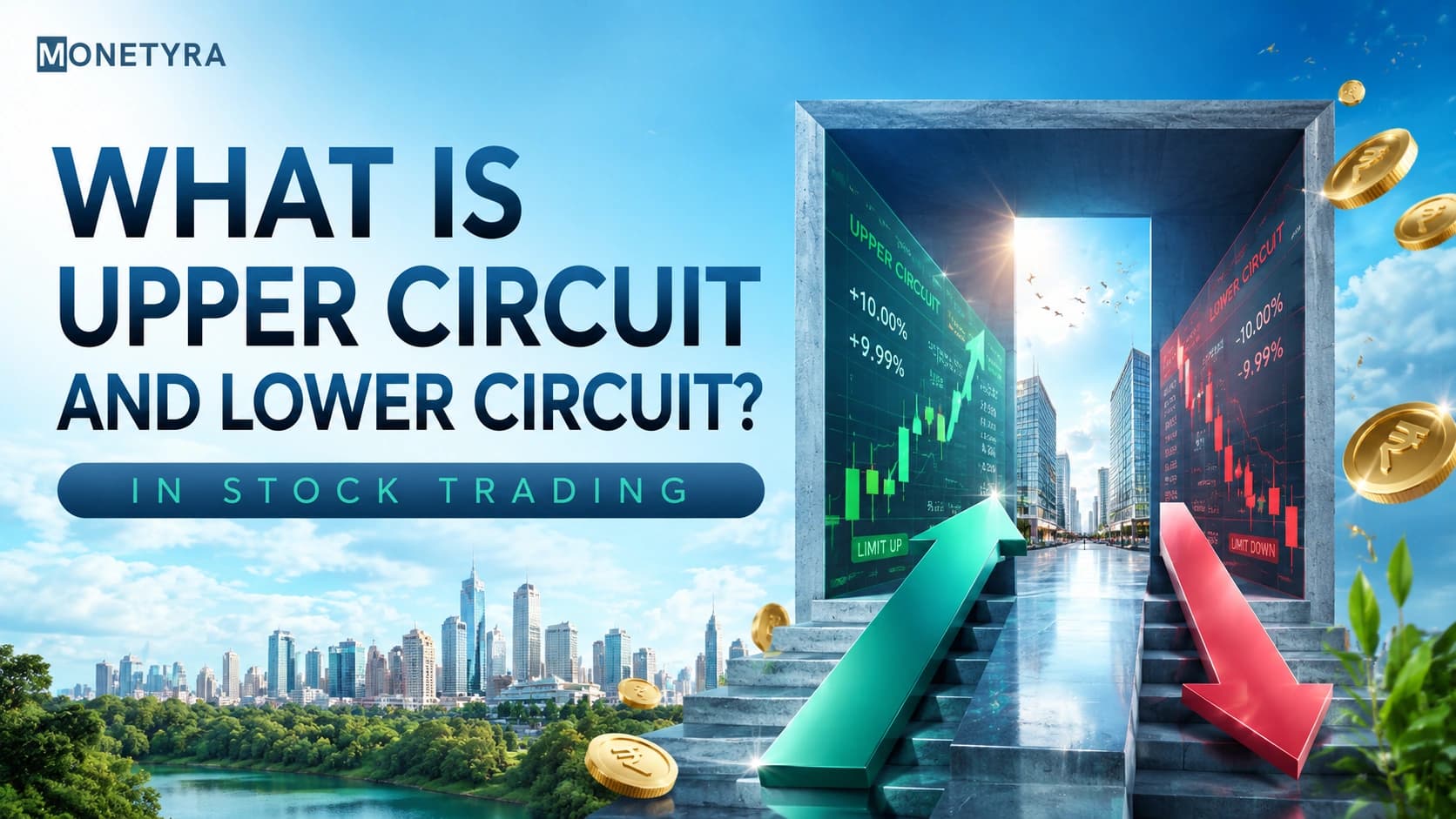
Upper and lower circuits are exchange-mandated price boundaries that restrict the maximum amount a stock’s price can fluctuate within a single trading day. These regulatory thresholds act as automatic safety mechanisms to check extreme volatility, maintain market stability, and protect retail investors from sudden, irrational price swings.
If you have ever attempted to buy a surging stock or sell a crashing one, only to find your order permanently stuck as “pending,” you have likely encountered these operational boundaries. To navigate these situations safely, investors must understand what is upper circuit and lower circuit and how this framework functions.
This knowledge is critical to protecting your capital and navigating liquidity freezes on Indian exchanges. This guide breaks down exactly how these daily limits function, how they impact your execution, and how SEBI regulates them.
Quick Takeaways
- Hitting a circuit limit completely halts normal two-way matching, leaving the order book entirely asymmetric, with either only buyers or only sellers.
- While an upper circuit locks short-sellers into unlimited risk, a lower circuit traps long investors by removing their ability to liquidate positions.
- Unlike individual stock price bands, index-level circuit breakers pause or shut down the entire exchange for specified cooling-off periods.
- Standard stop-loss orders frequently fail or get skipped entirely when a stock opens the day directly at a circuit limit via a gap-up or gap-down.
What Is Upper Circuit and Lower Circuit?
To understand what is upper circuit and lower circuit, it helps to look directly at the mechanics of an exchange’s order book. An upper circuit represents the maximum price a stock is permitted to reach during a single trading session, while a lower circuit represents the minimum allowed price for that same day. Exchanges calculate these boundaries daily based on the previous session’s closing price.
Think of these limits like a speed governor installed on a commercial vehicle. The governor does not alter the normal operation of the vehicle at standard speeds, but it prevents the vehicle from accelerating past a point where the driver is highly likely to lose control.
When a stock breaches one of these boundaries, the underlying market mechanism changes instantly. In normal trading conditions, an exchange continuously matches buyers and sellers at mutually agreed prices. However, when a stock touches its circuit limit, this equilibrium breaks entirely:
- At the Upper Circuit: The price hits its daily ceiling. Sellers completely vanish from the order book because no one is willing to sell at that price or lower, leaving a massive queue of unexecuted buy orders.
- At the Lower Circuit: The price hits its daily floor. Buyers vanish entirely because no one is willing to buy at that price or higher, leaving an overwhelming queue of unexecuted sell orders.
How Daily Price Bands and Circuits Work
The National Stock Exchange (NSE) and the Bombay Stock Exchange (BSE) implement daily price bands to maintain orderly trading conditions across thousands of listed equities. These daily price bands the NSE uses are systematically assigned based on the liquidity, volume, and derivative status of each specific script.
| Band Limit | Typical Volatility Profile | Purpose / Stock Category |
|---|---|---|
| 2% to 5% | High Risk / Low Liquidity | Applied to highly volatile penny stocks, small-caps under surveillance, or stocks undergoing major corporate actions. |
| 10% | Moderate Volatility | Assigned to mid-cap companies and standard small-cap equities with steady structural volume. |
| 20% | Standard Maximum Limit | The baseline default band for major large-cap stocks that do not have active Futures & Options (F&O) contracts. |
| No Fixed Band | Highly Liquid / Institutional | Reserved for stocks traded in the Futures & Options segment; these use dynamic price bands rather than static ceilings. |
Static Price Bands vs. Dynamic Price Bands
For standard cash-segment stocks, the price band is entirely static. If a stock closed yesterday at ₹100 and carries a 10% price band, its upper circuit is fixed at ₹110 and its lower circuit is fixed at ₹90 for the entire day. No trades can occur outside this window. However, stocks that feature active derivative trading operate under dynamic price bands.
To prevent erroneous trades while allowing true price discovery, the exchange applies an initial operating filter (typically 10%). If trading activity pushes the stock price to that 10% limit, the exchange does not lock the order book permanently.
Instead, it briefly pauses matching, reviews the order book, and systematically relaxes the filter in increments of 5% after a short cooling period. This dynamic adjustment allows high-volume stocks to absorb major fundamental news events without permanent liquidity lockups.
What Happens to Your Order at a Circuit Limit?
When a stock enters a circuit condition, a retail trader’s interaction with the market shifts dramatically. If your current intraday trading strategy relies on rapid execution, hitting a circuit ceiling or floor can completely disrupt your expected trade outcome.
Trapped in an Upper Circuit: The Buyer’s Dilemma
When a stock experiences an overwhelming surge of positive momentum, it can lock into an upper circuit.
- The Order Book State: The “Ask” side of the order book drops to zero. Only “Bid” orders remain.
- Market Impact: If you try to place a market buy order, it will sit unexecuted in a queue sorted strictly by time priority.
- The Core Risk: For long buyers, the risk is purely opportunity cost—you miss out on the rally. However, for short-sellers who sold the stock earlier in the day expecting it to drop, an upper circuit presents severe liquidity risk. Because you cannot buy back the shares to close your position, you are trapped. If the circuit does not break before the market closes at 15:30 Indian Standard Time (IST), your position will face an involuntary auction process by the exchange, often resulting in heavy financial penalties.
Trapped in a Lower Circuit: The Seller’s Lockout
Conversely, when severe negative news hits a company, the stock can plummet straight to its lower circuit limit.
- The Order Book State: The “Bid” side of the book drops to zero. Only “Ask” orders remain.
- Market Impact: There are absolutely no buyers willing to absorb the shares at that price level.
- The Core Risk: Long position holders face complete capital lockup. If you hold shares and want to cut your losses, your market or limit sell orders will simply sit pending at the bottom of the queue. This is where behavioral panic frequently amplifies market damage, as retail investors watch their portfolio value decline without any structural mechanism to exit the position.
Tip: Many traders fail to realize that standard stop-loss orders provide no protection when a stock gaps directly past your target price overnight. If a stock closes at ₹100 and opens the next morning locked at a lower circuit of ₹90, your stop-loss set at ₹95 will be bypassed completely, as no trades ever occurred at your specified trigger price.
Circuit Breaker Rules: SEBI Framework
It is vital to distinguish between a single stock hitting its daily price band and an index-level circuit breaker halting the entire national market. The Securities and Exchange Board of India (SEBI) mandates strict, coordinated market-wide circuit breaker rules to manage macro-level systemic panics across both the NSE and BSE.
When the benchmark indices—either the Nifty 50 or the Sensex—experience severe market-wide shocks, the exchange triggers a mandatory, coordinated trading halt based on three progressive percentage thresholds: 10%, 15%, and 20%.
| Trigger Level | Time of Trigger (IST) | Trading Halt Duration | Market Re-open Phase |
|---|---|---|---|
| 10% | Before 13:00 | 45 minutes | 15-minute pre-open session after halt |
| 10% | Between 13:00 and 14:30 | 15 minutes | 15-minute pre-open session after halt |
| 10% | At or After 14:30 | No Halt | Trading continues normally |
| 15% | Before 13:00 | 1 hour and 45 minutes | 15-minute pre-open session after halt |
| 15% | Between 13:00 and 14:30 | 45 minutes | 15-minute pre-open session after halt |
| 15% | At or After 14:30 | Remainder of the day | Entire market closed until next session |
| 20% | Any time during market hours | Remainder of the day | Entire market closed until next session |
Note: These specific timelines and percentage steps are calculated dynamically by the exchanges each day based on the index closing figures from the previous trading day.
How Traders Manage Circuit Risks
Because circuit limits completely disrupt normal order execution, managing circuit risk must form a core component of your broader risk management plan for traders.
- Avoid Illiquid Penny Stocks: Highly manipulated or low-volume micro-cap stocks are heavily prone to consecutive daily circuits. A stock can move from upper circuit to upper circuit on low volume, attract retail buyers, and then reverse into a multi-week chain of lower circuits, leaving retail buyers with no exit liquidity.
- Monitor Corporate Actions and Earnings Schedules: Heightened price volatility routinely surrounds quarterly earnings calls, regulatory audits, and major corporate restructuring events. Reducing position sizing ahead of these major events lowers your exposure to catastrophic overnight gap-downs that bypass your stop-loss settings.
- Understand Derivative Cushioning: If you want more reliable liquidity, focus your capital primarily on equities that belong to the F&O segment. Because these equities use dynamic price bands rather than hard static ceilings, they rarely suffer permanent, day-long liquidity freezes.
Conclusion
Understanding the structural design of the upper circuit and lower circuit framework shifts your perspective from seeing it as a minor inconvenience to recognizing it as a critical risk variable.
While these price bands serve as an essential defense against systemic market panics, they introduce acute liquidity challenges that can trap retail traders who do not fully grasp what is upper circuit and lower circuit. Incorporating circuit logic into your daily position sizing protects your capital from catastrophic execution failures.
To deepen your operational market knowledge, explore our comprehensive stock-academy hub for more core trading guides.
Disclaimer: This article was drafted with AI assistance, reviewed for accuracy by the Monetyra editorial team, and is reviewed every 6 months to reflect the latest market conditions and regulatory updates. It is for educational purposes only and should not be considered financial advice. Trading in financial instruments involves significant risk of loss and is not suitable for all investors, and past market behaviour does not guarantee future outcomes. Please consult with a licensed financial advisor before making any trading decisions.
In India, stock trading is regulated by the Securities and Exchange Board of India (SEBI). Trading activities on national exchanges like the National Stock Exchange (NSE) and the Bombay Stock Exchange (BSE) are governed by operational guidelines updated periodically by regulators. Readers are advised to verify the regulatory compliance of their trading accounts and ensure alignment with current exchange operational frameworks before placing market capital at risk.
FAQs
In simple terms, an upper circuit is the maximum price a stock can reach in one day, and a lower circuit is the minimum price it can drop to. The exchange sets these limits daily to prevent wild, uncontrolled price movements driven by sudden panic or speculation.
You can place a sell order, but it will not execute because there are zero buyers present in the market at that price. Your order will simply remain pending in the exchange queue until a buyer enters the market or the next trading session opens with revised price bands.
For individual cash-segment stocks, an upper circuit lock lasts for the remainder of the entire trading day unless sellers emerge to meet the buying demand. For major market indices like Nifty or Sensex, the halt lasts between 15 minutes to the remainder of the day, depending strictly on the time the trigger occurs.
SEBI enforces a strict market-wide circuit breaker system that applies nationwide triggers at 10%, 15%, and 20% drops or rises in the Nifty 50 or Sensex. These triggers mandate temporary trading halts ranging from 15 minutes to an immediate, full-day closure of all equity markets.
Yes, an investor can buy a stock locked in the lower circuit immediately. Because the order book is completely flooded with unexecuted sell orders and lacks buyers, any buy order you place will match instantly with an existing seller at that floor price.
The maximum standard static daily price band limit for a cash-segment stock on the NSE is 20%. Stocks belonging to the active Futures & Options segment do not have fixed, permanent daily limits and use dynamically expanding operational filters instead.