After Market Order (AMO): Meaning, Timings & Guide
Quick Takeaways
- An after market order is an off-hours trade instruction queued through your broker outside regular market hours (9:15 AM – 3:30 PM IST).
- Brokers collect AMOs overnight and route them automatically to the National Stock Exchange (NSE) or Bombay Stock Exchange (BSE) during the pre-market order entry window (9:00 AM – 9:08 AM IST).
- Because news and global overnight developments occur while markets are closed, AMOs face execution price gap risk when continuous trading opens the next morning.
What Is an After Market Order (AMO)?
Understanding after market order mechanics helps working professionals trade without monitoring live charts during business hours.
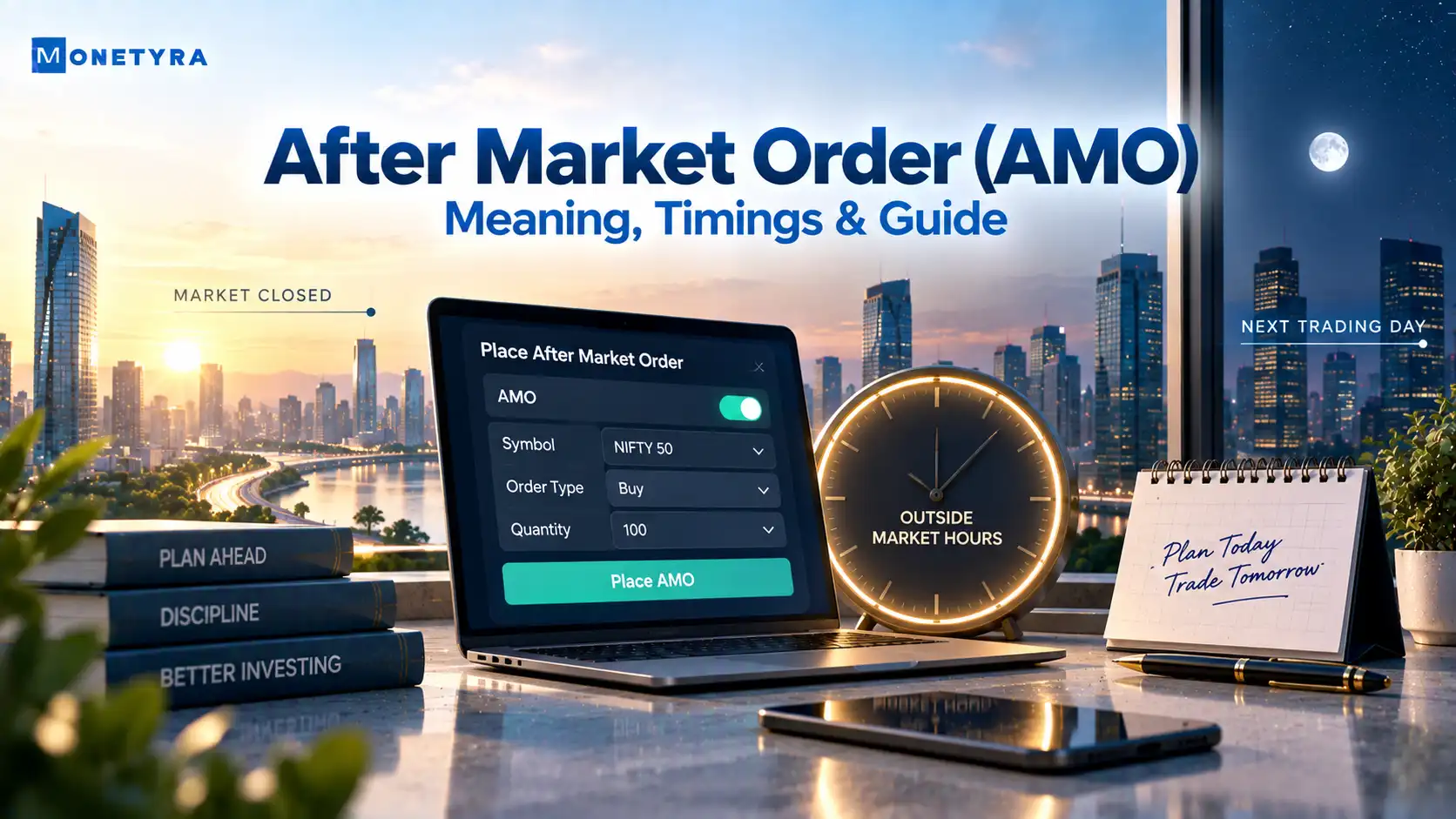
The amo order full form stands for After Market Order. It is a specialized order type provided by stockbrokers in India that lets you place buy or sell orders for equity shares, futures, or options outside standard trading sessions. Regulated under guidelines enforced by the Securities and Exchange Board of India (SEBI), AMOs are held on broker servers overnight and submitted directly to exchange order books before normal continuous trading begins.
When you submit an AMO, your broker validates your trading account margin or holdings. Once verified, the order sits in a pending queue until the exchange opens its pre-market clearing system the following business morning.
Tips: An AMO allows you to plan your trades calmly after work, but it does not guarantee execution at the previous day’s closing price.
Key Rules: Broker Timing Windows and Processing
Knowing after market order timings is essential because brokers enforce distinct submission windows based on asset class and demat authorization status:
| Segment / Asset Class | Broker Acceptance Window (Typical IST) | Exchange Forwarding Window | Execution Session |
|---|---|---|---|
| Equity (NSE & BSE) | 3:45 PM / 4:00 PM – 8:57 AM / 8:59 AM | 9:00 AM – 9:08 AM | Pre-Market / Normal Session |
| Equity Derivatives (F&O) | 3:45 PM / 4:00 PM – 9:10 AM | 9:15 AM (at market open) | Normal Session |
| Currency Derivatives | 5:00 PM – 8:59 AM | 9:00 AM | Normal Session |
| Commodities (MCX) | 11:30 PM – 8:58 AM | 9:00 AM | Normal Session |
For non-POA or non-DDPI demat accounts in India, selling shares via AMO requires performing CDSL or NSDL TPIN authorization before placing the sell instruction.

How After Market Orders Work: Step-by-Step
Understanding after market order meaning involves following how an order moves from your trading app to the exchange matching engine:
- Order Placement: You select the stock, quantity, and order type (Market or Limit) on your trading platform between 4:00 PM and 8:57 AM IST, tagging the order product type as “AMO”.
- Margin Verification: Your broker checks your cash balance for buy orders or blockable shares in your demat account for sell orders.
- Pre-Market Routing: At 9:00 AM IST, the broker’s system bulk-routes equity AMOs into the exchange order book during the 9:00 AM – 9:08 AM order entry window.
- Price Discovery & Execution: The exchange calculates the equilibrium opening price between 9:08 AM and 9:12 AM IST. If your limit price matches the discovered price, your trade executes immediately at 9:15 AM IST.
If an AMO does not match during the pre-market session, it automatically rolls forward into the regular trading session order book as a normal order.
Warning: Avoid placing market AMOs during volatile earnings announcements, as opening gap-ups or gap-downs can execute your order at a far worse price than expected.
Differences: AMO vs. Regular Orders vs. GTT Orders
To select the right execution tool, traders often compare AMOs against regular intraday and Good Till Triggered (GTT) orders:
- Regular Orders: Placed only during live trading hours (9:15 AM – 3:30 PM IST) through standard market order vs limit order choices for immediate market matching.
- After Market Orders (AMO): Placed outside market hours, valid for the immediate next trading day only. Unexecuted AMOs cancel automatically at the end of that day’s 3:30 PM closing session.
- GTT (Good Till Triggered) Orders: Feature multi-month validity (up to 1 year). The order sits dormant on broker servers until your custom trigger price is hit during live trading hours.
Risks and Limitations of Trading with AMOs
While AMOs offer operational convenience, traders must manage several inherent trading risks:
- Overnight Gap Risk: Global market moves or earnings reports published overnight can cause stocks to open significantly higher (gap-up) or lower (gap-down) than the previous day’s close.
- Slippage on Market Orders: Placed as market AMOs, your buy order could execute at the highest opening ask price, leading to substantial execution slippage.
- Modification Windows: AMOs can be modified or cancelled anytime before 8:57 AM IST. However, once the pre-market order entry window locks at 9:08 AM IST, orders cannot be edited until regular trading opens at 9:15 AM IST.
Timing your entries around the official market schedule is closely linked to establishing the Best Intraday Trading Time in India.
Conclusion
Mastering the after market order mechanism provides flexibility for investors who cannot actively trade during live market hours. By placing limit AMOs instead of market orders and managing overnight gap risk, you can execute disciplined trades without disrupting your daily routine. Always evaluate market trends and verify order parameters before submitting off-hours trade requests.
Master equity trading mechanics, order execution types, and exchange timing rules with our practical educational guides.
FAQs
At 9:00 AM IST, your broker forwards the queued equity AMO to the exchange pre-market session. If matched during price discovery, it executes at 9:15 AM IST; if unmatched, it stays active in the order book until filled or cancelled at 3:30 PM IST.
Brokers typically accept equity AMOs from 3:45 PM / 4:00 PM IST until 8:57 AM / 8:59 AM IST the following morning, just before the pre-market session begins.
Yes, equity AMOs submitted before 8:57 AM IST are sent to the exchange order book during the pre-open session (9:00 AM – 9:08 AM IST) and can execute during price matching between 9:08 AM and 9:12 AM IST.
Yes, you can modify or cancel an AMO anytime overnight until the broker cutoff window closes around 8:57 AM IST. Once routed into the pre-open session, modifications pause until regular trading starts at 9:15 AM IST.
The full form of AMO order is After Market Order, a feature allowing trade submissions outside regular stock exchange hours.
Disclaimer: This article was written with the help of AI and reviewed by the Monetyra editorial team. It is for educational purposes only and should not be considered financial advice. Trading and investing in financial instruments involve significant risk of loss and are not suitable for all investors, and past performance of any strategy does not guarantee future results. Please consult a licensed financial advisor before making any investment decision.
In India, equity trading operations are regulated by the Securities and Exchange Board of India (SEBI) and trade execution platforms are hosted across exchanges like the National Stock Exchange (NSE) and Bombay Stock Exchange (BSE). Investors should verify order parameters carefully before committing capital.