Order Block Trading: Identifying Institutional Zones
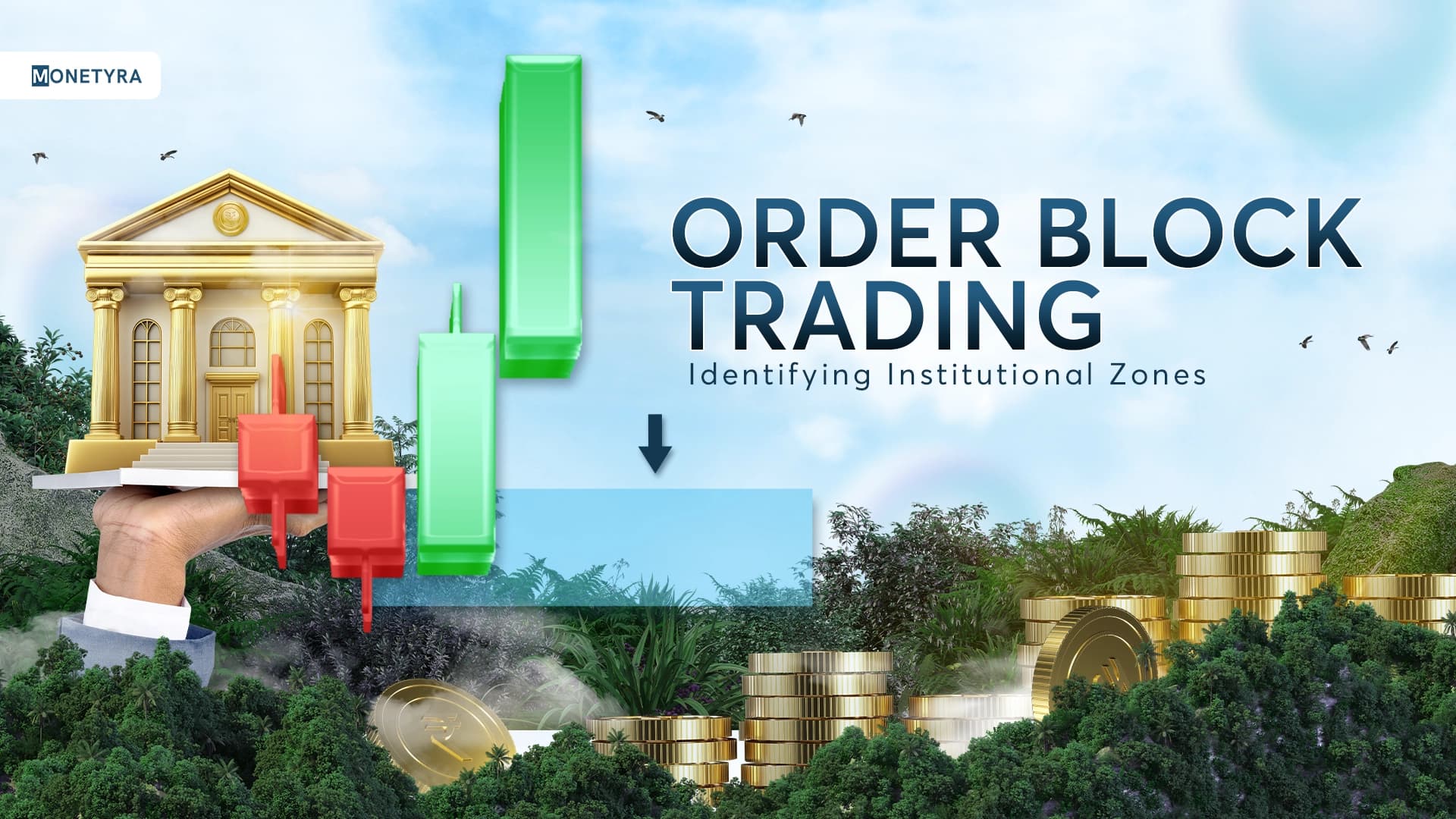
Retail traders often find themselves on the wrong side of a massive price move, wondering why the market suddenly reversed. This happens because large financial institutions, such as central banks and global hedge funds, do not buy or sell like individuals. Instead of placing a single order, they execute massive positions in stages. Order Block trading is a method used to identify these specific price zones where institutional “smart money” has left its footprint, allowing traders to align themselves with the dominant market force.
What Is Order Block Trading Strategy?
Order block trading is a specialized approach that focuses on recognizing that global markets are driven primarily by liquidity and large-scale institutional activity. When a major entity wants to buy a massive amount of an asset, such as a blue-chip stock, a major currency pair, or a global index, they cannot fill the entire order at once without causing an artificial and massive price spike. Instead, they accumulate or distribute their positions within a tight range, creating a block of orders that leaves a permanent mark on the price chart.
The Role of Smart Money in Market Movements
Smart money refers to the highly capitalized players—investment banks, sovereign wealth funds, and institutional investors—who have the power to shift market trends. These entities move the market because of their sheer volume. Unlike retail sentiment, which is often reactive, smart money is proactive. They wait for specific liquidity pools—usually where retail stop-losses are clustered—to execute their trades.
Understanding Institutional Accumulation vs. Distribution
Institutional activity generally falls into two categories across all global exchanges:
- Accumulation: Big players are quietly buying, often after a downtrend, creating a base before a bullish breakout.
- Distribution: Big players are offloading their positions at the top of a trend, preparing the market for a bearish reversal.
How to Identify Valid Order Blocks in Trading

Not every last candle before a move is a valid institutional zone. To filter out the noise, you must look for specific footprints that prove big money was involved in the price action.
Key Criteria for a High-Probability Zone
A valid zone must be followed by a clear, aggressive move away from that price level. This indicates that the buy or sell orders were so significant that they created an immediate imbalance between supply and demand.
Analyzing Price Displacement and Momentum
Displacement serves as the primary indicator of institutional intent. If price slowly drifts away from a candle, it is likely not an institutional footprint. You want to see large, high-momentum candles that leave behind Fair Value Gaps (FVG). This surge confirms that the smart money has committed to a direction.
Identifying the Break in Market Structure (BMS)
A zone is only confirmed once it causes a change in the market’s trend. For a bullish setup, the subsequent move must break a previous swing high (resistance). In a bearish setup, it must break a previous swing low (support).
Warning: Trading a zone that has not resulted in a break in market structure is high-risk, as the previous trend may still be intact.
Different Types of Order Blocks and How They Work
Institutional zones are classified by their behavior and where they appear in a price cycle.
Trend-Following Types
These are the most common setups, occurring when the market is clearly trending in one direction.
- Bullish Type: This is the final bearish (down) candle before a significant move higher. Traders look for prices to eventually return to this candle’s range to pick up remaining buy orders.

- Bearish Type: This is the final bullish (up) candle before a sharp drop. It represents the zone where institutions distributed their holdings.

Structural Variation Types
Sometimes the market structure evolves, changing how a zone is used.
- Breaker Type: This occurs when a bullish zone is broken or violated by a downward move. That zone then flips its role, acting as a ceiling (resistance) for future price tests.

- Rejection Type: These are characterized by long wicks rather than the candle body. A long wick at a high or low suggests that institutions aggressively pushed price back, leaving a massive liquidity void.

The Mechanics of Order Block Analysis
Once a zone is identified, the next step is planning the execution. This is not about chasing the move but waiting for the market to return to the source of the displacement. This retracement is often called a “return to impulse,” where the market seeks to fill the remaining institutional orders left behind during the initial surge.
Theoretical Entry and Exit Frameworks
The most common entry point is the “Open” of the candle that defines the zone. For a bullish setup, this is the opening price of the last down-candle; for a bearish setup, it is the opening price of the last up-candle. By entering here, you ensure you are part of the move as soon as price re-enters the institutional footprint.
Exits are typically defined by the next structural liquidity point. Your primary target should be the swing high or low created by the displacement move itself. This ensures a logical take profit point where other traders might be looking to exit or reverse.
The Concept of the Mean Threshold (50% Level)
Institutions often retest the exact middle of their footprint. Known as the mean threshold, the 50% level of the order block’s body (excluding wicks) acts as a high-probability magnetic zone. Prices frequently pierce the “Open” of the block and deep-dive into this midpoint before reversing sharply.
If price closes beyond the 50% level on a high timeframe, it often signals that the zone is weakening. However, a “wick” into this area followed by a quick rejection is a classic sign of institutional buy/sell programs being triggered.
Standard Risk Management Theory
Since these setups rely on institutional footprints, if price moves entirely through the zone, the setup is invalidated. The low of a bullish block or the high of a bearish block represents the point where the institution’s interest has failed to protect the price.
In regional contexts like the NSE or BSE in India, where volatility can be high during the opening hour (9:15 AM), using a buffer for your stop-loss is essential. Market openers often feature “stop hunts”—sudden, sharp wicks designed to clear out retail orders before the real move begins. A stop-loss placed exactly at the edge of a block is often too vulnerable; adding a small buffer based on the Average True Range (ATR) can protect your position from these local liquidity spikes.
Why Some Order Blocks Fail and How to Avoid Them
Even the best-looking setup can fail if the context is wrong. Successful traders focus on confluence—where the institutional zone aligns with other factors like higher-timeframe trends, Fibonacci retracement levels, or key psychological round numbers.
Beyond looking for external confluence, the internal quality of the zone itself is the primary indicator of whether a setup is likely to hold. By analyzing the freshness of the level and the environment in which it formed, you can filter out weak setups that often lead to unnecessary losses.
Identifying Low-Probability Trade Setups
A zone that forms in the middle of a sideways, choppy market is usually a trap. Smart money footprints are rarest during low-volume periods. Furthermore, if a zone is too small or lacks a strong displacement move, it likely represents retail exhaustion rather than institutional intent.
The Danger of Mitigated Zones
In institutional trading, mitigation refers to the process of institutions closing out or re-balancing their positions. A zone is mitigated once price has returned to it to tap into the remaining orders.
- Fresh Zones: The first time price returns to a block, it is considered “unmitigated” and high-probability. This is where the maximum number of unfilled institutional orders typically reside.
- Mitigated Zones: If price hits a zone for the third or fourth time, the institutional interest is likely exhausted. Every subsequent touch uses up the available liquidity, making the level weaker. Eventually, price will blast through a mitigated zone as it no longer serves as a barrier.
Warning: Relying on a zone that has already been tested multiple times is one of the most common mistakes. Always prioritize fresh zones that haven’t been touched since the initial displacement move.
Conclusion
Mastering the identification of institutional zones allows you to move away from lagging indicators and toward understanding the actual supply and demand dynamics of the global market. By focusing on where the world’s largest banks and funds position themselves, you transition from reactive to proactive trading. While no strategy is foolproof, aligning with institutional footprints provides a significant edge by placing you on the side of true market momentum.
Order blocks are the building blocks of a much larger institutional framework. Understanding how these zones fit into the broader market context of liquidity and structure is what separates consistently profitable traders from the rest. To see how these footprints integrate into the foundational framework of institutional trading, refer back to our guide on SMC in Trading.
Disclaimer
Trading in any financial market involves significant risk. This content is for educational purposes only and does not constitute financial advice. Always consult with a certified advisor before making investment decisions.
FAQs
Order Block trading or OB involves entering a fresh institutional zone that successfully pushes the price to a new high or low. Breaker Block trading or BB occurs when a previous order block is broken; the zone then flips its role, turning from a failed support into a new resistance (or vice versa).
While they appear on all timeframes, higher timeframes like the Daily (D1) or 4-hour (H4) are much more reliable for identifying major institutional moves globally, as they filter out the noise of lower-timeframe volatility.
Traders typically look for price to return to the “Open” of the candle or the 50% Mean Threshold of its body to find potential interest. Rather than entering blindly, many wait for a lower-timeframe confirmation—such as a shift in market structure—to manage risk, though there is no guarantee that price will react to or hold these levels.
Look for the last down-candle before a strong bullish surge or the last up-candle before a sharp bearish drop. A valid block must be followed by high-momentum displacement and a Break in Market Structure (BMS) to prove institutional participation.
In trading, a “missed” trade is better than a forced one; if price does not return to the zone, the orders were likely filled elsewhere or the move was too strong, and you should simply wait for a new setup to form.