Swap Rate in Forex: Beginner’s Guide to Rollover Rates
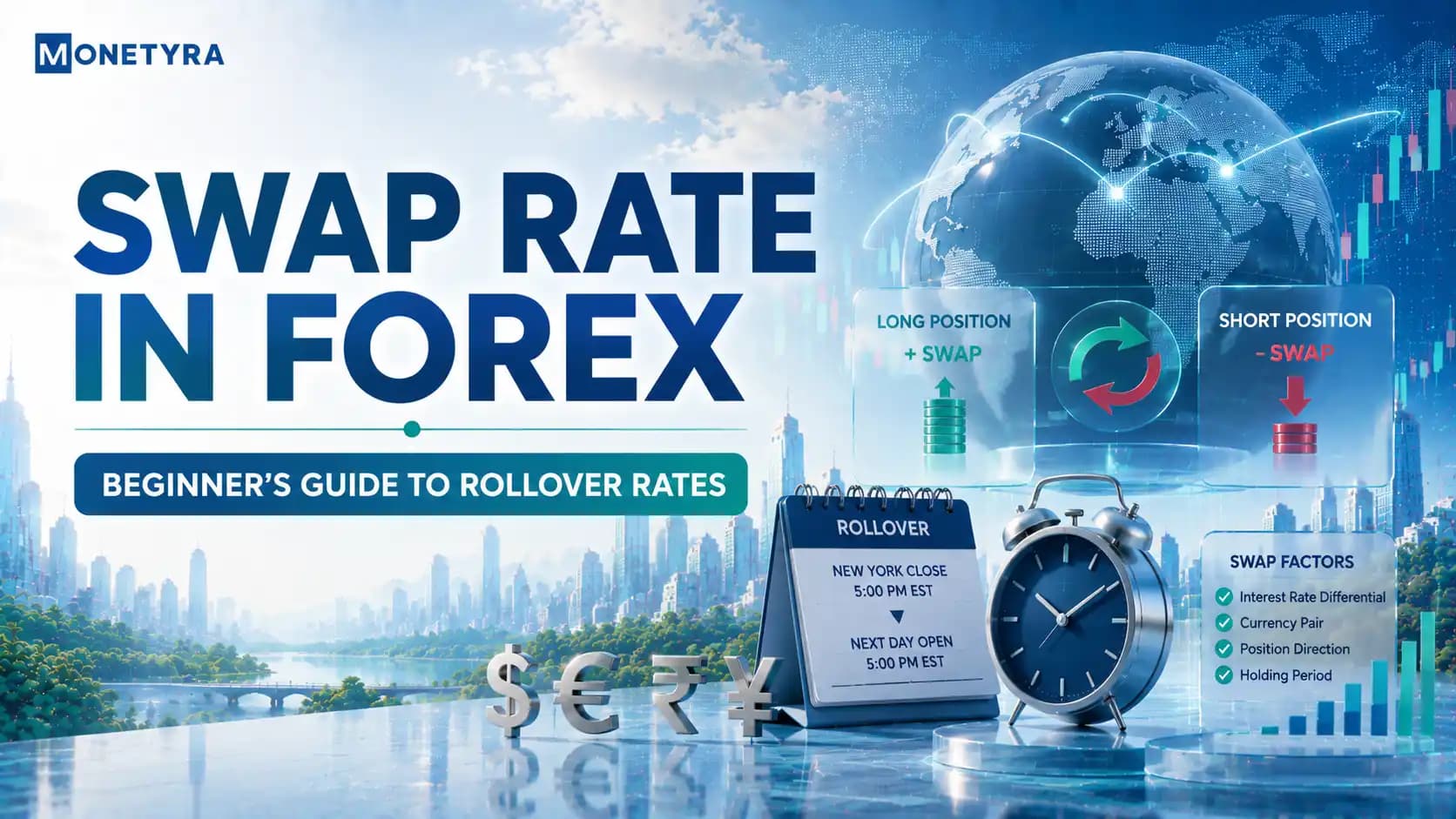
Imagine getting paid daily interest just for holding a forex position—or, conversely, watching small overnight fees eat into your hard-won trading gains. That is the reality of the forex swap rate. Whether you are executing a long-term carry trade strategy or simply swinging a currency pair across multiple sessions, learning how brokers apply daily rollover charges equips you to calculate holding costs accurately and protect your net trading edge.
Quick Takeaways
- A swap rate in forex is the net interest rate fee debited or credited to a trader’s account when holding a currency position overnight past the daily market roll.
- Rollover calculations depend directly on central bank benchmark rates, interest rate differentials between currencies, and broker markups.
- Foreign exchange trading in India is governed by RBI and FEMA guidelines, restricting retail traders to SEBI-regulated exchanges and authorized INR-denominated or cross-currency contracts.
What Is a Swap Rate in Forex?
A swap rate in forex is the net interest rate differential credited or debited when holding a currency position overnight past the market rollover cutoff.
When trading currency pairs, a market participant simultaneously buys one currency and sells another. Every currency carries an underlying overnight interest rate set by its issuing central bank. Depending on whether a trader holds a Long And Short Position In Trading, holding a position overnight requires borrowing the sold currency to finance the bought currency.
Understanding how the Base Currency And Quote Currency interact is essential for calculating daily financing costs:
- Base Currency: The first currency listed in a currency pair, which is bought in a long position.
- Quote Currency: The second currency listed in a currency pair, used as the pricing reference.
Tips: Position traders holding trades for days or weeks must factor daily swap charges into their trade planning, as negative swaps add to total execution costs.
How Swap Rates Are Calculated
The daily rollover fee depends on the Currency Correlation and interest rate differential between the two national central banks.
Central banks—such as the Reserve Bank of India (RBI) or the US Federal Reserve—set monetary policy rates. Brokers use these policy benchmarks plus an administrative financing markup to compute the final swap value.
Swap = (Lot Size × Contract Size × (Base Rate – Quote Rate – Broker Markup) ÷ 365) × Exchange Rate
| Currency Pair Position | Interest Rate Dynamics | Swap Type | Impact on Trading Account |
|---|---|---|---|
| Long High-Yield / Short Low-Yield | Base interest rate is higher than quote rate | Positive Swap | Account receives daily interest credit |
| Long Low-Yield / Short High-Yield | Base interest rate is lower than quote rate | Negative Swap | Account pays daily interest debit |
| Equal Rate Pair (after markup) | Base and quote rates are nearly identical | Negative Swap | Small daily debit due to broker financing spread |

Rollover Timing and Triple Swap Wednesday
In global OTC currency markets, daily rollover occurs at the end of the New York trading session (5:00 PM EST, which corresponds to 3:30 AM IST during standard time).
A key concept in overnight financing is Triple Swap Wednesday:
- T+2 Settlement Rule: Spot forex trades settle on a two-day settlement cycle ($T+2$).
- Weekend Adjustment: Trades held open past 5:00 PM EST on Wednesday roll over past the weekend, resulting in three days’ worth of interest debited or credited in a single session.
Warning: Holding unhedged positions across Wednesday rollover without accounting for triple swap fees can cause unexpected account drawdowns.
Indian Regulatory Context: RBI and FEMA Rules
Retail market participants in India must evaluate currency trading mechanisms within the legal framework established by the Securities and Exchange Board of India (SEBI) and the Foreign Exchange Management Act (FEMA).
On Indian exchanges such as the National Stock Exchange (NSE), currency trading operates via exchange-traded futures and options (ETCDs) rather than OTC spot contracts:
- Exchange Futures Expiry: Domestic currency futures resolve through monthly settlement prices, meaning retail traders pay futures spreads rather than daily spot swap rates.
- FEMA Restrictions: Indian residents are prohibited under FEMA from sending funds overseas via the Liberalised Remittance Scheme (LRS) to trade on unregulated OTC foreign exchange platforms offering spot swaps.
How Swap Rates Impact Overnight Risk
Overnight holding costs directly affect long-term trading outcomes. A high leverage ratio meaning amplifies both exchange rate volatility and daily swap debits.
- Carry Trade Risks: Attempting to capture positive swap rates by buying high-yielding currencies carries exchange rate risk. Adverse price movements in the underlying exchange rate can quickly outweigh accrued interest gains.
- Negative Swap Accumulation: Keeping losing positions open over long periods causes negative swaps to steadily erode trading capital.
How to Evaluate a Course for Trading for Beginners
When evaluating a structured course for trading for beginners, retail learners should verify that the curriculum addresses realistic operational costs.
A comprehensive course must cover:
- Calculation Mechanics: How central bank policy rates, broker markups, and lot sizes shape rollover fees.
- Regulatory Compliance: Clear distinction between domestic exchange-traded currency contracts and illegal offshore spot platforms.
- Risk Management Rules: Implementing stop-loss discipline and evaluating total carrying costs before entering multi-day positions.
Swap-Free Accounts and Special Conditions
Certain traders utilize Swap-Free accounts (often structured as Islamic accounts) to comply with religious principles prohibiting interest payments.
| Feature | Standard Forex Account | Swap-Free (Islamic) Account |
|---|---|---|
| Overnight Financing | Variable interest swap (credit or debit) | Zero interest swap charged or earned |
| Holding Cost Structure | Based on central bank interest rate differentials | Fixed administration fee after holding past threshold |
| Eligibility | Open to all retail traders | Requires religious account verification |
Conclusion
Understanding how a swap rate in forex works allows market participants to account for overnight carrying costs, central bank policy shifts, and market rollover mechanics. By prioritizing risk management and adhering to Indian exchange regulations, retail traders can evaluate positions with realistic expectations.
Master currency pair mechanics, interest rate differentials, and SEBI regulatory guidelines tailored for Indian retail markets.
FAQs
A forex swap rate is the net interest fee credited or debited to a trader’s account when a position is held overnight past the daily market rollover.
It is calculated using the interest rate differential between the two currencies in the pair, adjusted for contract size, lot size, and broker administrative markups.
A positive swap earns daily interest credit when buying a higher-yielding currency, while a negative swap debits interest when holding a lower-yielding currency relative to the sold currency.
Because spot forex transactions operate on a $T+2$ settlement convention, holding positions past Wednesday rollover covers the interest for Wednesday, Saturday, and Sunday.
Indian residents trading authorized currency derivatives on SEBI-regulated domestic exchanges (NSE/BSE) deal with futures spreads rather than spot swaps. Trading spot forex on unregulated offshore platforms is restricted under FEMA and RBI guidelines.
A thorough beginner course should teach rollover mechanics, central bank policy impacts, triple swap timing, and risk management guidelines for multi-day positions.
Disclaimer: This article was written with the help of AI and reviewed by the Monetyra editorial team. It is for educational purposes only and should not be considered financial advice. Trading and investing in financial instruments involve significant risk of loss and are not suitable for all investors, and past performance of any strategy does not guarantee future results. Please consult a licensed financial advisor before making any investment or trading decision.
In India, currency trading is regulated by the Securities and Exchange Board of India (SEBI) and the Reserve Bank of India (RBI) under FEMA provisions. Readers are advised to trade only authorized currency contracts on regulated domestic exchanges.