Basant Maheshwari: Portfolio, Net Worth, and Strategy
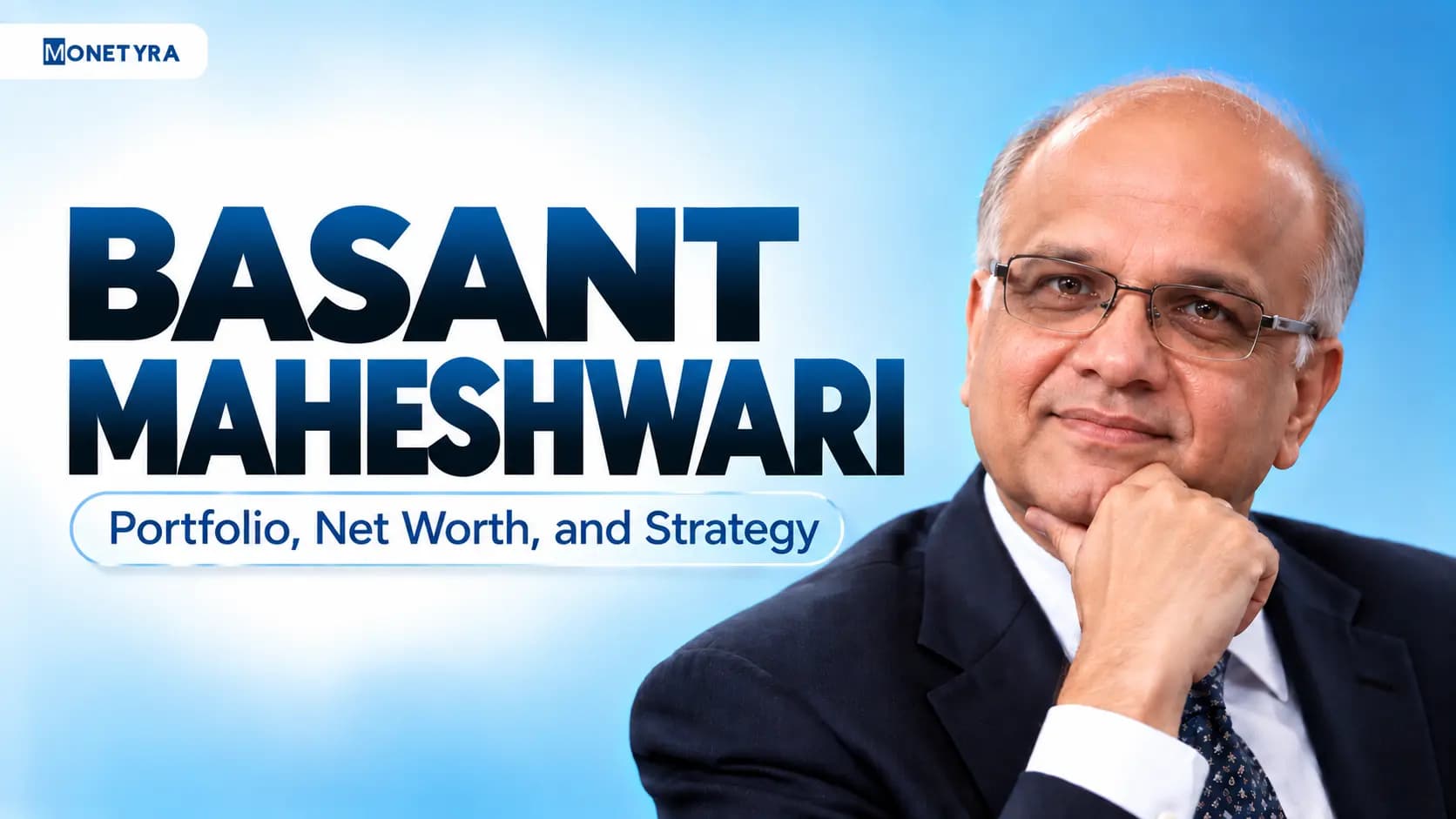
Equity investing in India often splits into two camps: deep-value bargain hunters and high-growth compounding advocates. Basant Maheshwari is a well-known voice in the second camp. He is a full-time equity investor, an author, and a portfolio manager registered with the Securities and Exchange Board of India (SEBI). He built his reputation by picking early consumer and financial companies that grew for many years. Instead of hunting for cheap, beaten-down stocks, he looks for market leaders with high return on equity (ROE), pricing power, and transparent governance.
Quick Takeaways
- High-ROE growth focus: Basant Maheshwari invests in companies with predictable, consistent earnings and above-average earnings growth, according to his firm’s profile. High ROE is a common feature of such companies.
- Concentrated portfolios: His smallcase BM Vision 2030 launched with 10 to 12 stocks, according to Maheshwari. Other baskets differ in size and market-cap range.
- Multiple-contraction risk: High-valuation growth portfolios can fall sharply when liquidity tightens, so you need a clear exit rule if earnings growth slows.
Who Is Basant Maheshwari?

- Current Position: Co-founder and Partner at Basant Maheshwari Wealth Advisers Limited Liability Partnership (LLP), holding SEBI registrations as a Portfolio Manager (INP000004946), Investment Adviser (INA000018498), and Research Analyst (INH000017949).
- Estimated Net Worth: Basant Maheshwari net worth estimates range from about ₹1,500 crore to ₹2,565 crore (2024), based mainly on shareholdings he has disclosed. These are not official figures and change with market prices. (1 crore = 10 million.)
- Core Market Focus: Listed Indian equities on the National Stock Exchange (NSE) and the Bombay Stock Exchange (BSE), mainly large and mid-cap growth companies.
- Literary Contribution: The Thoughtful Investor
Image source: theequitydesk.com
A great company is not a great investment if you pay too much for it, but a high-growth company with a high ROE can outgrow a high P/E multiple faster than the market expects.
History
Basant Maheshwari studied commerce at St. Xavier’s College in Kolkata and qualified as a Cost Accountant through the Institute of Cost and Works Accountants of India (ICWAI). He turned to the Indian stock market in the late 1990s with modest capital.
He then focused on fundamental equity analysis during a period of rapid change for Indian industry. He studied past bull and bear cycles to build a framework for picking high-growth companies before institutional money arrived.
Achievement
Maheshwari gained recognition among Indian investors through several multibagger stocks during the economic expansion after 2003. His early calls on modern retail, branded apparel, and housing finance came before these sectors became index heavyweights.
In February 2016, he co-founded Basant Maheshwari Wealth Advisers LLP, which offers Portfolio Management Services (PMS) under Securities and Exchange Board of India (SEBI) regulations. It added smallcase model portfolios for retail investors in 2022.
Core Investment Philosophy: High ROE and Earnings Momentum
Maheshwari’s approach differs from traditional deep-value investing. His firm describes it as investing in companies with predictable and consistent earnings that can typically generate above-average earnings growth over longer periods. The thresholds below are illustrative examples of how growth investors think, not figures Maheshwari has published. Understanding these criteria can help you see why growth investors accept paying a premium for market leaders.
- Return on Equity (ROE) as a quality check: Growth investors often look for ROE well above the cost of capital, because it suggests a company can fund growth without issuing much new equity.
- Pricing power and gross margins: Growth investors look for companies that can pass on raw material inflation to consumers without hurting demand or losing market share.
- Demystifying high P/E multiples: Growth investors argue that a high price-to-earnings (PE) ratio can fall quickly if earnings per share (EPS) compound fast. This only works if growth actually continues. To see how the ratio works, read our guide PE Ratio Meaning & Formula.
- Secular megatrends over cyclical turnarounds: Growth strategies like this one usually favor long-term domestic consumption, private banking, and branded goods over deep cyclical commodities, though holdings change over time.
Unlike traditional value investors who wait for market cycles to re-rate unloved assets—a topic explored in What Is Contrarian Investing? Strategic Portfolio Framework—Maheshwari focuses on businesses that can drive their own growth. His growth-led approach differs from classic bargain-hunting styles.
Tips: Look for operating leverage, where revenue grows faster than operating costs, so net profit margins can expand even in inflationary periods.
Basant Maheshwari Portfolio: Historical Multibaggers & Sector Allocation
The historical Basant Maheshwari portfolio is concentrated rather than index-like. BM Vision 2030 launched with 10 to 12 stocks, according to Maheshwari. Third-party trackers such as Altius Investech counted 32 stocks in his disclosed shareholdings in December 2024, so holdings vary by vehicle and date.
Below is an analytical breakdown of prominent historical case studies and themes associated with his public investment journey:
| Company / Theme | Sector / Industry | Core Thesis | Primary Drivers Observed |
|---|---|---|---|
| Pantaloon Retail (Historical) | Organized Retail | Early-stage organized retail penetration in urban India | Large sales square-footage expansion during the 2003–2007 economic boom |
| Page Industries (Historical) | Consumer Branded Apparel | Exclusive licensing of the Jockey innerwear brand in India | Negative working capital, high ROE, and a wide retail distribution network |
| Titan Company (Historical) | Branded Consumer Discretionary | Formalization of the unorganized retail jewelry and watch market | Brand trust, fast store footprint growth, and gold-on-lease capital efficiency |
| Housing Finance & Private Non-Banking Financial Companies (NBFCs) | Retail Credit & Financials | Expanding formal home-loan demand across tier-2 and tier-3 cities | Low non-performing assets, stable net interest margins, and secular retail credit growth |
A concentrated portfolio works both ways. If one core holding breaks down unexpectedly, it can move the whole portfolio sharply.
Warning: If you put 50% or more of your portfolio into three or four consumer or lending stocks, you become exposed to sector-specific rule changes and sharp demand slowdowns.
Basant Maheshwari Smallcase Strategies & PMS Models
SEBI sets a ₹50 lakh (₹5 million) minimum for Portfolio Management Services. Retail investors who want model portfolios with a lower minimum can use smallcase, a platform where Basant Maheshwari Wealth Advisers LLP introduced portfolios in 2022. (1 lakh = 100,000.)
- Available baskets: According to smallcase and third-party reviews, the baskets include BM Vision 2030, BM Nifty Top 20, BM Top 10, BM Focused Small Cap, and BM Horizon Hunters.
- Check each basket: Stock count, market-cap range, and liquidity differ between baskets, so check them before you subscribe.
- Model rebalancing: Subscribers receive periodic digital rebalancing updates to adjust stock weights or replace holdings.
- Direct account ownership: Unlike mutual funds or pooled PMS vehicles, smallcase subscribers retain full legal ownership of the underlying equities directly in their own demat accounts.
These products widen access to professional research, but you remain responsible for executing updates. Delayed rebalancing can cause your results to differ from the model portfolio.
Growth Investing vs Downside Risks: Lessons for Retail Investors
Studying Maheshwari’s career shows how wealth can be built, but it also shows how hard it is to manage a high-growth, high-multiple portfolio in bear markets.
- The danger of multiple compression: High-PE growth stocks need steady quarterly results. Suppose a company trading at 60 times earnings sees profit growth fall from 30% to 10%. Its stock can take a double hit from lower earnings and a lower valuation multiple.
- Navigating cyclical drawdowns: Portfolios of high-beta growth stocks can fall a lot during liquidity crunches or interest rate hikes. Understanding metrics like Maximum Drawdown can help you protect capital during long corrections.
- Exit discipline: Growth investors commonly sell when earnings slow structurally or governance deteriorates, so you need a clear exit rule before you buy.
- Capital suitability: Growth strategies often need an investment horizon of 5 to 7 years or more. Investors who cannot accept temporary drawdowns of 30% to 40% may panic-sell at market lows.
Monetyra’s Take: Basant Maheshwari’s high-ROE growth approach is a framework many growth investors follow, but it is not a guaranteed path. A 2026 review by Learn Stock Market showed that ₹1 crore in his PMS grew to about ₹1.85 crore over five years, versus about ₹2.17 crore for the Nifty 50. Retail investors also need the stamina to hold concentrated, high-multiple stocks through sharp corrections, and pairing growth allocations with conservative assets can help those who cannot tolerate large drawdowns.
Conclusion
Basant Maheshwari has become a well-known voice in Indian retail investing by promoting high-ROE, pricing-power businesses. His writing, PMS, and smallcase portfolios point investors toward market leaders rather than speculative penny stocks.
This approach demands close attention. If you pay premium valuations, you need to monitor quarterly earnings momentum and capital efficiency, and sell when the fundamental thesis breaks down.
Master the investing frameworks of India’s top market minds.
FAQs
Basant Maheshwari is an Indian equity investor, author of The Thoughtful Investor, and partner at Basant Maheshwari Wealth Advisers LLP. He is known for his high-ROE, growth-oriented approach to equity investing.
Third-party sites estimate the Basant Maheshwari net worth at about ₹1,500 crore to ₹2,565 crore (2024), based mainly on his disclosed shareholdings. These are not official figures, and they change with market prices.
His prominent stock picks, according to his firm’s profile, have included Pantaloon Retail, Page Industries, Titan, Hawkins Cooker, Gruh Finance, Repco Home Finance, Canfin Homes, Bajaj Finance, and Avenue Supermarts. These are historical case studies, not recommendations.
The Basant Maheshwari smallcase baskets, such as BM Vision 2030, offer retail investors model equity portfolios. BM Vision 2030 launched with 10 to 12 stocks, according to Maheshwari, and baskets differ in size and market-cap range, so check each one before you subscribe.
He authored The Thoughtful Investor. The book describes his journey as a small investor and his approach to stock market investing.
Disclaimer: This article was written with the help of AI and reviewed by the Monetyra editorial team. It is for educational purposes only and should not be considered financial advice. All mentions of specific companies, historical stock selections, and portfolio allocations are provided strictly as historical case studies and do not constitute recommendations to buy or sell any security. Trading and investing in financial instruments involve significant risk of loss, and past performance of any fund manager or investment strategy does not guarantee future results. Please consult a SEBI-registered financial advisor before making any investment decisions.
In India, investment advisory and portfolio management activities are regulated by the Securities and Exchange Board of India (SEBI). Readers are advised to verify the regulatory status of any investment adviser or portfolio manager on the official SEBI intermediary portal before committing capital.