Jack Bogle: The Man Who Made Low-Cost Investing Possible
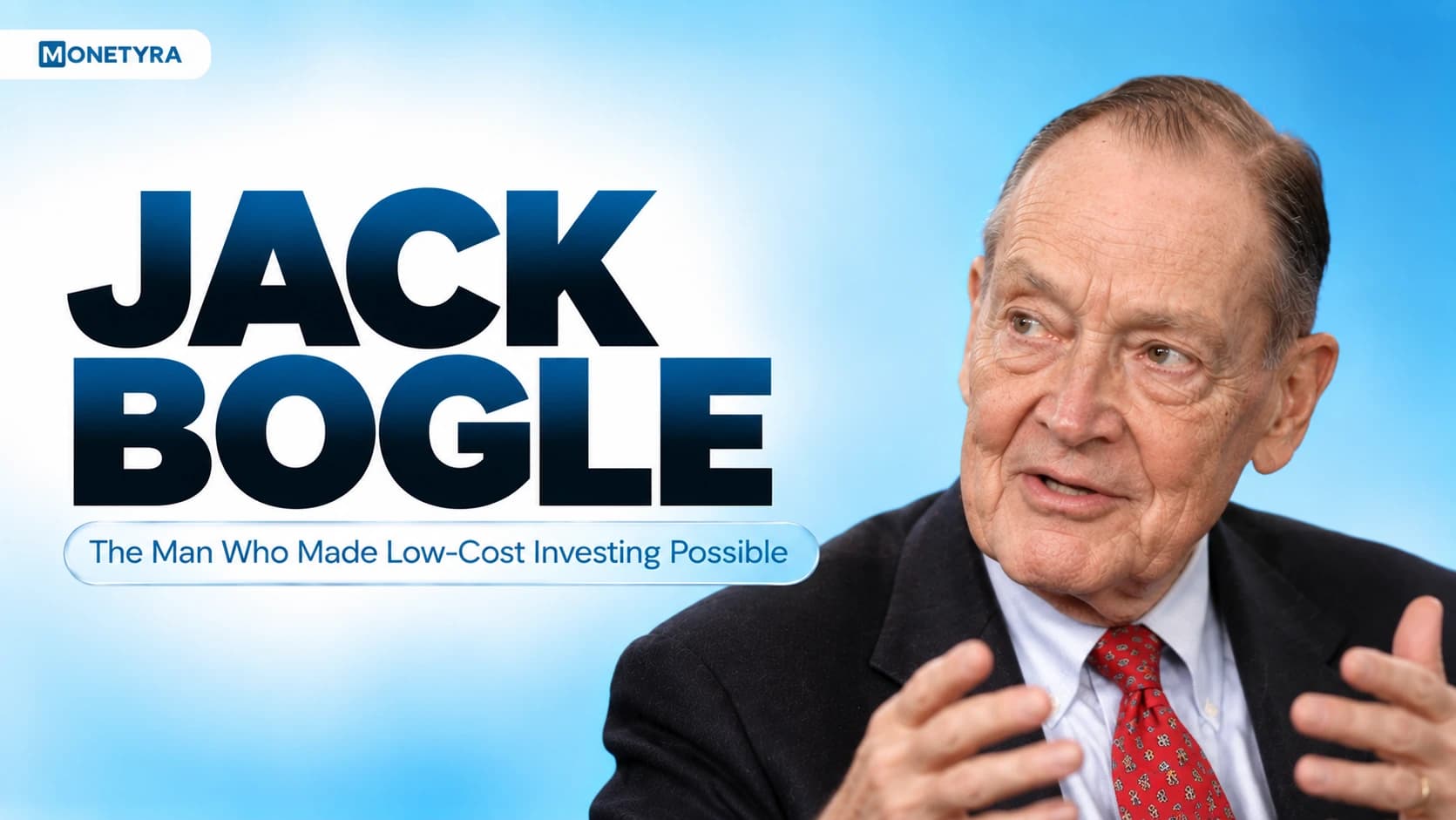
For decades, the financial industry convinced everyday investors that beating the market required expensive managers, complex algorithms, and steep fees. Jack Bogle dismantled this model by showing that fees compound just like returns—only in reverse, actively eroding investor wealth. By pioneering the world’s first retail index mutual fund and structuring his firm as a client-owned cooperative, Bogle shifted hundreds of billions of dollars from Wall Street balance sheets directly back into the pockets of everyday savers.
Quick Takeaways
- Jack Bogle democratized global wealth building by creating the first index mutual fund, advocating for low-cost, broad-market equity ownership over active stock picking.
- Fund expenses, advisory commissions, and transaction friction compound negatively over time, creating a substantial drag on terminal portfolio wealth.
- Broad-market indexing does not shield capital from market downturns. Passive investors must tolerate equity volatility without attempting to time market cycles.
Who Is Jack Bogle?

- Full Name: John Clifton Jack Bogle
- Lifetime: May 8, 1929 – January 16, 2019
- Final Position: President of the Bogle Financial Markets Research Center
- Estimated Net Worth: Approximately $80 million at the time of his death —a modest sum compared to contemporary Wall Street executives
- Key Contribution: Created the first index mutual fund available to individual retail investors and pioneered the at-cost mutual ownership structure for asset management
Image source: Fortune.com
Don’t look for the needle in the haystack. Just buy the haystack — Jack Bogle
History
Bogle’s focus on fund structures began at Princeton University. His 1951 senior thesis argued funds should prioritize low costs over management profits. He joined Wellington Management after graduation and eventually rose to chief executive. A disastrous corporate merger led to his firing in 1974.
Instead of leaving finance, Bogle approached the fund board directly. He persuaded them to separate from the management company. This move created a new, independent firm named The Vanguard Group.
Achievement
In 1975, Bogle revolutionized retail finance by launching the First Index Investment Trust (now the Vanguard 500 Index Fund), tracking the S&P 500 index with initial assets of just $11 million. Wall Street competitors dismissed the initiative as un-American and labeled it “Bogle’s Folly,” arguing that settling for average market returns was fundamentally flawed.
Over the following four decades, Bogle’s relentless crusade against excessive fund management fees expanded Vanguard into an asset management powerhouse overseeing more than $8 trillion in assets under management (AUM) as of 2026, permanently lowering expense ratios across the global fund industry.
The Mutual Structure: Eliminating Wall Street’s Profit Margin
Traditional asset management companies operate under an inherent structural conflict of interest. A conventional asset manager is owned either by private partners or public stockholders who demand quarterly earnings growth and rising profit margins. Because an asset manager earns revenue by charging management fees on client assets, maximizing shareholder profit naturally means charging investors as much as the market will tolerate.
Bogle resolved this conflict by structuring Vanguard as a mutual organization. Under this model, the Vanguard mutual funds own the management company itself, and the individual fund investors own the funds.
Because there are no external corporate stockholders demanding a dividend, Vanguard operates on an at-cost basis. When fund operational efficiencies increase or total assets under management scale up, the savings are returned directly to fund unit holders in the form of lower expense ratios. This structural alignment allowed Vanguard to steadily drive index fund expense ratios down toward near-zero levels.
The Arithmetic of Compounding: Why Costs Matter Most
Bogle articulated the mathematical reality of long-term investing through what he termed the Cost Matters Hypothesis. In any asset class, the gross return of the aggregate market equals the weighted average return of all participants combined. Before deducting investment costs, active and passive investors collectively earn the market return. After deducting advisory fees, transaction commissions, distribution loads, and management expenses, the average actively managed fund must mathematically underperform the broad market index.
The true damage of fund fees is obscured by annual percentage reporting. A 1.5% annual fee sounds minor in isolation, but compounded across an investment horizon of two to three decades, it confiscates a substantial portion of the investor’s potential wealth.
To see how fees alter outcomes over time, consider an Indian retail investor contributing ₹10,000 per month via a Systematic Investment Plan (SIP) over a 20-year period, assuming a gross nominal equity market return of 12.00% per annum.
The Compound Drag of Fund Expense Ratios (20-Year SIP)
| Parameter | Low-Cost Direct Index Fund | Typical Active Regular Fund | Net Impact / Drag |
|---|---|---|---|
| Monthly SIP Outflow | ₹10,000 | ₹10,000 | ₹0 |
| Total Invested Principal | ₹24,00,000 | ₹24,00,000 | ₹0 |
| Gross Annual Market Return | 12.00% | 12.00% | 0.00% |
| Total Expense Ratio (TER) | 0.15% | 1.85% | 1.70% fee differential |
| Net Annualized Return | 11.85% | 10.15% | -1.70% net performance drag |
| Estimated Terminal Corpus | ₹96,89,742 | ₹78,65,491 | -₹18,24,251 lost to fees |
Note: Compounded future values are calculated based on monthly compounding over 240 months. Figures are illustrative and exclude taxes and platform charges.
In this example, an apparently modest 1.70% fee difference strips more than ₹18.24 lakh away from the investor’s final portfolio. Investment returns are never guaranteed and fluctuate with macroeconomic cycles, but the expense ratio is deducted from fund Net Asset Value (NAV) daily regardless of whether the market finishes in positive or negative territory.
Core Tenets of the Bogleheads Investment Philosophy
The grassroots movement inspired by Bogle’s writings—known globally as the Bogleheads—codified his strategy into a rules-based framework for individual wealth accumulation.
- Develop a workable financial plan: Establish realistic savings targets and design a disciplined asset allocation combining equities for long-term purchasing power expansion and fixed income for capital stability.
- Diversify across the total market: Rather than attempting to identify individual winning stocks or top-performing sector themes, hold broad market capitalization-weighted index funds that capture aggregate corporate earnings.
- Minimize all structural costs: Select fund direct plans with the lowest available total expense ratios, minimize portfolio turnover to control internal brokerage commissions, and avoid speculative short-term trading.
- Maintain long-term course: Market volatility, macroeconomic downturns, and media headlines frequently provoke emotional buying and selling. Successful indexing demands enduring deep market corrections without attempting tactical market timing.
Warning: Attempting to switch into cash during market corrections introduces the dual friction of exit penalties and missed recovery days, which historically degrades long-term compounding.
Applying Jack Bogle’s Philosophy to the Indian Market
While Bogle built his philosophy around the US financial system, his mathematical principles apply directly to Dalal Street. The Indian asset management industry operates under regulatory guidelines defined by the Securities and Exchange Board of India (SEBI) and monitored by the Association of Mutual Funds in India (AMFI).
Indian mutual funds offer Regular Plans, which carry higher Total Expense Ratios (TER) to fund distributor commissions, and Direct Plans, which eliminate these commissions to lower the TER for the identical underlying portfolio. Choosing a Direct Plan directly reflects Bogle’s principle of removing costly financial intermediaries.
S&P Dow Jones SPIVA India scorecards demonstrate that most actively managed large-cap mutual funds fail to beat their benchmark indices over 5- and 10-year rolling periods after factoring in management fees. Consequently, allocating to a Nifty 50 Index Fund direct plan provides transparent, low-cost domestic equity exposure to India’s 50 largest corporate enterprises.
What to Look for in Indian Index Fund
When selecting an Indian index fund or ETF, investors must examine two critical variables:
- Total Expense Ratio (TER): Seek the lowest direct-plan fee structure available across competing fund houses.
- Tracking error and tracking difference: A fund may charge a low TER but still deviate from the index due to poor cash management or execution lag. Evaluating Tracking Error Meaning ensures that the fund house replicates benchmark returns with minimal slippage.
Investors evaluating options in the market can review our analysis on the Best Index Fund in India to compare low-cost fund houses across TER and historical tracking metrics. Understanding the baseline differences across the Types of Mutual Funds in India enables you to construct a portfolio grounded in mathematical realism.
Monetyra’s Take: Jack Bogle did not build his legacy by inventing complex trading strategies or forecasting market cycles. Instead, he forced the global investment community to confront a basic truth: in finance, you get what you do not pay for. By pairing low-cost market indexing with patient, long-term discipline, retail investors can eliminate the structural drag of distribution fees and retain their rightful share of financial market returns.
Conclusion
Jack Bogle re-engineered collective wealth accumulation by resolving the structural conflict of interest between asset managers and fund unit holders. By pioneering an at-cost corporate model and establishing broad-market indexing, he replaced expensive, underperforming active management with transparent market beta. Ultimately, his framework proves that enduring financial independence requires neither market forecasting nor costly intermediation—only broad diversification, rigorous fee reduction, and the discipline to let market returns compound uninterrupted.
Master fund mechanics, fee structures, and disciplined portfolio building with the pioneers who shaped modern markets.
FAQs
He is an American investor, author, and founder of The Vanguard Group, known for creating the first retail index mutual fund in 1975, which allowed individual investors to purchase a broad market basket of equities at exceptionally low management fees.
Bogle advocated passive, long-term indexing: holding low-cost, broadly diversified stock and bond index funds, rebalancing periodically, minimizing turnover to cut tax friction, and avoiding emotional market timing during downturns.
When Jack Bogle passed away in 2019, his net worth was roughly $80 million—kept modest because he organized Vanguard as a client-owned mutual firm instead of accumulating personal equity.
Because active managers collectively trail the market, Bogle built buy-and-hold index funds to cut research and transaction costs, passing gross market returns directly to investors.
The Bogleheads philosophy centers on early, regular investing across low-cost, diversified index funds while maintaining asset allocation and discipline through market cycles.
Indian investors can apply Bogle’s framework by choosing commission-free direct plans of broad-market index funds—like Nifty 50 or Nifty LargeMidcap 250—while screening for low Total Expense Ratios and minimal tracking error.
Disclaimer: This article was written with the help of AI and reviewed by Monetyra. It is for educational purposes only and should not be considered financial advice. Trading and investing in financial instruments involve significant risk of loss and are not suitable for all investors. Past performance and illustrative return assumptions do not guarantee future results. Please consult a licensed financial advisor before making any investment decision.
In India, mutual fund schemes are regulated by SEBI and governed by circulars issued by SEBI and AMFI. Readers are advised to verify the regulatory status and offer documents of their fund house, including the Scheme Information Document (SID) and Key Information Memorandum (KIM), before committing capital.