John Templeton: Contrarian Investing and Market Lessons
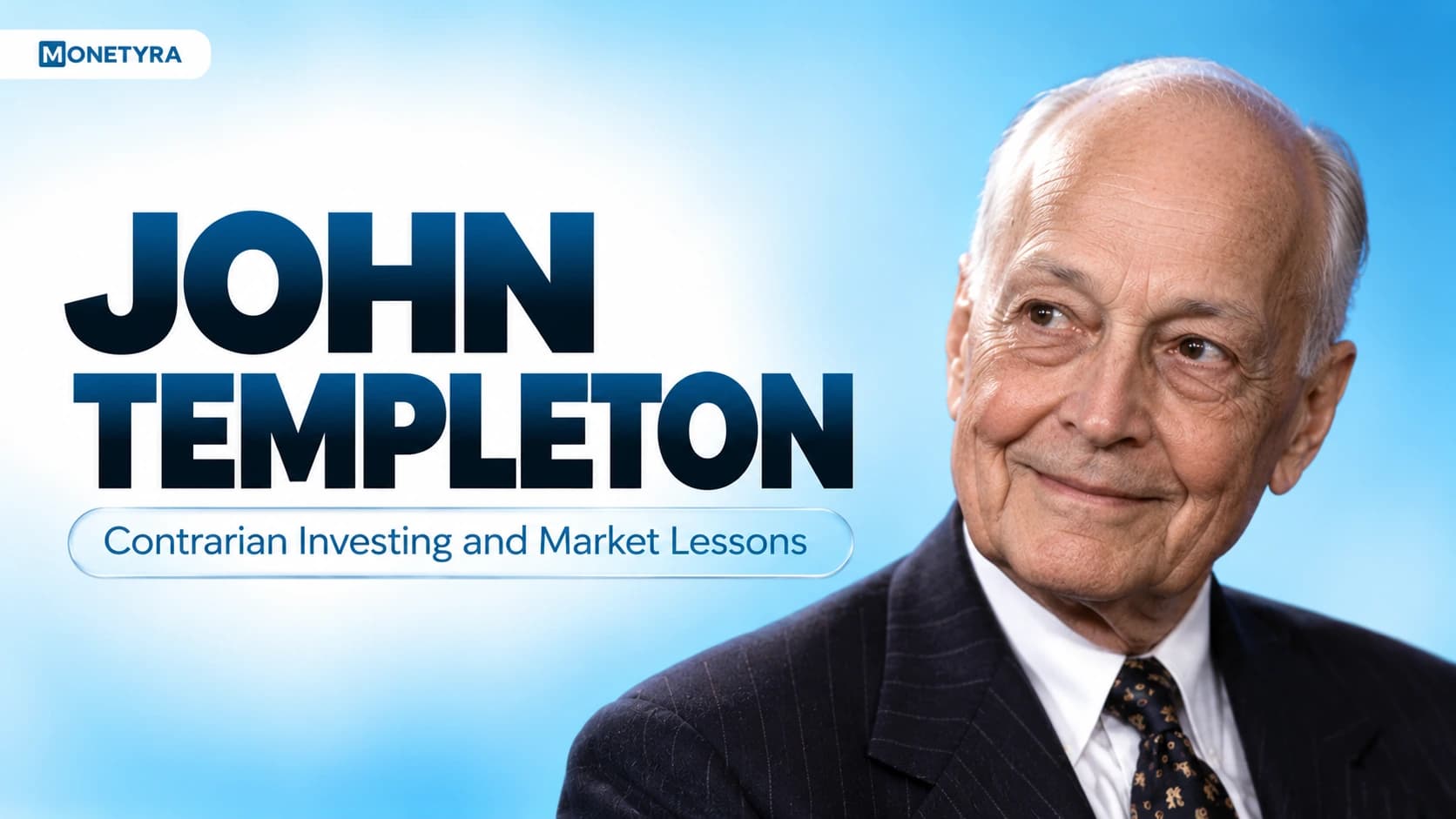
Mastering financial markets requires maintaining emotional detachment when public sentiment reaches extremes. Before modern quantitative hedge funds mapped institutional capital flows, John Templeton played an important role in transforming portfolio management. He searched globally for assets suffering from unjustified neglect. Rather than following consensus forecasts, he treated market panics as capital misallocation events, systematically buying high-quality businesses when despair pushed valuations far below replacement cost.
For modern market participants, studying his disciplined philosophy provides a practical anchor for navigating severe market drawdowns, currency volatility, and cyclical corrections.
Quick Takeaways
- Sir John Templeton pioneered globally diversified mutual funds, operating the Templeton Growth Fund from 1954 to 1992 with an annualized return exceeding 14.5%.
- His central framework centered on buying at the “point of maximum pessimism,” purchasing fundamentally viable businesses when institutional forced selling drove prices to multi-year discounts.
- Contrarian bargain hunting requires enduring severe drawdown periods, substantial liquidity risk, and the discipline to avoid structural value traps.
Who Is John Templeton?

- Net Worth at Peak / Death: Approximately $1 billion before the majority of his personal fortune was transferred into charitable endowments and philanthropic trusts prior to his passing in 2008.
- Historic Career Position: Founder of Templeton Growth Fund (1954), Chairman of Templeton Funds, pioneer of global emerging-market investing, philanthropist, and early Chartered Financial Analyst (CFA) charterholder.
- Core Specialization: Global contrarian value investing, macroeconomic cycle analysis, and deep bargain hunting.
Image source: Templeton.org
The time of maximum pessimism is the best time to buy, and the time of maximum optimism is the best time to sell. — John Templeton
History
Born in 1912 in Winchester, Tennessee, John Marks Templeton experienced the brutal economic contraction of the Great Depression firsthand. He funded his education at Yale University through academic excellence and poker earnings, graduating top of his class before studying law at Balliol College, Oxford, as a Rhodes Scholar.
His entry onto Wall Street in 1937 was marked by intense analytical frugality. In 1939, as World War II erupted in Europe, Templeton executed his signature early trade: borrowing $10,000 to purchase 100 shares in every company listed on the New York Stock Exchange trading at $1 or less per share. Across 104 companies—37 of which were officially bankrupt—only four proved worthless, allowing him to quadruple his capital as war industrialization rebounded corporate earnings.
Achievement
Templeton established the Templeton Growth Fund in 1954, based in the Bahamas to optimize cross-border tax efficiencies for global holdings. Over a 38-year tenure ending in 1992, as documented in Franklin Templeton’s historical fund fact sheets, the fund delivered an annualized return of approximately 14.5% to 15%, turning a $10,000 initial investment into roughly $2 million with distributions reinvested.
Beyond capital allocation, he was knighted by Queen Elizabeth II in 1987 for philanthropic endeavors and established the prestigious Templeton Prize to recognize progress in research concerning spiritual realities and scientific progress.
The “Point of Maximum Pessimism” Strategy
The point of maximum pessimism defines the exact market phase where investor liquidation, panic selling, and adverse headlines depress asset valuations to irrational extremes. Rather than viewing volatility as a hazard, Templeton recognized that true discounts cannot materialize while broad institutional sentiment remains constructive.
Buying assets during widespread distress requires rigorous financial statement verification. Investors must distinguish between cyclical valuation compression and terminal balance sheet decay:
- Earnings sustainability: Assessing whether underlying cash flows can survive an extended macroeconomic downturn without fatal equity dilution.
- Debt maturity structure: Verifying that near-term debt obligations do not trigger insolvency before operating margins normalize.
- Competitive moats: Ensuring enterprise pricing power remains intact despite temporary demand destruction.
Contrarian buying carries real hazards. Entering a position solely because an equity has declined 60% invites catastrophic capital loss if the company faces structural obsolescence. That same leverage of buying during panic cuts both ways—an undervalued stock can remain depressed or drop another 30% before the cycle turns.
Warning: Accumulating equities solely based on price collapse without auditing underlying debt covenants frequently turns contrarian investing into an irreversible value trap.
Global Diversification: Lessons from Post-War Japan to Tech Bubbles
Global diversification served as Templeton’s operational hedge against domestic home-country bias. In the early 1960s, while Western fund managers restricted capital to domestic blue chips, Templeton conducted on-the-ground fundamental research in post-war Japan. He identified rapidly modernizing manufacturing enterprises trading at price-to-earnings (P/E) multiples below 4x, compared to US equities averaging multiples three to four times higher. At its peak, the Templeton Growth Fund allocated over 50% of its portfolio to Japanese equities, generating historic outperformance as Japan transformed into an export powerhouse.
Decades later, during the late 1990s Dot-Com mania, Templeton demonstrated the reverse application of his framework: shorting speculative euphoria. Recognizing that hundreds of unprofitable internet firms traded at unprecedented price-to-sales ratios, he structured short positions timed around the expiration of insider lock-up periods. When early venture backers were legally permitted to sell their stock, an avalanche of secondary supply triggered a cascade of price collapses, validating his non-consensus thesis.
| Historical Market Event | Templeton’s Contrarian Action | Prevailing Consensus Sentiment | Outcome / Market Realization |
|---|---|---|---|
| Outbreak of WWII (1939) | Borrowed $10,000 to buy 104 NYSE stocks trading at or below $1 | Complete terror and liquidity withdrawal | Quadrupled capital within four years as war manufacturing expanded |
| Post-War Japanese Reconstruction (1960s) | Allocated over 50% of fund assets into Japanese manufacturing | Dismissed as low-quality, high-risk emerging market | Delivered historic multi-year outperformance as multiples expanded |
| US Dot-Com Bubble (2000) | Shorted speculative tech stocks ahead of IPO lock-up expirations | Boundless tech euphoria; “New Economy” paradigm | Captured steep gains as unprofitable tech valuations plummeted |
Applying Templeton’s Framework to Indian Equities
Deploying a contrarian philosophy within domestic markets requires aligning fundamental screening with institutional liquidity patterns. In India, foreign institutional investor (FII) flows frequently trigger broad-based market corrections that pull down sound companies alongside speculative counters.
To avoid impulsive bottom-fishing, disciplined investors track objective valuation yardsticks rather than emotional sentiment:
- Valuation tracking: Monitoring long-term historical valuation bands on the Nifty PE Ratio provides perspective on whether index-level pullbacks represent panic or justified repricing.
- Sentiment extremes: Cross-referencing technical and market sentiment using tools like the Fear and Greed Index helps detect periods of institutional despondency.
- Institutional cross-currents: Evaluating domestic institutional investor (DII) absorption against overseas outflows clarifies whether liquidity is structurally leaving the market.
Executing contrarian entries in Indian equities requires patience. As demonstrated in broader Contrarian Investing strategies, long-term wealth creation relies on balance sheet strength rather than timing absolute bottoms. Domestic retail market participants who studied legendary investors like Rakesh Jhunjhunwala similarly observed that durable compounders emerge when fundamentally pristine businesses are purchased during broad cyclical shakeouts.
Tip: Phase your capital deployment into market drawdowns using staggered systematic tranches rather than deploying an entire allocation on a single down day.
According to statutory guidelines from the Securities and Exchange Board of India (SEBI), retail investors must avoid speculative leveraged averaging. Using debt or short-term intraday facilities to purchase declining shares creates severe liquidation vulnerability if a market correction extends longer than anticipated.
Monetyra’s Take: Templeton’s story is proof that patience and discipline — not luck — turn market panic into opportunity. For Indian investors navigating today’s volatility, his playbook offers a steady, confidence-building roadmap: verify the fundamentals, stay grounded in risk discipline, and let conviction carry you through the storm.
Conclusion
Sir John Templeton’s enduring legacy proves that independent, disciplined analysis consistently triumphs over emotional herd behavior. His career demonstrated that achieving superior long-term returns requires the temperament to allocate capital precisely when market consensus appears most discouraging. By combining comprehensive fundamental valuation, global diversification, and rigid risk management, investors can navigate volatile market cycles with confidence.
Unpack the battle-tested frameworks, valuation models, and cycle strategies.
FAQs
He was a pioneering investor, mutual fund manager, and philanthropist who founded the Templeton Growth Fund in 1954. He is celebrated for establishing globally diversified mutual funds and popularizing disciplined contrarian value investing.
His core investment strategy focused on searching for high-quality, undervalued securities and purchasing them at the point of maximum pessimism. He relied on fundamental analysis, low p/e multiples, and long-term holding horizons.
His most recognized quote is: “The time of maximum pessimism is the best time to buy, and the time of maximum optimism is the best time to sell.” It captures his philosophy of capitalizing on cyclical market panics.
Templeton built his fortune through disciplined stock picking, followed by four decades of compounding global equities inside the Templeton Growth Fund and selling his fund management firm to Franklin Resources in 1992.
He had an estimated net worth exceeding $1 billion during his lifetime. A committed philanthropist, he donated the vast majority of his wealth to scientific and spiritual foundations prior to his death in 2008.
It is renowned for being one of the first and most successful globally diversified mutual funds in history, achieving an annualized return of approximately 14.5% over a 38-year span between 1954 and 1992.
Disclaimer: This article was written with the help of AI and reviewed by Monetyra. It is for educational purposes only and should not be considered financial advice. Trading and investing in financial instruments involve significant risk of loss and are not suitable for all investors. Past performance, including the historical figures discussed in this article, does not guarantee future results. Please consult a licensed financial advisor before making any investment or trading decision.
In India, investment products and equity participation are subject to market risks and regulatory directives established by SEBI and the Reserve Bank of India (RBI). Readers are advised to verify the regulatory credentials of their intermediaries and evaluate their personal risk tolerance before allocating capital.