Philip Fisher: Pioneer of Growth Stocks and Compounding
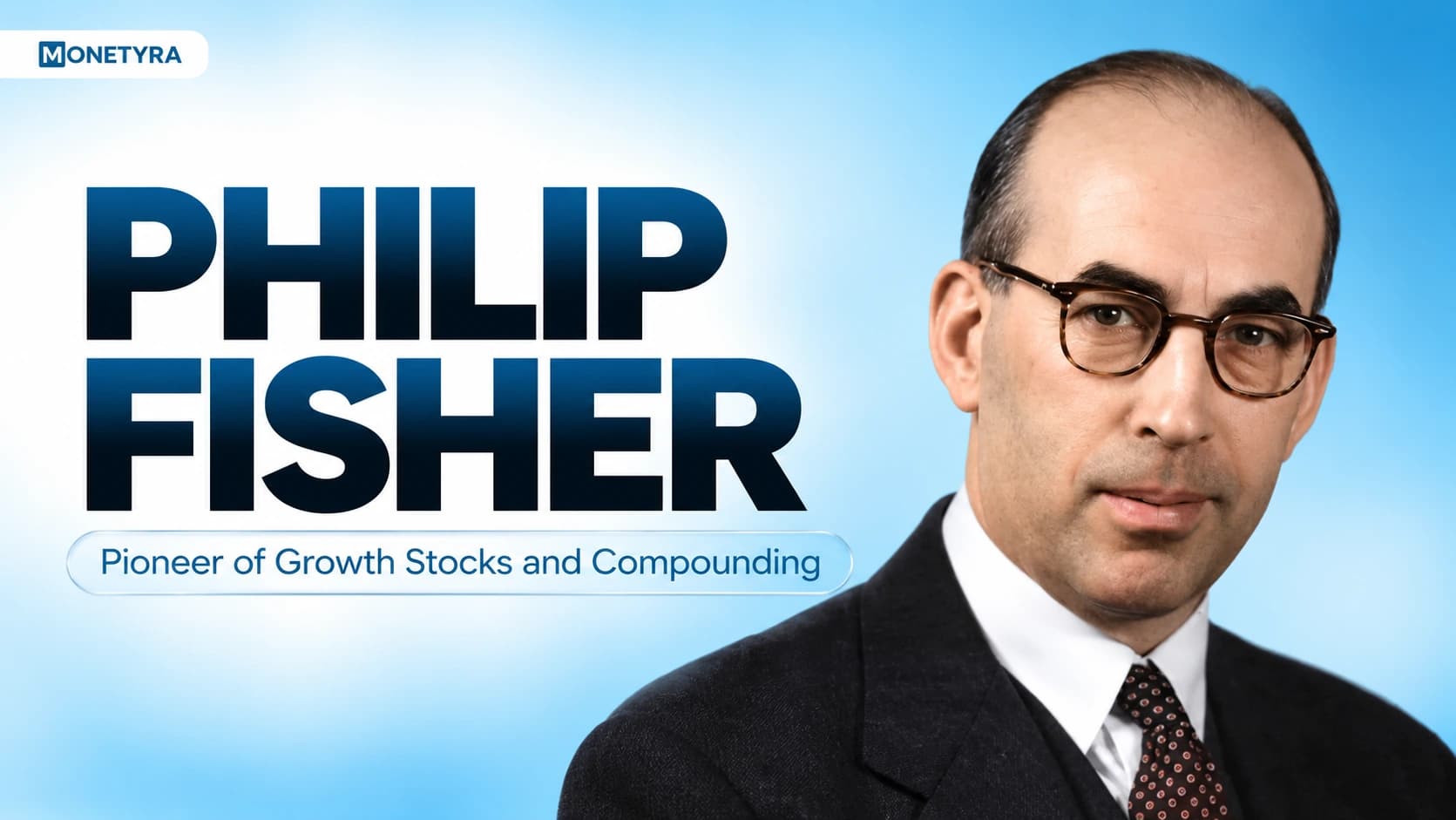
Most investors spend their entire careers chasing cheap stocks, hoping a depressed price tag will automatically protect their capital. Philip Fisher took the opposite approach, arguing that paying a fair price for an extraordinary business with superior management and runaway compounding potential will generate vastly superior wealth over time. Rather than sifting through balance sheets for discarded liquidation value, Fisher pioneered modern growth investing by focusing on qualitative business quality, research and development capabilities, and competitive moats.
Quick Takeaways
- Philip Fisher founded Fisher & Company in 1931 and pioneered modern growth investing, focusing on qualitative business excellence rather than balance sheet liquidation value.
- His methodology relies on the “Scuttlebutt” method (field channel checks across competitors, suppliers, and customers) and a disciplined 15-point qualitative checklist.
- Extreme portfolio concentration into a handful of high-conviction compounders demands rigorous ongoing monitoring and exposes investors to substantial drawdowns during broad market corrections.
Who Is Philip Fisher?

- Born / Lived: September 8, 1907 – March 11, 2004 (San Francisco, California)
- Historical Position: Founder and Managing Partner of Fisher & Company (established in 1931; retired in 1999 at age 91)
- Estimated Net Worth: Approximately $100 million at his firm’s peak
- Known For: Pioneering growth stock evaluation, creating the “Scuttlebutt” qualitative research process, and holding a concentrated portfolio for decades
Image source: Medium.com
If the job has been correctly done when a common stock is purchased, the time to sell it is—almost never. — Philip Fisher
History
Fisher entered Stanford University in 1923 and later attended the newly opened Stanford Graduate School of Business. He left academia in 1928 to work as a securities analyst at the Anglo-London Bank in San Francisco. After briefly working for a local brokerage firm, he launched his own money management firm, Fisher & Company, on March 1, 1931, during the depths of the Great Depression. Operating with minimal overhead and a small circle of clients, he managed money for nearly seven decades until his retirement in 1999.
Achievement
Fisher demonstrated that patient, concentrated holdings in innovative companies can generate substantial compounding returns. His most famous career milestone was his purchase of Motorola in 1955, back when it was primarily a radio equipment manufacturer. Recognizing its technical talent and research capabilities, Fisher held Motorola common stock for nearly fifty years until his death in 2004, delivering an extraordinary return over his nearly fifty-year holding period.
The Core Investment Philosophy of Philip Fisher
Philip Fisher fundamentally departed from the asset-stripping, deep-value methodology championed by Benjamin Graham. Where Graham sought “cigar butt” equities selling below liquidation value, Fisher sought dynamic businesses capable of compounding revenue and earnings for decades.
Fisher believed that true investment safety comes not from buying mediocre assets at a steep discount, but from identifying companies with structural advantages and exceptional managerial integrity. This qualitative insight transformed Wall Street and provided the intellectual framework for Charlie Munger and Warren Buffett. Buffett famously acknowledged this synthesis, stating that he was “85 percent Graham and 15 percent Fisher,” highlighting that Fisher taught him the value of paying a fair price for an outstanding business rather than a low price for a struggling one.
A hallmark of Fisher’s philosophy was extreme portfolio concentration. He rarely held more than ten to twelve stocks, with the top three to four positions often accounting for over 70% of total assets. In Fisher’s view, putting capital into a vast list of companies an investor barely understands provides only the illusion of safety while diluting long-term compounding.
Tip: Deep familiarity with five extraordinary businesses offers better downside protection than surface-level tracking of fifty mediocre ones.
The “Scuttlebutt” Method: Channel Checks and Qualitative Due Diligence
Fisher developed what he coined the scuttlebutt method—an exhaustive, boots-on-the-ground intelligence-gathering technique designed to assess a company’s real competitive position from the outside in.
Rather than relying purely on polished annual reports or executive speeches, Fisher cross-examined a company’s entire operating ecosystem:
- Competitors: Asking industry rivals what competitors do better, where their operational advantages lie, and who they fear losing business to.
- Suppliers and Vendors: Evaluating whether the firm pays promptly, negotiates fairly, or squeezes vendors during cyclical downturns.
- Customers and Distributors: Assessing product quality, customer service responsiveness, brand loyalty, and recurring order habits.
- Former Employees and Middle Managers: Uncovering operational bottlenecks, internal morale, and whether executive compensation matches real frontline performance.
Warning: Relying exclusively on management’s quarterly earnings presentations exposes investors to corporate spin and masks operational decay.
Philip Fisher’s 15 Points: Modern Checklist for Compounders
In his writings, Fisher codified his qualitative framework into fifteen specific operational and managerial characteristics. He required an equity candidate to meet virtually all of these criteria before allocating capital.
| Category | Fisher’s Core Question | Key Modern Indicator to Track |
|---|---|---|
| Market Potential | Does the firm have products with market potential to show substantial sales growth for years? | Addressable TAM growth and multi-year organic revenue run-rates |
| R&D Efficiency | Does management develop products that add to sales potential beyond current lines? | R&D spending as a percentage of sales and patent commercialization |
| Sales Organization | Does the company possess an above-average sales and distribution engine? | Customer acquisition cost (CAC) efficiency and distribution density |
| Cost Competitiveness | Does the company maintain an above-average profit margin and low cost base? | Operating profit margins relative to direct industry competitors |
| Labor Relations | Does the company maintain outstanding employee and personnel relations? | Glassdoor ratings, employee turnover, and operational strike history |
| Executive Relations | Does the firm maintain an outstanding corporate climate for executives? | Middle-management retention and clear succession planning |
| Accounting Controls | Does the company maintain strong cost analysis and accounting controls? | Working capital cycles and cash conversion efficiency |
| Governance Transparency | Does management talk freely to investors when facing difficulties? | Transparent disclosure in concalls and prompt disclosure of operational setbacks |
| Management Integrity | Does management possess unquestioned integrity and shareholder alignment? | Related-party transactions, insider buying, and executive remuneration |
A high score on Return on Invested Capital is often the mathematical byproduct of a business satisfying Fisher’s qualitative checklist. However, Fisher maintained that quantitative metrics are lagging indicators; qualitative excellence leads the numbers.
Applying Fisher’s Principles to the Indian Stock Market
Translating Fisher’s framework to Indian equities listed on the National Stock Exchange (NSE) and Bombay Stock Exchange (BSE) requires adapting his scuttlebutt technique to domestic regulatory frameworks.
Indian retail investors have distinct qualitative advantages when conducting channel checks:
- E-Commerce and Consumer Feedback: Tracking authentic customer reviews on major consumer platforms, consumer forum filings, and merchant feedback.
- Supply Chain Field Checks: Visiting local authorized distributors, retail pharmacies, and auto dealerships to evaluate distributor inventory levels and dealer margins.
- Regulatory Filings: Reading the Ministry of Corporate Affairs (MCA) filings to examine related-party transactions, subsidiary health, and statutory auditor notes.
Regulatory Boundaries: Channel Checks vs. SEBI PIT
Conducting scuttlebutt in India comes with a strict legal line. Under the Securities and Exchange Board of India (SEBI) (Prohibition of Insider Trading) Regulations, 2015, investors must never solicit or trade on Unpublished Price Sensitive Information (UPSI).
Independent field observations—such as counting footfall at retail storefronts or talking to dealers about overall product popularity—are legitimate qualitative research tools. However, obtaining advance quarterly sales numbers, non-public margin projections, or unreleased regulatory approvals from corporate insiders or suppliers crosses directly into illegal insider trading.
Structural Limits in Emerging Markets
While Fisher advocated holding winning compounders almost indefinitely, Indian equities face distinct structural challenges:
- Mid-Cap Drawdowns: Indian small- and mid-cap compounders frequently experience 40% to 60% cyclical drawdowns during broader liquidity contractions, even if business fundamentals remain intact.
- Valuation Extremes: High-quality Indian consumer and industrial franchises often command high valuation multiples, meaning an investor tracking a company with an elevated P/E ratio faces severe multiple-compression risk if earnings growth decelerates even slightly.
Essential Philip Fisher Books for Long-Term Investors
Investors looking to understand Fisher’s operational methodology directly should study the definitive Philip Fisher books that shaped modern equity analysis.
- Common Stocks and Uncommon Profits (1958): Fisher’s foundational masterpiece and the first investment book to ever make the New York Times bestseller list. It introduces the 15-point checklist, details the scuttlebutt technique, and outlines the critical mistakes investors make when selling winning compounders prematurely.
- Conservative Investors Sleep Well (1975): A pragmatic guide detailing how to evaluate operational risk, capital allocation efficiency, and production management. Fisher explores how holding structurally superior companies reduces psychological stress during broader market panics.
- Developing an Investment Philosophy (1980): A concise, reflective treatise detailing Fisher’s evolution as an investor, illustrating how he refined his circle of competence and learned from early market misjudgments.
Monetyra’s Take: Fisher’s big lesson is simple: owning a few truly outstanding companies beats holding a basket of mediocre bargains every time. But “holding for the long run” isn’t an excuse to put your portfolio on autopilot. In volatile spaces like Indian mid- and small-caps, even great businesses routinely take painful 40% to 60% cyclical hits. Using the scuttlebutt approach means doing the homework to stay confident when the market wobbles, while staying well clear of insider trading lines. If you want Fisher-sized returns, you need both his patience and his legwork.
Conclusion
Philip Fisher fundamentally reshaped modern investing by demonstrating that long-term capital compounding is driven by qualitative business excellence rather than short-term price fluctuations. By combining the rigorous scuttlebutt method with an uncompromising checklist of operational integrity and research productivity, Fisher built an enduring roadmap for identifying generational compounders. While his concentrated strategy requires high emotional discipline and a stomach for sharp cyclical drawdowns, his principles remain essential reading for anyone seeking to build lasting equity wealth.
Sharpen your investing framework by studying the legends who shaped the markets. Head over to our Financial Leaders library for in-depth profiles, core strategies, and timeless market wisdom.
FAQs
Philip Fisher was an influential American investor, author, and money manager who founded Fisher & Company in 1931. He is widely recognized as the father of modern growth investing and is best known for creating the scuttlebutt method of qualitative company research.
Fisher is known for pioneering qualitative equity analysis, developing the famous 15-point framework for picking growth compounders, and purchasing Motorola in 1955, which he held for nearly fifty years. He also authored the bestselling 1958 classic Common Stocks and Uncommon Profits.
Fisher’s 15 points form a comprehensive qualitative checklist used to assess a company’s long-term growth viability. The checklist evaluates market expansion potential, research and development productivity, sales organization quality, profit margins, cost accounting controls, employee and executive relations, and management integrity.
Fisher’s investment philosophy centered on buying a concentrated portfolio of outstanding growth companies with exceptional management and secular industry tailwinds, holding them for decades. He prioritized qualitative field research over backward-looking balance sheet discounts and famously advocated rarely selling an outstanding business.
Philip Fisher authored several cornerstone investment books, most notably Common Stocks and Uncommon Profits (1958). He subsequently published Paths to Wealth through Common Stocks (1960), Conservative Investors Sleep Well (1975), and Developing an Investment Philosophy (1980).
Fisher profoundly influenced Warren Buffett by shifting his focus away from cheap, struggling businesses toward high-quality franchises with competitive advantages and superior management. Buffett frequently attributes his modern investment style to a blend of 85% Benjamin Graham and 15% Philip Fisher.
Disclaimer: This article was written with the help of AI and reviewed by Monetyra’s editorial team. It is for educational purposes only and should not be considered financial advice. Trading and investing in financial instruments involve significant risk of loss and are not suitable for all investors. Past performance, including historical case studies such as Motorola, does not guarantee future results. Please consult a licensed financial advisor before making any investment or trading decision.