Circle of Competence in Investing: Strategic Portfolio Guide
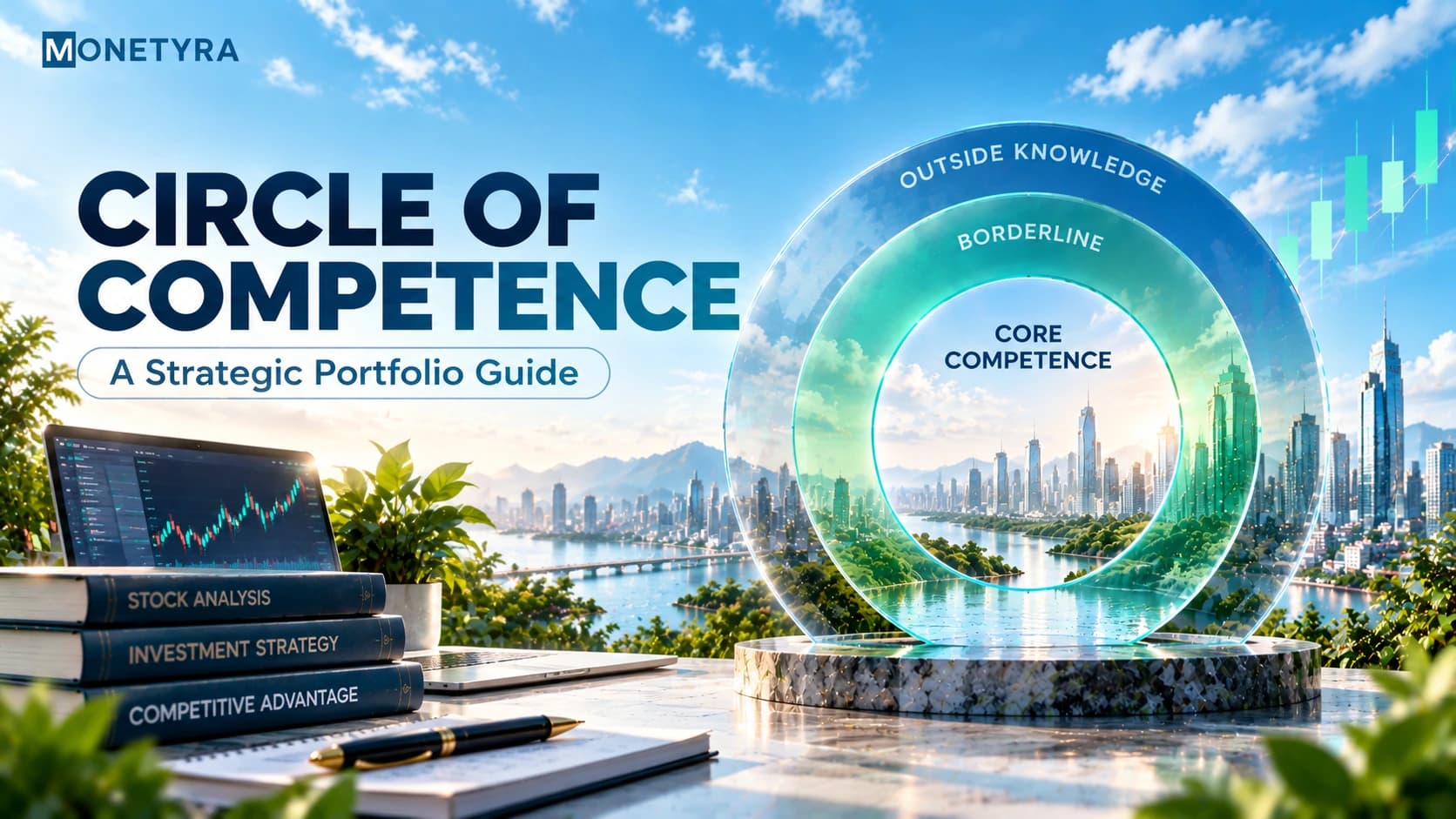
Navigating the stock market does not require mastering every sector, but operating within your circle of competence ensures you recognize your knowledge boundaries and act strictly within them. Successful equity selection relies on focusing on what you truly understand rather than chasing speculative trends.
Popularized by Warren Buffett and Charlie Munger, this mental framework helps investors evaluate companies accurately, avoid high-risk traps, and protect long-term capital.
Quick Takeaways
- The circle of competence defines the specific operational sectors and business models an investor genuinely understands well enough to evaluate accurately.
- Knowing the precise boundary of your financial knowledge is far more critical for long-term wealth preservation than attempting to master every market sector.
- Venturing into complex derivatives or unvetted speculative shares outside your core domain drastically increases the probability of capital drawdown.
What Is the Circle of Competence in Investing?
The circle of competence is the specific range of industries, business models, and financial structures that an investor thoroughly understands. First popularized by Warren Buffett and Charlie Munger, this mental framework emphasizes that successful equity selection depends not on how much you know, but on how realistically you define the edge of what you do not know.
Investors often confuse general familiarity with operational competence. Recognizing a consumer product on store shelves or using a digital service daily does not automatically place that corporate entity within your domain of expertise. True competence requires a clear understanding of the company’s revenue mechanics, profit margins, cost structures, regulatory risks, and competitive advantages over a five-to-ten-year horizon. When you operate strictly within this boundary, you reduce the likelihood of making catastrophic misjudgments caused by speculative hype.
Warren Buffett’s Core Framework and Origin
The concept gained formal prominence in Berkshire Hathaway’s 1996 Shareholder Letter, where Warren Buffett outlined his fundamental approach to portfolio allocation. Buffett observed that investors do not need to be experts on every company or even dozens of industries. Instead, they only need to evaluate businesses correctly within their personal sphere of understanding.
Tip: Charlie Munger famously operationalized this philosophy by utilizing a “Too Hard” tray on his desk, instantly rejecting complex financial engineering or unpredictable business models that required speculative forecasting.
By categorizing opportunities into three distinct buckets—”In”, “Out”, and “Too Hard”—investors neutralize the psychological trap of overconfidence bias. In equity markets, the fear of missing out (FOMO) frequently pressures retail market participants into buying high-technology assets, biotech counters, or complex financial instruments simply because their prices are rising. Adhering strictly to a defined competence boundary creates an analytical filter, preventing impulsive capital deployment into assets whose underlying cash flows remain unpredictable.
What Happens When You Invest Outside Your Circle?
Stepping outside your analytical domain exposes your portfolio to severe information asymmetry. Institutional market participants employ dedicated sector analysts, access management disclosures, and perform rigorous fundamental research. When a retail investor trades in unfamiliar sectors, they routinely sit on the losing side of this information gap.
This imbalance becomes particularly hazardous during speculative market phases. In the Indian market, retail participation in volatile SME IPOs and complex financial derivatives has escalated significantly. According to a regulatory study published by the Securities and Exchange Board of India (SEBI), over 90% of individual traders in the equity Futures & Options (F&O) segment incurred net financial losses over recent fiscal periods.
When market volatility strikes, investors who hold shares outside their domain lack the conviction to hold through temporary downturns. Because they cannot independently calculate an asset’s intrinsic valuation, they react to price movement rather than business fundamentals, often locking in heavy losses at market bottoms.
Warning: Entering complex derivatives or unvetted speculative micro-caps without domain expertise exposes retail capital to severe drawdown risks during market corrections.
How to Identify Your Circle of Competence
Defining your analytical boundaries requires an honest, objective self-assessment. Indian retail investors can apply a structured three-step audit to map out their core investment domain.
- Map Your Professional & Personal Domain: Start with industries where you possess direct operational insight. An IT systems engineer may understand cloud migration software margins better than a financial analyst, while a logistics manager can easily grasp supply chain bottlenecks affecting transportation firms.
- Audit Financial Reading Comprehension: Test whether you can read a company’s balance sheet, income statement, and cash flow disclosures without relying on broker reports or media summaries. If you cannot identify the main revenue drivers and major debt obligations, the company sits outside your circle.
- Assess Economic Moat Visibility: Determine whether you can explain how the business will defend its market share against competitors over the next decade. If the industry undergoes rapid technological displacement where winners change every two years, predicting long-term cash flows becomes guesswork.
Controlled Framework for Expanding Boundaries Over Time
Your circle of competence is not static; it can expand through deliberate study. However, expanding your boundaries requires disciplined execution rather than speculative jumping.
To incorporate a new sector—such as renewable energy or specialized banking—begin by reading annual reports, regulatory filings under the National Stock Exchange of India (NSE), and industry research papers for several months before committing real capital. Utilize paper trading or allocate a microscopic test position (1–2% of portfolio value) to observe quarterly performance disclosures before treating the industry as part of your core domain.
Applying the Framework: Well-Understood vs. High-Risk Assets in India
To build a resilient portfolio, investors must distinguish between simple, transparent equity models and complex, opaque instruments. The table below illustrates how different asset categories in the Indian market compare across business clarity, valuation predictability, and retail suitability.
| Market Segment | Business Clarity | Key Valuation Drivers | Risk Profile & Retail Suitability |
|---|---|---|---|
| Large-Cap FMCG & Consumer Staples | High (predictable demand, simple distribution) | Volume growth, input cost trends, pricing power | Low-to-Moderate Risk; Highly suitable for retail core portfolios |
| Established IT Services | Moderate-to-High (transparent deal pipelines) | Attrition rates, deal wins, client IT budget cycles | Moderate Risk; Suitable for investors tracking global tech spending |
| Speculative SME IPOs & Micro-Caps | Low (short operating history, sparse coverage) | Promoter background, order book execution, liquidity | High Risk; Unsuitable unless backed by deep industry research |
| Futures & Options (F&O Derivatives) | Opaque (requires quantitative probability modeling) | Volatility (IV), time decay (), leverage dynamics | Extreme Risk; Unsuitable for capital preservation strategies |
Contrarian Investing Within Known Boundaries
Staying inside your sphere of understanding does not mean avoiding out-of-favor stocks. In fact, contrarian investing works best when applied strictly within familiar sectors.
When a high-quality consumer or IT business experiences temporary market distress—such as a short-term margin contraction due to raw material inflation—a competent investor can recognize that the long-term economic engine remains intact. Because you understand the business model thoroughly, you can confidently buy discounted shares when market sentiment turns negative. Conversely, buying a falling stock in an industry you do not understand is not contrarian investing; it is unvetted speculation.
Monetyra’s Take: Indian retail investors often dilute their long-term wealth by chasing speculative momentum in complex financial products or unvetted micro-caps. Building a core portfolio around 10 to 15 well-understood compounders provides far superior risk-adjusted performance over market cycles. Depth of understanding will always beat breadth of asset exposure when managing real capital.
Conclusion
The circle of competence framework offers a practical filter for capital allocation in volatile equity markets. By establishing clear boundaries around what you truly understand, you eliminate the pressure to act on every market movement. Long-term wealth preservation is not achieved by knowing everything about the stock market; it is built by acting decisively on the limited opportunities that fall squarely within your analytical domain.
Depth over breadth is how long-term equity wealth is preserved.
FAQs
The circle of competence in the stock market refers to the specific range of industries and business models an investor genuinely understands well enough to evaluate their financial health and future earnings accurately.
You identify your circle of competence by auditing your professional industry background, testing your ability to read financial statements independently, and evaluating whether you can clearly explain a company’s 10-year competitive advantage.
Warren Buffett’s rule states that the size of your circle of knowledge is far less important than knowing where its exact boundaries lie. Investors should only invest in businesses that fall strictly inside their understanding.
Investing outside your competence boundary exposes you to information asymmetry, overconfidence bias, and panic selling during market corrections because you lack the fundamental conviction to value the underlying business correctly.
Indian retail investors can define their circle by focusing on sectors tied to their daily work or personal expertise, reading primary SEBI disclosures, and avoiding complex derivatives or speculative SME IPOs that lack clear operational history.
Yes, you can expand your circle of competence through structured study of financial reports, continuous industry research, and starting with small test allocations before making major portfolio commitments.
Disclaimer: This article was written with the help of AI and reviewed by Monetyra. It is for educational purposes only and should not be considered financial advice. Trading and investing in financial instruments involve significant risk of loss and are not suitable for all investors, and past performance of any strategy does not guarantee future results. Please consult a licensed financial advisor before making any investment or trading decision.
In India, SEBI regulates listed equity securities and derivatives disclosures. Readers are advised to verify the regulatory status of their market intermediaries and ensure compliance with applicable Indian laws before investing.