Disadvantages of Senior Citizen Savings Scheme: 7 Key Risks
For many Indian retirees, the Senior Citizen Savings Scheme (SCSS) is the first stop when deploying a retirement lump sum, largely because it carries sovereign backing from the Government of India. Yet putting a large share of your retirement corpus into one small-savings instrument without examining the disadvantages of the Senior Citizen Savings Scheme rules can quietly reduce your post-tax cash flow and limit liquidity when medical or family emergencies arise.
Understanding these structural drawbacks before committing capital helps you decide how much of your portfolio belongs in SCSS and where complementary fixed-income instruments make more sense.
Quick Takeaways
- Core Limitation: SCSS interest is fully taxable at your marginal income tax slab rate, and mandatory quarterly payouts prevent your principal from compounding over the 5-year tenure.
- Liquidity and Cap Rules: Cumulative deposits are capped at ₹30 lakh per individual, while premature withdrawals trigger principal penalties of 1.0% to 1.5%.
- Key Caveat: Because the interest rate locks in on the account-opening date for five full years, your real purchasing power can erode if consumer or healthcare inflation rises faster than your post-tax yield.
What Are the Key Disadvantages of the Senior Citizen Savings Scheme?
The primary disadvantages of senior citizen savings scheme accounts are fully taxable interest payouts, a ₹30 lakh investment ceiling, a rigid 5-year lock-in with early exit penalties, fixed rate lock-in risk, zero compounding mechanics, strict age eligibility criteria, and Tax Deducted at Source (TDS) compliance under Section 194A.
While government backing eliminates default risk on your principal, operational rules restrict how much wealth you can build and how quickly you can access your money. Evaluating each limitation alongside the specific investor profile it hurts most clarifies where SCSS falls short in a broader retirement plan.
7 Major Disadvantages of Senior Citizen Savings Scheme
1. Fully Taxable Interest at Marginal Income Tax Slabs
Unlike tax-free bonds or long-term equity gains that receive preferential tax treatment, every rupee of quarterly interest earned from SCSS is added to your total taxable income and taxed at your marginal slab rate according to the Income Tax Department. Although initial deposits qualify for deductions up to ₹1.5 lakh per financial year under Section 80C (available only under the old tax regime), the ongoing income stream offers no tax exemption.
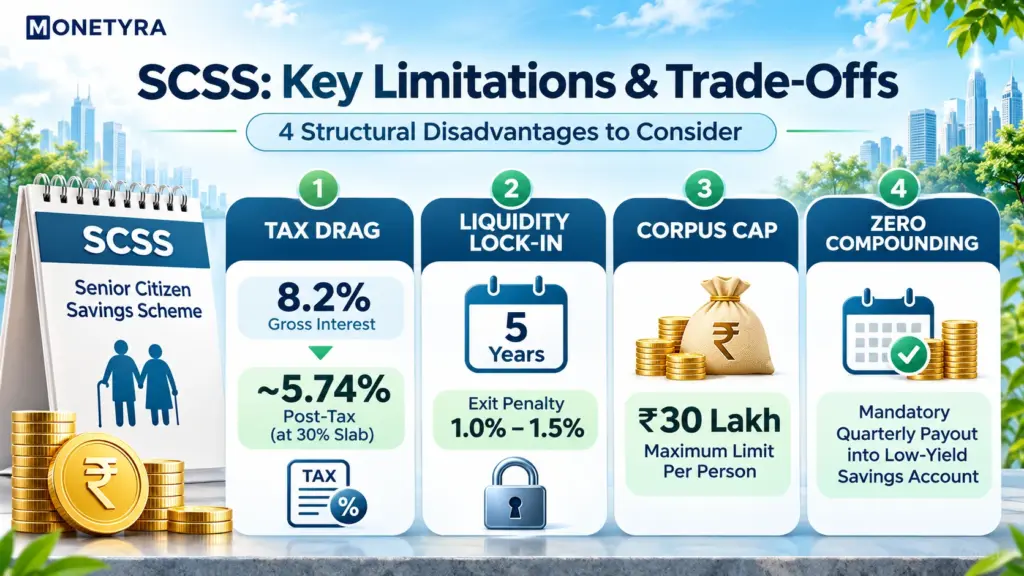
In a hypothetical example, an investor in the 30% tax slab earning an 8.2% per annum gross interest rate retains only about 5.74% per annum before surcharge and cess.
Who Is Hit Hardest: Retirees receiving a government or corporate pension alongside rental or dividend income who fall into the 20% or 30% tax brackets.
2. No Compounding Option Due to Mandatory Quarterly Payouts
SCSS does not offer a cumulative growth option. Interest is credited strictly on a quarterly schedule—on the first working day of April, July, October, and January—directly into your linked savings account, leaving zero mechanism to reinvest earnings back into the SCSS principal automatically.
If you do not need the quarterly cash flow for immediate living expenses and leave those payouts sitting in a regular savings account earning roughly 2.5% to 3.5% per annum, your blended portfolio return drops noticeably.
Who Is Hit Hardest: Early retirees aged 60 to 65 who still have active income and want their lump sum to compound rather than generate immediate cash payouts.
3. Rigid 5-Year Lock-In and Premature Withdrawal Penalties
Capital deposited into SCSS remains locked for a mandatory 5-year tenure, with an option to extend the account once for an additional three years upon maturity. Accessing your principal early is permitted, but premature closure incurs direct financial penalties deducted from your deposit balance:
- Closure within 1 year: Zero interest is payable, and any quarterly interest already disbursed is recovered directly from your principal before payout.
- Closure between 1 and 2 years: A penalty equal to 1.5% of the deposited principal is deducted.
- Closure between 2 and 5 years: A penalty equal to 1.0% of the deposited principal is deducted.
For a ₹30 lakh deposit closed after 14 months, a 1.5% penalty costs ₹45,000 out of your original capital.
Who Is Hit Hardest: Retirees without a separate liquid emergency fund who may need sudden lump-sum cash for hospitalisation or family obligations.
4. ₹30 Lakh Maximum Investment Cap Per Individual
The Ministry of Finance restricts cumulative SCSS investments to ₹30 lakh per individual across all post office and authorized bank accounts combined (deposits must be in multiples of ₹1,000). Even if you open multiple accounts, your aggregate balance cannot cross this statutory ceiling.
For a retiree with a ₹1 crore retirement corpus, SCSS can absorb at most 30% of their savings, forcing them to deploy the remaining ₹70 lakh into lower-yielding bank deposits or market-linked instruments.
Who Is Hit Hardest: High-net-worth retirees and senior professionals with substantial Provident Fund or gratuity payouts seeking sovereign-backed fixed income for their entire corpus.
5. Fixed Interest Rate Lock-In Across the 5-Year Tenure
When you open an SCSS account, the prevailing quarterly rate notified by the Ministry of Finance locks in for the entire 5-year period. You can review the latest quarterly revisions and historical payouts in our breakdown of the current Senior Citizen Savings Scheme interest rate.
This fixed structure creates two-sided macro risk: if the Reserve Bank of India raises policy rates and market yields climb after you invest, your capital stays trapped at the older, lower rate unless you pay an exit penalty to reinvest; meanwhile, persistent inflation in medical and household costs erodes the real value of fixed quarterly payouts.
Who Is Hit Hardest: Retirees locking in funds near the bottom of an interest-rate cycle or relying solely on fixed payouts over a 15-to-20-year retirement horizon.
6. Strict Age and Retirement Eligibility Restrictions
Unlike bank fixed deposits that anyone can open at any age, SCSS enforces tight entry conditions. Standard eligibility starts at age 60, though individuals aged 55 to 60 who have opted for the Voluntary Retirement Scheme (VRS) or superannuation may invest within one month of receiving retirement benefits, and retired defence personnel can enter between ages 50 and 60 subject to specific conditions. You can verify the exact documentation and branch-level rules in our guide on Senior Citizen Savings Scheme post office rules and eligibility.
Furthermore, Non-Resident Indians (NRIs) and Hindu Undivided Families (HUFs) are ineligible to open new SCSS accounts.
Who Is Hit Hardest: Self-employed professionals retiring before age 60 without formal VRS documentation, as well as NRI retirees returning to India without resident status.
7. Mandatory TDS Deduction Under Section 194A
If your aggregate annual interest from SCSS crosses the statutory threshold prescribed under Section 194A of the Income Tax Act—historically ₹50,000 for senior citizens—the bank or post office automatically deducts TDS at 10% (or 20% if PAN is not furnished).
Even if your total taxable income falls below the basic tax exemption limit, failing to submit Form 15H at the start of every financial year results in cash-flow deductions that you can only reclaim by filing an Income Tax Return (ITR) and waiting for a refund.
Who Is Hit Hardest: Low-income retirees who depend on every rupee of quarterly interest for monthly bills and miss the April deadline for submitting Form 15H.
Tip: Submit Form 15H during the first week of April each financial year at your bank or post office branch if your net taxable income is below the exemption limit so your quarterly payouts arrive without TDS deductions.
How SCSS Compares With Other Senior Income Alternatives
Evaluating SCSS alongside comparable fixed-income options highlights where alternative instruments solve specific SCSS drawbacks such as liquidity, compounding, or floating rates. Retirees looking for smoother monthly cash flows can also review broader monthly income investment plans in India.
| Feature (as of Nov 2026) | Senior Citizen Savings Scheme (SCSS) | Senior Citizen Bank FD | Post Office Monthly Income Scheme (POMIS) | RBI Floating Rate Savings Bonds |
|---|---|---|---|---|
| Issuer / Backing | Government of India (Sovereign) | Scheduled Commercial Banks (DICGC insured up to ₹5 lakh) | Government of India (Sovereign) | Reserve Bank of India (Sovereign) |
| Tenure & Lock-In | 5 years (extendable by 3 years once) | Flexible (7 days to 10 years) | 5 years | 7 years (early exit allowed only for ages 60+ after lock-in) |
| Payout Frequency | Quarterly only | Monthly, quarterly, or cumulative at maturity | Monthly | Semi-annual (January 1 and July 1) |
| Interest Rate Type | Fixed at entry for 5 years (8.2% p.a.) | Fixed at entry (varies by bank, ~6.5%–7.75% p.a.) | Fixed at entry (7.4% p.a.) | Floating, reset every 6 months (8.05% p.a.) |
| Maximum Deposit Limit | ₹30 lakh per individual | No statutory upper cap | ₹9 lakh (single) / ₹15 lakh (joint) | No upper investment limit |
| Taxation | Taxable at slab rate; Section 80C on principal | Taxable at slab rate; 5-yr tax-saver FD eligible for 80C | Taxable at slab rate; no Section 80C benefit | Taxable at slab rate; no Section 80C benefit |
Each alternative addresses a specific limitation of SCSS. Senior citizen bank FDs allow cumulative compounding and flexible tenures without a ₹30 lakh ceiling, though deposit insurance caps out at ₹5 lakh per bank. POMIS delivers monthly payouts rather than quarterly disbursements, while RBI Floating Rate Savings Bonds remove the upper investment cap and adjust interest rates semi-annually if benchmark yields rise.
When SCSS Still Makes Sense for Retirees
Despite these seven limitations, SCSS remains a core fixed-income allocation for specific retiree profiles when used within its structural boundaries:
- Retirees in the 0% or 5% Tax Bracket: When your total income falls below the taxable threshold, the gross sovereign yield becomes your net post-tax return, outperforming most large commercial bank FDs without taking credit risk.
- Core Sovereign Allocation Up to ₹30 Lakh: Allocating up to ₹30 lakh per spouse (₹60 lakh combined across two individual accounts) provides predictable quarterly cash flow backed directly by the central government.
- Investors Seeking Fixed Predictability Over 5 Years: If interest rates appear to have peaked and are expected to decline over the next few years, locking in the SCSS rate for five years protects your quarterly payout against falling bank deposit rates.
Monetyra’s Take
SCSS works best as a foundational safety sleeve rather than an all-in-one retirement portfolio. While sovereign backing and competitive gross yields make it attractive for retirees in lower tax brackets, investors in the 20% or 30% tax slabs lose a substantial share of that advantage to income tax and zero compounding. Pairing an SCSS allocation with more liquid or floating-rate instruments helps balance safety, inflation protection, and emergency access.
Conclusion
The disadvantages of senior citizen savings scheme accounts—specifically slab-rate taxation, mandatory non-cumulative payouts, a ₹30 lakh individual cap, and early withdrawal penalties—mean the scheme cannot solve every retirement need on its own. High-tax-bracket investors and retirees requiring high liquidity or long-term compounding feel these constraints most acutely. By sizing your SCSS deposit carefully and pairing it with flexible bank FDs or uncapped sovereign bonds, you can capture government-backed income without sacrificing portfolio agility.
Explore New Investment Trends
Compare sovereign savings schemes, floating-rate bonds, and tax-aware income strategies for Indian investors.
FAQs
1. What are the main disadvantages of Senior Citizen Savings Scheme?
The primary drawbacks include fully taxable quarterly interest at your marginal income tax slab rate, no cumulative compounding option, a ₹30 lakh individual deposit ceiling, a rigid 5-year lock-in period with 1.0% to 1.5% premature exit penalties, and strict age eligibility rules starting at age 60.
2. Is SCSS interest taxable for senior citizens?
Yes, SCSS interest is fully taxable according to your individual income tax slab rate. While your principal deposit qualifies for a Section 80C deduction up to ₹1.5 lakh under the old tax regime, the quarterly interest payouts are added to your gross total income and taxed accordingly.
3. What is the penalty for premature withdrawal of SCSS?
If you close an SCSS account within one year of opening, no interest is paid, and any interest already credited is recovered from your principal. Closing between one and two years incurs a 1.5% principal penalty, while closing between two and five years incurs a 1.0% penalty.
4. Can SCSS interest be compounded instead of paid quarterly?
No, SCSS does not offer a cumulative or reinvestment option. Interest is disbursed strictly on a quarterly basis—on the first working day of April, July, October, and January—into your linked savings account, meaning your principal remains static throughout the 5-year tenure.
5. What is the TDS limit on SCSS interest for senior citizens?
Under Section 194A of the Income Tax Act, banks and post offices deduct 10% TDS if your annual SCSS interest crosses the statutory exemption limit for senior citizens—historically ₹50,000 per financial year. Eligible retirees can submit Form 15H to avoid TDS.
6. How does SCSS compare to bank fixed deposits for senior citizens?
SCSS offers direct sovereign backing and typically higher gross yields than standard commercial bank FDs. However, bank FDs provide greater liquidity, flexible tenures from seven days to ten years, cumulative compounding choices, and no ₹30 lakh statutory upper investment cap.
Disclaimer: This article was written with the help of AI and edited by the Monetyra editorial team. It is for educational purposes only and should not be considered financial advice. Trading and investing in financial instruments involve significant risk of loss and are not suitable for all investors. Please consult a licensed financial advisor before making any investment or trading decision.