PPF Account in India: Interest Rate, Rules, and How to Open

If you are a conservative saver in India, a PPF account might be a good fit, because it offers government-backed capital protection along with tax exemptions. Run by the Central Government under the Public Provident Fund Scheme, 2019, it combines annual compound interest with triple tax exemptions across your deposits, interest accrual, and maturity proceeds.
Planning around its mandatory 15-year lock-in period and annual deposit limits requires a clear grasp of how interest is calculated, how to complete account opening, and what happens at maturity before you commit capital.
Quick Takeaways
- A PPF account is backed by the Government of India and offers Exempt-Exempt-Exempt (EEE) tax status for deposits between ₹500 and ₹1,50,000 per financial year.
- As of Q3 FY 2026–27 (October 1 to December 31, 2026), the scheme pays 7.1% interest per annum, compounded annually based on the lowest monthly balance after the 5th day of each month.
- Liquidity is restricted during the 15-year lock-in tenure, and interest rates are subject to quarterly revision by the Ministry of Finance, meaning returns may lag inflation over multi-decade horizons.
November 19, 2026 | 7 min read | By Monetyra Editorial Team
What Is a PPF Account and How Does It Work?
A Public Provident Fund (PPF) account is a 15-year, government-backed small savings scheme that pays interest at a rate notified every quarter, compounded annually, and provides tax-free maturity returns to resident Indians.
Established under the Government Savings Promotion Act, 1873, and governed by the Public Provident Fund Scheme, 2019, the scheme is administered by the Ministry of Finance through the National Savings Institute (NSI). Because both principal and accrued interest carry a sovereign guarantee from the Government of India, the instrument carries minimal credit risk compared with corporate bonds or market-linked funds regulated by the Securities and Exchange Board of India (SEBI).
You can open and operate an account through authorized public and private sector banks or any India Post office under standard annual contribution rules:
- Minimum Annual Deposit: ₹500 per financial year is required to keep the account active.
- Maximum Annual Deposit: ₹1,50,000 per financial year across your self-account and any minor account held as a guardian combined.
- Contribution Frequency: You can deposit in a lump sum or in multiple installments throughout the financial year, in multiples of ₹50.
- Account Limit: Only one individual account is permitted per resident citizen; joint accounts are not allowed.
If you fail to deposit at least ₹500 in a financial year, the account becomes discontinued. Reactivating a discontinued account requires paying a default fee of ₹50 per inactive year plus the ₹500 minimum subscription arrear for each missed year.
Current PPF Interest Rate and Key Account Rules
As of Q3 FY 2026–27 (October 1 to December 31, 2026), the PPF interest rate is 7.1% per annum, compounded annually, according to the National Savings Institute (NSI) and Ministry of Finance notifications.
The Ministry of Finance reviews small savings interest rates every quarter. Although interest is credited to your account once at the end of each financial year (March 31), it is calculated monthly using a strict cutoff date, explained below.
Tip: Deposit your monthly or lump-sum contribution on or before the 5th of the month so the added amount earns interest for that entire calendar month.
Interest for any month is computed solely on the lowest balance between the close of the 5th day and the last day of that month. Funds credited on or after the 6th day generate zero interest until the following month.
| Parameter | Current Rule (As of Nov 2026) | Governing Framework |
|---|---|---|
| Sovereign Backing | Government of India Guarantee | Government Savings Promotion Act, 1873 |
| Interest Rate | 7.1% p.a. (Compounded Annually) | NSI / Ministry of Finance (Q3 FY 2026–27) |
| Tax Category | Exempt-Exempt-Exempt (EEE) | Section 123 & Section 11 (Schedule II), Income-tax Act, 2025 |
| Lock-in Tenure | 15 Full Financial Years | Public Provident Fund Scheme, 2019 |
| Annual Deposit Limit | ₹500 (Min) to ₹1,50,000 (Max) | Public Provident Fund Scheme, 2019 |
| Loan Interest Rate | 1% p.a. above prevailing PPF rate | Public Provident Fund Scheme, 2019, Para 9 |
How to Open a PPF Account Online and Offline
Only resident Indian individuals are eligible to open a new account, either for themselves or on behalf of a minor or a person of unsound mind. Non-Resident Indians (NRIs) and Hindu Undivided Families (HUFs) cannot open a new account. An existing account opened while a resident may continue until its original 15-year maturity on a non-repatriation basis, meaning the balance cannot be sent abroad.
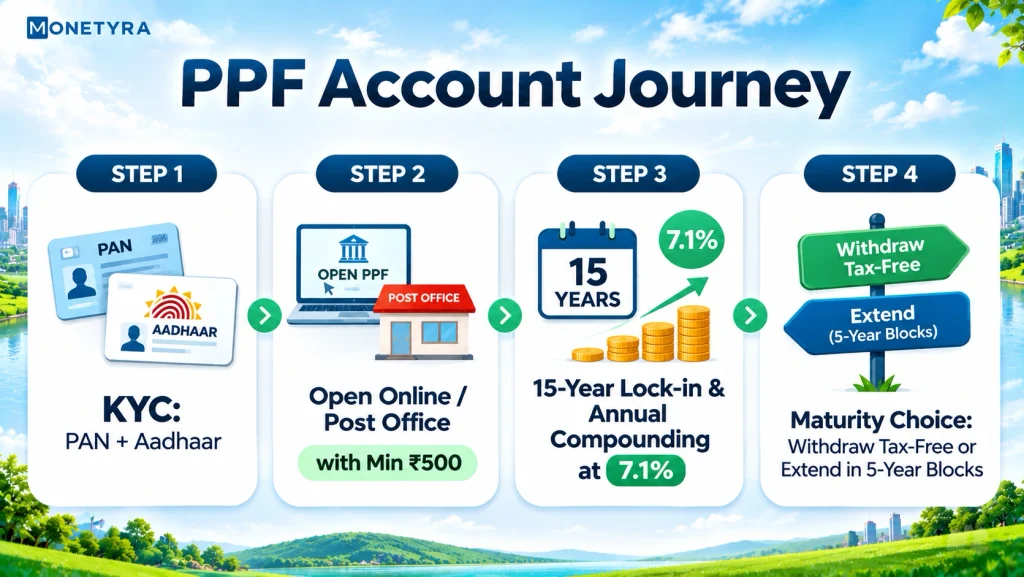
Per Ministry of Finance notifications effective April 1, 2023, submitting both your Permanent Account Number (PAN) and Aadhaar number is mandatory for opening and operating small savings accounts.
Online Opening Steps (Through Authorized Banks)
- Log in to Net Banking or Mobile App: Access your existing savings account portal with an authorized bank (such as State Bank of India, HDFC Bank, ICICI Bank, or Axis Bank).
- Select the PPF Opening Option: Locate the “Open a PPF Account” section under investments or government schemes and choose between a self-account or a minor account.
- Verify KYC and Nominee Details: Confirm your pre-filled PAN, Aadhaar, and address details, and add up to four nominees with percentage shares.
- Set Initial Deposit and Submit: Enter an initial contribution of at least ₹500, authenticate the application via Aadhaar OTP, and download your account receipt.
Offline Opening Steps (Bank Branch or Post Office)
- Collect Form-1: Obtain the account opening application (Form-1 under the 2019 rules) at an authorized bank branch or India Post office.
- Attach KYC Documents: Provide self-attested copies of your PAN card, Aadhaar card, proof of address, and a passport-sized photograph, along with originals for verification.
- Deposit Initial Contribution: Submit the completed form with your initial deposit (minimum ₹500) via cash, cheque, or demand draft to receive your passbook.
PPF Maturity Calculation Example (15-Year Tenure)
Because interest compounds once per financial year while balances are tracked monthly, estimating your final corpus requires an annual compounding formula.
Standard Annual Compounding Formula (for fixed annual deposits made at the start of each financial year):
Maturity Value = Annual Deposit × [((1 + r)^n − 1) ÷ r] × (1 + r)
Where r is the annual interest rate in decimal form (0.071 for 7.1%), and n is the tenure in years (15).
Worked Hypothetical Example
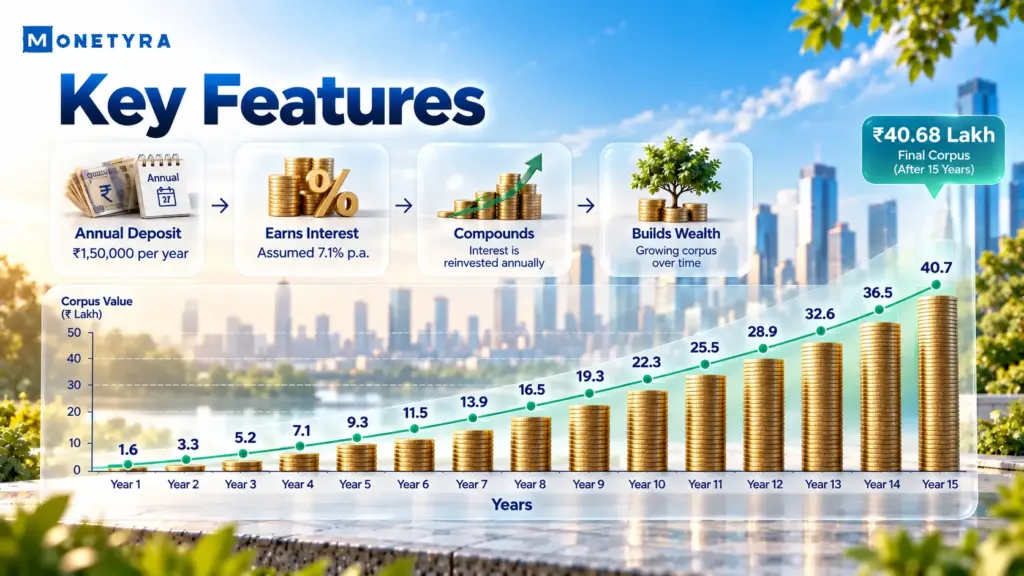
In this hypothetical example, assume an investor deposits the maximum ₹1,50,000 on or before April 5 every year for 15 consecutive financial years, and the interest rate remains constant at 7.1% per annum throughout the tenure:
- Total Principal Invested: ₹1,50,000 × 15 years = ₹22,50,000
- Compounding Factor: [((1 + 0.071)^15 − 1) ÷ 0.071] × 1.071 = 27.121395
- Estimated Maturity Corpus: ₹1,50,000 × 27.121395 = ₹40,68,209 (comprising ₹22,50,000 principal and ₹18,18,209 tax-free interest)
| Annual Contribution (Deposited Before April 5) | Total Invested (15 Years) | Estimated Interest Earned (at 7.1% p.a.) | Hypothetical Maturity Value |
|---|---|---|---|
| ₹30,000 (₹2,500/month) | ₹4,50,000 | ₹3,63,642 | ₹8,13,642 |
| ₹60,000 (₹5,000/month) | ₹9,00,000 | ₹7,27,284 | ₹16,27,284 |
| ₹1,20,000 (₹10,000/month) | ₹18,00,000 | ₹14,54,567 | ₹32,54,567 |
| ₹1,50,000 (Max Annual Limit) | ₹22,50,000 | ₹18,18,209 | ₹40,68,209 |
Note: Actual maturity values will vary if the Ministry of Finance revises quarterly interest rates during the 15-year period or if deposits are made after the 5th of each month.
EEE Tax Benefits and Maturity Extension Options
A primary advantage of holding a PPF account is its Exempt-Exempt-Exempt (EEE) status under guidelines administered by the Income Tax Department, alongside flexible post-maturity choices.
How the EEE Tax Framework Applies
- Exempt at Contribution: Deposits up to ₹1,50,000 per financial year qualify for a deduction under Section 123 of the Income-tax Act, 2025 (formerly Section 80C of the Income-tax Act, 1961).
- Important edge case: This Section 123 deduction is available only if you opt for the Old Tax Regime; taxpayers under the default New Tax Regime cannot claim Section 123 deductions.
- Exempt at Accrual: Annual interest earned is completely tax-free under Section 11 and Schedule II of the Income-tax Act, 2025, regardless of which tax regime you choose.
- Exempt at Withdrawal: The entire maturity corpus and partial withdrawals are exempt from income tax.
Three Options After Completing 15 Financial Years
The 15-year tenure is counted from the end of the financial year in which you opened the account (meaning an account opened in November 2026 matures on April 1, 2042). At maturity, you can choose one of three paths:
- Full Withdrawal and Closure: Withdraw the entire balance tax-free and close the account.
- Extension Without Contribution: Retain the balance in 5-year blocks indefinitely without depositing new money. The corpus continues earning the prevailing PPF rate, and you may make one partial withdrawal per financial year of any amount.
- Extension With Contribution: Continue making annual deposits in 5-year blocks by submitting Form-4 (formerly Form H) within one year from the date of maturity.
PPF Loan, Partial Withdrawal, and Alternative Schemes
While capital is locked in for 15 years, the scheme provides limited pre-maturity liquidity and sits alongside several competing retirement instruments in India.
- Loan Facility (Years 3 to 6): You can borrow up to 25% of the balance standing at the end of the second preceding financial year. The loan carries an interest rate of 1% per annum above the prevailing PPF rate if repaid within 36 months.
- Partial Withdrawals (From Year 7 Onward): One partial withdrawal is allowed per financial year starting from the 7th financial year. For exact calculation formulas, withdrawal caps, and premature closure conditions, review the complete PPF withdrawal rules.
Investors allocating long-term savings often weigh sovereign fixed returns against market-linked or employer-backed schemes:
| Scheme | Lock-in / Tenure | Current Yield (As of Nov 2026) | Tax Treatment | Risk Profile |
|---|---|---|---|---|
| PPF Account | 15 Financial Years | 7.1% p.a. (Compounded Annually) | EEE (Section 123 under Old Regime) | Low (Sovereign Guarantee) |
| EPF (Employees’ Provident Fund) | Until Retirement (Age 58) | Around 8.25% p.a. (FY 2024–25/26 rate; may change each year) | EEE (Interest above ₹2.5 lakh per year taxable) | Low (Statutory / Sovereign) |
| NPS (National Pension System) | Until Age 60 | Market-Linked (Equity & Debt) | Section 124 Deductions; 60% Lump Sum Tax-Free | Moderate to High (Market-Linked) |
| VPF (Voluntary Provident Fund) | Until Retirement (Age 58) | Matches EPF Rate | EEE (Subject to ₹2.5 lakh annual cap) | Low (Statutory / Sovereign) |
Warning: Relying solely on fixed-income schemes like PPF for multi-decade goals exposes your purchasing power to inflation risk if post-inflation real yields compress over time.
Salaried employees deciding between statutory deductions and voluntary accounts can compare EPF vs PPF or evaluate VPF vs PPF to see how contribution caps affect tax-free interest. Those seeking higher long-term growth potential through equity exposure can examine NPS vs PPF before splitting retirement allocations.
Monetyra’s Take
A PPF account might work well as a tax-exempt debt anchor for conservative Indian savers, particularly those filing under the Old Tax Regime who want relatively steady compounding without market volatility. However, the strict 15-year lock-in and ₹1,50,000 annual deposit ceiling mean it rarely generates enough corpus on its own to fund a complete retirement. Pairing it with liquid emergency reserves and growth-oriented assets might help balance safety against long-term inflation.
Conclusion
The PPF account combines sovereign capital protection, annual compounding, and EEE tax exemptions into a straightforward 15-year savings vehicle. Understanding the 5th-of-the-month interest calculation rule, mandatory PAN and Aadhaar KYC requirements, and regime-specific Section 123 limits allows you to plan contributions accurately. Reviewing your liquidity needs and long-term inflation targets alongside alternative schemes will help you decide how much capital to commit.
Explore More Long-Term Savings & Investment Guides
Compare sovereign schemes, pension options, and tax-efficient strategies across India.
FAQs
1. What is the current PPF interest rate?
As of Q3 FY 2026–27 (October 1 to December 31, 2026), the PPF interest rate is 7.1% per annum, compounded annually. The Ministry of Finance reviews and notifies small savings interest rates every quarter via the National Savings Institute (NSI).
2. How do you open a PPF account in India?
You can open a PPF account online through the net banking portal of an authorized bank or offline at a designated bank branch or India Post office. You must submit Form-1, a minimum initial deposit of ₹500, and mandatory KYC documents, including your PAN card and Aadhaar card.
3. How much will I get if I invest ₹1.5 lakh in PPF for 15 years?
In a hypothetical scenario, you deposit ₹1,50,000 on or before April 5 every year for 15 years, and the interest rate stays constant at 7.1% per annum. Your total investment of ₹22,50,000 would then grow to approximately ₹40,68,209 at maturity, including ₹18,18,209 in tax-free interest.
4. Can NRIs open a PPF account?
No, Non-Resident Indians (NRIs) are not eligible to open a new PPF account. However, if a resident Indian opens an account and later becomes an NRI, they may continue operating it until its original 15-year maturity on a non-repatriation basis, meaning the balance cannot be sent abroad. They cannot extend it afterward.
5. Can I extend my PPF account after 15 years?
Yes, upon completing 15 full financial years, you can extend your account in 5-year blocks indefinitely. You may choose to extend it without making further deposits, or extend it with continued annual deposits by submitting Form 4 within one year of the maturity date.
Disclaimer: This article was written with the help of AI and reviewed by the Monetyra editorial team. It is for educational purposes only and should not be considered financial advice. Trading and investing in financial instruments involve significant risk of loss and are not suitable for all investors, and past performance of any strategy does not guarantee future results. Please consult a licensed financial advisor before making any investment or trading decision.
In India, small savings schemes are administered by the Ministry of Finance and operated through authorized banks and India Post offices. Readers are advised to verify current government notifications regarding interest rates and scheme rules before investing.