Tax Free Bonds: Yields, PSU List, and FD Comparison
High-income investors in India often face steep tax drag on traditional debt instruments, where interest from bank deposits is taxed at marginal slab rates up to 30% plus surcharge and cess. Tax free bonds offer a government-backed fixed-income alternative whose annual coupon interest is entirely exempt from personal income tax, allowing investors in higher brackets to preserve more of their stated yield over multi-year horizons.
Quick Takeaways
- Tax-Exempt Interest Only: Annual coupon payments on eligible bonds carry zero income tax under Section 10(15)(iv)(h) of the Income-tax Act, 1961, though capital gains from selling before maturity remain taxable.
- Secondary Market Access Only: The Government of India has not authorized fresh primary issuances after FY 2015–16, meaning existing series are purchased through Demat accounts on the NSE and BSE.
- Liquidity and Premium Caveat: Thinly traded bond tranches can carry wide bid-ask spreads, and buying at a market price well above face value lowers your effective Yield to Maturity (YTM).
What Are Tax Free Bonds and How Do They Work?
Tax-free bonds are long-term debt securities issued by government-backed enterprises where annual coupon interest is completely exempt from income tax under Section 10(15)(iv)(h).
Under the statutory framework administered by the Income Tax Department, coupon payouts from notified bonds are excluded from your taxable total income, and issuers do not deduct Tax Deducted at Source (TDS) on these interest payments. Originally issued with 10-year, 15-year, and 20-year tenures to fund public infrastructure, these instruments typically carry AAA credit ratings backed by quasi-sovereign ownership.
A common misconception is that the entire investment is exempt from all forms of taxation. While the periodic interest remains tax-free regardless of whether you bought the bond during the initial offer or later on an exchange, the principal transaction is not exempt from capital gains rules if you exit early.
- Interest Exemption: Attached to the security itself under Section 10(15)(iv)(h), benefiting whoever holds the bond on the record date.
- Fixed Coupon Structure: Interest rates were locked at issuance (historically between 7.04% and 9.01% across different tranches and investor categories) and do not reset with market interest rates.
- Principal Repayment: At maturity, the issuer redeems the bond at its face value (typically ₹1,000 per unit).
Tip: Investors in the 30% income tax slab gain the largest relative post-tax advantage from exempt coupon payouts compared to investors in the 0% or 5% slabs.
Major PSU Issuers and Current Issuance Status
Fresh primary public issues of tax-free bonds have not been authorized by the Ministry of Finance since FY 2015–16 (with Notification No. 59/2015 marking the final batch of notified tranches). As of November 2026, no new primary issues are open for subscription, though existing 15-year and 20-year tranches continue to trade on the secondary debt segments of the National Stock Exchange (NSE) and the Bombay Stock Exchange (BSE).
Rather than issuing new tax-exempt retail tranches, public infrastructure financing in recent years has shifted toward taxable PSU bonds and sovereign environmental debt such as green bonds in India. Consequently, any investor seeking tax-free bond exposure today must acquire existing units from current holders on the open market.
The major Public Sector Undertakings (PSUs) with outstanding tax-free bond series include:
- National Highways Authority of India (NHAI): Autonomous agency funding national highway corridors and road infrastructure.
- Power Finance Corporation (PFC): State-backed financial institution lending to power generation, transmission, and distribution projects.
- Rural Electrification Corporation (REC): Public sector financier supporting rural electrification and grid modernization across India.
- Indian Railway Finance Corporation (IRFC): Dedicated borrowing arm of Indian Railways for rolling stock and rail network expansion.
- Housing and Urban Development Corporation (HUDCO): Government enterprise financing social housing and urban utility infrastructure.
- NTPC Limited & NABARD: Select tranches issued for power generation and agricultural development projects.
Illustrative Secondary Market Yields and Bond List
Because tax-free bonds trade on the secondary market at prices driven by prevailing interest rates and remaining tenure, their effective return is measured by Yield to Maturity (YTM) rather than the original coupon rate. Most series trade at a premium above their ₹1,000 face value because buyers pay upfront for the tax-exempt cash flows, which compresses the effective YTM below the stated coupon.
| Issuer | Original Issue Year | Coupon Rate (p.a.) | Maturity Window | Indicative Secondary YTM | Market Source |
|---|---|---|---|---|---|
| NHAI | FY 2013–14 / 2015–16 | 7.35% – 8.75% | 2028 – 2036 | ~5.15% – 5.45% (Broader NHAI range: 5.10%–6.00%) | NSE / BSE Debt Segment |
| PFC | FY 2013–14 / 2015–16 | 7.35% – 8.92% | 2028 – 2036 | ~5.12% – 5.25% | NSE / BSE Debt Segment |
| REC | FY 2013–14 / 2015–16 | 7.35% – 8.71% | 2028 – 2036 | ~5.00% – 5.65% | NSE / BSE Debt Segment |
| IRFC | FY 2013–14 / 2015–16 | 7.35% – 8.65% | 2028 – 2036 | ~5.15% – 5.55% | NSE / BSE Debt Segment |
| HUDCO | FY 2013–14 / 2015–16 | 7.39% – 8.76% | 2028 – 2036 | ~5.05% – 5.20% | NSE / BSE Debt Segment |
Note: The table above lists major issuers for educational reference only and is not a ranking or investment recommendation. Live market prices and YTM change daily based on exchange order-book liquidity.
How to Buy Tax Free Bonds on NSE and BSE
Purchasing tax-free bonds requires a standard Demat and trading account with a SEBI-registered stockbroker or an Online Bond Platform Provider (OBPP). Because retail tranches often experience low daily trading volume, careful order execution is necessary to avoid overpaying.
- Locate the Specific ISIN: Search your broker’s debt terminal using the exact International Securities Identification Number (ISIN) or exchange symbol for the PSU tranche you are evaluating, verifying the remaining years to maturity and annual interest payment date.
- Inspect Order-Book Depth: Review the live bid and ask quotes on the NSE or BSE. Many tax-free bond series suffer from low liquidity and wide bid-ask spreads, meaning market orders can execute at unfavorable prices.
- Compute Approximate Yield to Maturity: Evaluate the return at the current ask price using the standard approximate YTM formula:
Approximate YTM = (Annual Coupon + [(Face Value − Market Price) ÷ Years to Maturity]) ÷ [(Face Value + Market Price) ÷ 2]
In this hypothetical example, suppose a bond with a ₹1,000 face value pays an 8.00% annual coupon (₹80), matures in 5 years, and trades at a clean market price of ₹1,100:
- Annualized Premium Loss: (₹1,000 − ₹1,100) ÷ 5 = −₹20 per year
- Adjusted Annual Return: ₹80 + (−₹20) = ₹60
- Average Capital Base: (₹1,000 + ₹1,100) ÷ 2 = ₹1,050
- Approximate YTM: ₹60 ÷ ₹1,050 = 5.71% per annum (tax-exempt)
- Place a Limit Order: Submit a limit buy order aligned with your target YTM rather than a market order, and account for accrued interest (dirty price) that you must pay the seller for days elapsed since the last coupon payout.
Warning: Thin secondary liquidity means you may struggle to sell a large quantity quickly before maturity without accepting a steep price discount.
Capital Gains Tax When Selling Before Maturity
While annual coupon interest is exempt under Section 10(15)(iv)(h), profits realized from selling tax-free bonds on a recognized stock exchange prior to maturity are taxable as capital gains. Under the amended provisions of Section 112 of the Income-tax Act, 1961 (effective for transfers on or after July 23, 2024, as of November 2026), listed bonds and debentures follow specific holding-period thresholds:
- Short-Term Capital Gains (STCG): If you sell the listed bond within 12 months of purchase, any net profit is added to your total income and taxed at your applicable income tax slab rate.
- Long-Term Capital Gains (LTCG): If you hold the listed bond for more than 12 months before selling on the exchange, any net profit is taxed at a flat rate of 12.5% without indexation (plus applicable surcharge and cess).
- Holding Until Maturity: If you hold the bond until its scheduled redemption date, you receive the ₹1,000 face value directly from the issuer; if you bought the bond at a premium above face value, that capital loss cannot typically be set off against your exempt coupon income.
Investors comparing fixed-income tax efficiency across wrappers should also review debt mutual fund taxation rules, as mutual fund units follow separate statutory classification rules.
Tax Free Bonds vs Fixed Deposits: Post-Tax Yield Comparison
Comparing tax-free bonds with standard bank Fixed Deposits (FDs) requires looking at net post-tax returns rather than headline rates. Unlike tax-free bonds, interest earned on a regular bank FD is fully taxable at your marginal slab rate every year on an accrual basis; you can check the detailed thresholds under tax rules on FD interest and TDS limits.
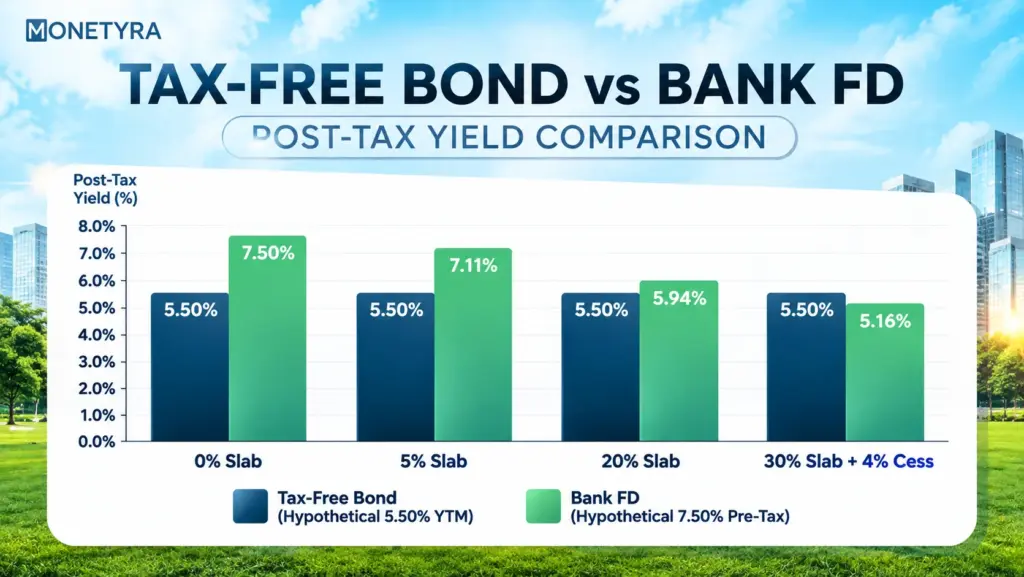
In this hypothetical example, assume a secondary-market tax-free bond offers a 5.50% YTM, while a bank FD offers 7.50% per annum (including 4% health and education cess on applicable tax slabs):
| Investor Income Tax Slab | Effective Tax Rate (incl. 4% Cess) | Hypothetical Bank FD (7.50% Pre-Tax) Post-Tax Yield | Hypothetical Tax-Free Bond (5.50% YTM) Post-Tax Yield | Pre-Tax FD Rate Needed to Match 5.50% Net |
|---|---|---|---|---|
| 0% (Exempt / Rebate) | 0.00% | 7.50% | 5.50% | 5.50% |
| 5% Slab | 5.20% | 7.11% | 5.50% | 5.80% |
| 20% Slab | 20.80% | 5.94% | 5.50% | 6.94% |
| 30% Slab | 31.20% | 5.16% | 5.50% | 7.99% |
Note: Figures above are hypothetical illustrations for educational comparison only and exclude surcharges applicable to incomes above ₹50 lakh.
Beyond yield math, the two instruments differ structurally:
- Liquidity and Capital Stability: Bank FDs allow premature withdrawal (subject to a minor bank penalty) without market price risk, whereas selling a tax-free bond early exposes you to interest-rate fluctuations and thin exchange order books.
- Alternative Sovereign Instruments: Investors in lower tax brackets or those seeking periodic rate resets often evaluate taxable sovereign options like RBI Floating Rate Savings Bonds, which adjust their coupon every six months without secondary market price volatility.
Monetyra’s Take
Secondary-market tax-free bonds remain a specialized fixed-income tool rather than an all-purpose deposit replacement. For investors in the 30% tax bracket who intend to hold until maturity, a clean YTM above 5.50% can outperform taxable bank deposits on a post-tax basis while carrying quasi-sovereign credit quality. However, because primary issuances ended over a decade ago, shrinking residual tenures and wide bid-ask spreads on the NSE and BSE mean investors in lower tax slabs—or anyone who may need early liquidity—often achieve better flexibility with standard deposits or taxable sovereign bonds.
Conclusion
Tax-free bonds provide predictable, tax-exempt annual interest under Section 10(15)(iv)(h), backed by AAA-rated public sector issuers. Because fresh primary issues ceased after FY 2015–16, participation requires buying existing tranches on the NSE or BSE and evaluating Yield to Maturity rather than the original coupon rate. Checking order-book liquidity, factoring in capital gains tax on early exits, and comparing post-tax returns against bank FDs ensure the instrument fits your tax bracket and holding horizon.
Continue Your Fixed-Income Research
Compare sovereign debt, taxable bonds, and yield strategies across Indian markets.
FAQs
1. What are tax-free bonds in India?
Tax-free bonds are long-term debt securities issued by government-backed enterprises such as NHAI, PFC, REC, and IRFC to fund infrastructure projects. Under Section 10(15)(iv)(h) of the Income-tax Act, 1961, the annual coupon interest paid to bondholders is completely exempt from personal income tax, though capital gains from selling the bonds before maturity remain taxable.
2. Are tax-free bonds still issued in India?
No, the Government of India has not authorized any new primary issuances of tax-free bonds since FY 2015–16. However, previously issued 15-year and 20-year tranches remain active and are traded daily on the secondary debt markets of the NSE and BSE, where retail investors can purchase them through a Demat account.
3. Is interest on tax-free bonds completely exempt from tax?
Yes, annual interest earned from notified tax-free bonds is 100% exempt from income tax under Section 10(15)(iv)(h), and issuers do not deduct TDS on coupon payouts. However, this exemption applies strictly to interest income; if you sell the bond on an exchange before maturity at a profit, the resulting capital gain is subject to tax.
4. How are capital gains taxed on tax-free bonds?
When you sell listed tax-free bonds on the NSE or BSE before maturity, gains are taxed under Section 112 of the Income-tax Act. If held for 12 months or less, short-term capital gains are taxed at your income tax slab rate. If held for more than 12 months, long-term capital gains are taxed at 12.5% without indexation.
5. How do tax-free bonds compare to fixed deposits for high tax slabs?
For investors in the 30% tax bracket, tax-free bonds often deliver a higher net return because their coupon income is exempt, whereas bank FD interest is taxed at slab rates. Conversely, investors in the 0% to 20% tax brackets frequently earn higher post-tax yields from standard bank FDs without facing secondary market price volatility.
6. How can retail investors buy tax-free bonds in the secondary market?
Retail investors can buy existing tax-free bonds on the NSE or BSE using a standard Demat and trading account or a SEBI-registered Online Bond Platform Provider. Search for the specific PSU bond by its ISIN, check the bid-ask spread, calculate the Yield to Maturity at the current ask price, and place a limit buy order.
Disclaimer: This article was written with the help of AI and edited by the Monetyra editorial team. It is for educational purposes only and should not be considered financial advice. Trading and investing in financial instruments involve significant risk of loss and are not suitable for all investors. Please consult a licensed financial advisor before making any investment or trading decision.