XIRR Meaning in Mutual Fund: How to Calculate It
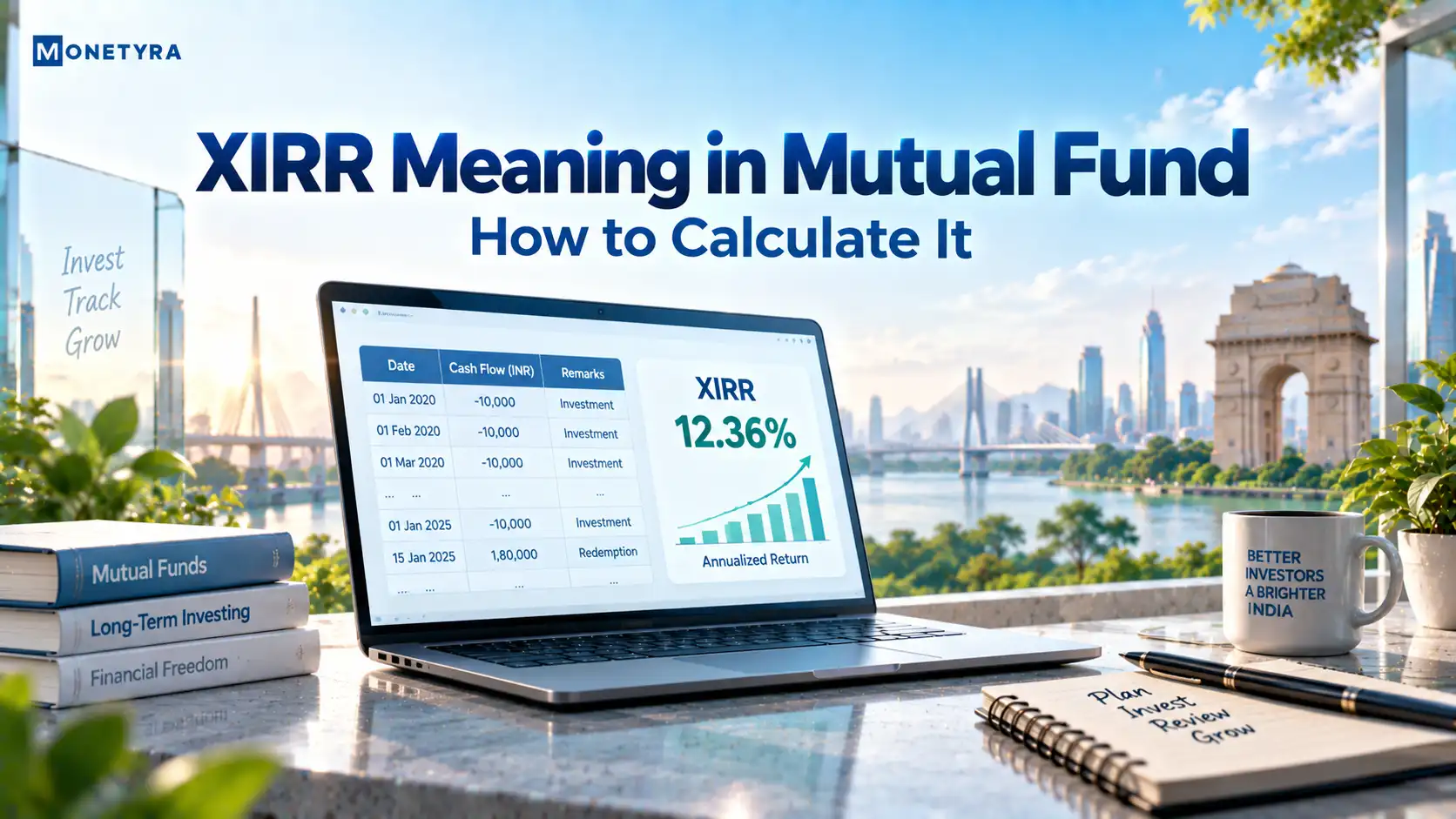
When evaluating investments made through multiple installments, relying on simple or point-to-point returns can give a misleading picture of performance. This is where understanding xirr meaning in mutual fund becomes essential. Short for Extended Internal Rate of Return, XIRR calculates the true annualized rate of return for portfolios involving multiple cash flows at different time intervals—such as monthly SIPs, top-ups, or partial redemptions.
Understanding how XIRR works, how to calculate it using Excel, and why it outperforms CAGR for SIP investments helps retail investors measure their actual portfolio growth with accuracy.
Quick Takeaways
- The xirr meaning in mutual fund context refers to Extended Internal Rate of Return—the annualized rate of return calculated across multiple cash flows occurring on different dates.
- Unlike CAGR, which assumes a single initial lumpsum payment, XIRR accounts for the exact timing of every cash inflow and outflow, making it the mandatory metric for systematic investment plans (SIPs).
- While XIRR provides an accurate reflection of multi-date cash flows, it can yield distorted annual figures when applied to SIPs held for fewer than 12 months.
What Is XIRR Meaning in Mutual Fund Investments?
The xirr meaning in mutual fund context stands for Extended Internal Rate of Return, which is the annualized yield of an investment that involves multiple cash inflows and outflows occurring at regular or irregular intervals over time.
Regulated under performance disclosure guidelines set by the Securities and Exchange Board of India (SEBI), mutual fund asset management companies (AMCs) and investment platforms use XIRR to show accurate, standardized returns for systematic investment plans (SIPs), systematic withdrawal plans (SWPs), and dividend reinvestments.
In simple terms, when you invest via a monthly What Is SIP in Mutual Fund scheme, each installment is deployed on a different date and held for a different duration. Your first ₹5,000 debit compounds for 36 months, while your latest installment compounds for only 30 days. Because simple point-to-point metrics like CAGR Meaning in Mutual Fund assume a single capital outlay, financial systems calculate XIRR to assign an individualized discount rate to every cash flow date.
Tips: Use XIRR to evaluate multi-date SIP investments, but switch to CAGR when reviewing a single lumpsum purchase.
XIRR Formula and Cash Flow Calculation Walkthrough
Understanding how to calculate xirr relies on solving for the internal rate of return that brings the net present value (NPV) of all cash flows to zero:
0 = ∑ [Cash Flow_i ÷ (1 + XIRR) ^ ((Date_i – Date_0) ÷ 365)]
Unlike simple arithmetic formulas, the mathematical xirr formula requires an iterative trial-and-error approach to find the exact rate where all discounted cash inflows balance all discounted cash outflows.
Cash Flow Directional Rules
To set up an XIRR calculation correctly in software tools like Excel or Google Sheets, cash flows must follow strict directional signs:
- Negative Cash Flows (-): Money leaving your bank account (e.g., monthly SIP debits, purchase installments, or initial lumpsum buys).
- Positive Cash Flows (+): Money returning to you or the final portfolio market value (e.g., scheme redemptions, dividend payouts, or current Net Asset Value).
Step-by-Step Calculation Example
Suppose you started a 3-month SIP of ₹10,000 in an equity mutual fund, followed by a redemption on the 4th month:
- January 1, 2026: Outflow of ₹10,000 → Entered as -10,000
- February 1, 2026: Outflow of ₹10,000 → Entered as -10,000
- March 1, 2026: Outflow of ₹10,000 → Entered as -10,000
- April 1, 2026: Final Redemption NAV Value of ₹31,500 → Entered as +31,500
Plugging these exact dates and signed values into the spreadsheet function =XIRR(values, dates) evaluates the precise time-weighted efficiency of each ₹10,000 debit across its respective holding window.

XIRR vs CAGR: Key Differences
Investors evaluating portfolio performance frequently compare XIRR vs CAGR to determine which metric matches their investment strategy:
| Feature | CAGR (Compound Annual Growth Rate) | XIRR (Extended Internal Rate of Return) |
|---|---|---|
| Primary Use Case | Single Lumpsum investments | Recurring investments (SIPs, SWPs, STPs) |
| Cash Flow Count | Exactly two (Initial buy + Final sell) | Multiple cash flows across different dates |
| Cash Flow Timing | Assumes single point-to-point tenure | Factors in exact calendar dates for each debit |
| Calculation Method | Direct geometric algebraic formula | Iterative discount rate algorithm |
| Ideal Asset Strategy | Single capital deployment in SIP vs Lumpsum | Multi-installment plans like What Is Step Up SIP |
While CAGR provides a clear annual rate for single purchases, applying CAGR to recurring installments produces distorted return figures because it misinterprets later debits as having compounded for the entire tenure.
Single Lumpsum Purchase → Evaluate with CAGR
Recurring Monthly SIP → Evaluate with XIRR
What Does XIRR Meaning in SIP Refer To?
In retail wealth management, xirr meaning in sip refers to the true annualized rate of return earned on a systematic investment plan where funds leave your bank account in multiple installments.
When an investor sets up a monthly SIP debit, each ₹1,000 or ₹5,000 installment buys mutual fund units at varying NAV prices on different dates. When you check your portfolio dashboard on apps like Zerodha Coin or Groww, the platform displays XIRR rather than absolute return. This ensures that an installment invested 3 years ago and an installment invested 3 weeks ago are discounted according to their exact days in the market.
Key Limitations of XIRR
While XIRR is an essential metric endorsed by the Association of Mutual Funds in India (AMFI), retail investors should recognize its specific analytical boundaries:
- Short-Term Distortion: For SIPs running for less than 12 months, XIRR annualizes short-term market swings, often producing misleadingly extreme annual percentage figures (e.g., a 2-month 5% gain might project as a 35% XIRR).
- Exact Date Dependency: A single incorrect date or missing cash flow entry in transaction logs skews the entire XIRR calculation.
- Ignores Volatility Sequences: XIRR measures annualized cash flow efficiency, but it hides severe interim NAV drawdowns experienced during market corrections.
Warning: A high short-term XIRR in the first few months of a new SIP does not guarantee future performance; long-term compounding requires evaluating schemes over 3 to 5-year horizons.
Capital Gains Taxation on SIP Redemptions
When redeeming units accumulated through a multi-installment SIP, capital gains taxes are computed under rules governed by the Income Tax Department using First-In, First-Out (FIFO) accounting.
Under FIFO rules, the units bought during your earliest SIP installment are treated as redeemed first:
For Equity Mutual Funds:
- Short-Term Capital Gains (STCG): Gains realized on units held for less than 12 months are taxed at 20%.
- Long-Term Capital Gains (LTCG): Gains realized on units held for 12 months or longer are taxed at 12.5% on aggregate net gains exceeding ₹1.25 lakh in a fiscal year.
Because each monthly SIP purchase starts its own independent 12-month holding clock, units redeemed together in a single transaction may trigger both STCG and LTCG tax liabilities simultaneously.
Conclusion
Understanding the xirr meaning in mutual fund investing provides an accurate framework to measure true annualized returns across multi-date cash flows. By accounting for the exact calendar date of every purchase and withdrawal, XIRR gives retail investors a realistic picture of wealth accumulation in systematic investment plans. However, to avoid misleading annualized projections, investors should combine XIRR analysis with long-term tenure horizons when evaluating mutual fund performance.
Master mutual fund metrics, calculation formulas, and regulatory standards with our clear educational guides.
FAQs
XIRR (Extended Internal Rate of Return) is the annualized return on an investment that involves multiple cash flows occurring on different dates, such as regular monthly SIP debits.
The formula solves for the discount rate where 0 = ∑ [Cash Flow_i ÷ (1 + XIRR) ^ ((Date_i – Date_0) ÷ 365)], discounting each cash flow back to its present value based on exact calendar days.
CAGR measures annualized growth for a single lumpsum investment with one purchase date, whereas XIRR calculates annualized returns for multiple cash flows across various dates, such as recurring SIPs.
To calculate XIRR, list all investment dates with negative cash flow values (e.g., -5000) and the final portfolio value with a positive sign (e.g., +65000) in Excel, then apply the =XIRR(values, dates) function.
In SIPs, XIRR refers to the real annualized yield earned across all individual monthly installments, accounting for the unique duration each debit has spent compounding in the fund.
CAGR assumes a single lump sum invested at the start. Since SIP debits occur on different dates throughout the year, CAGR gives an inaccurate return, whereas XIRR factors in time-weighted cash flows.
Disclaimer: This article was written with the help of AI and reviewed by the Monetyra editorial team. It is for educational purposes only and should not be considered financial advice. Trading and investing in financial instruments involve significant risk of loss and are not suitable for all investors. Please consult a licensed financial advisor before making any investment decision.
In India, mutual fund operations are regulated by the Securities and Exchange Board of India (SEBI) and trade execution platforms are hosted across exchanges like the National Stock Exchange (NSE). Investors should evaluate scheme documents carefully before committing capital.