KYC for Demat Account: SEBI Rules, 6 Attributes & Update
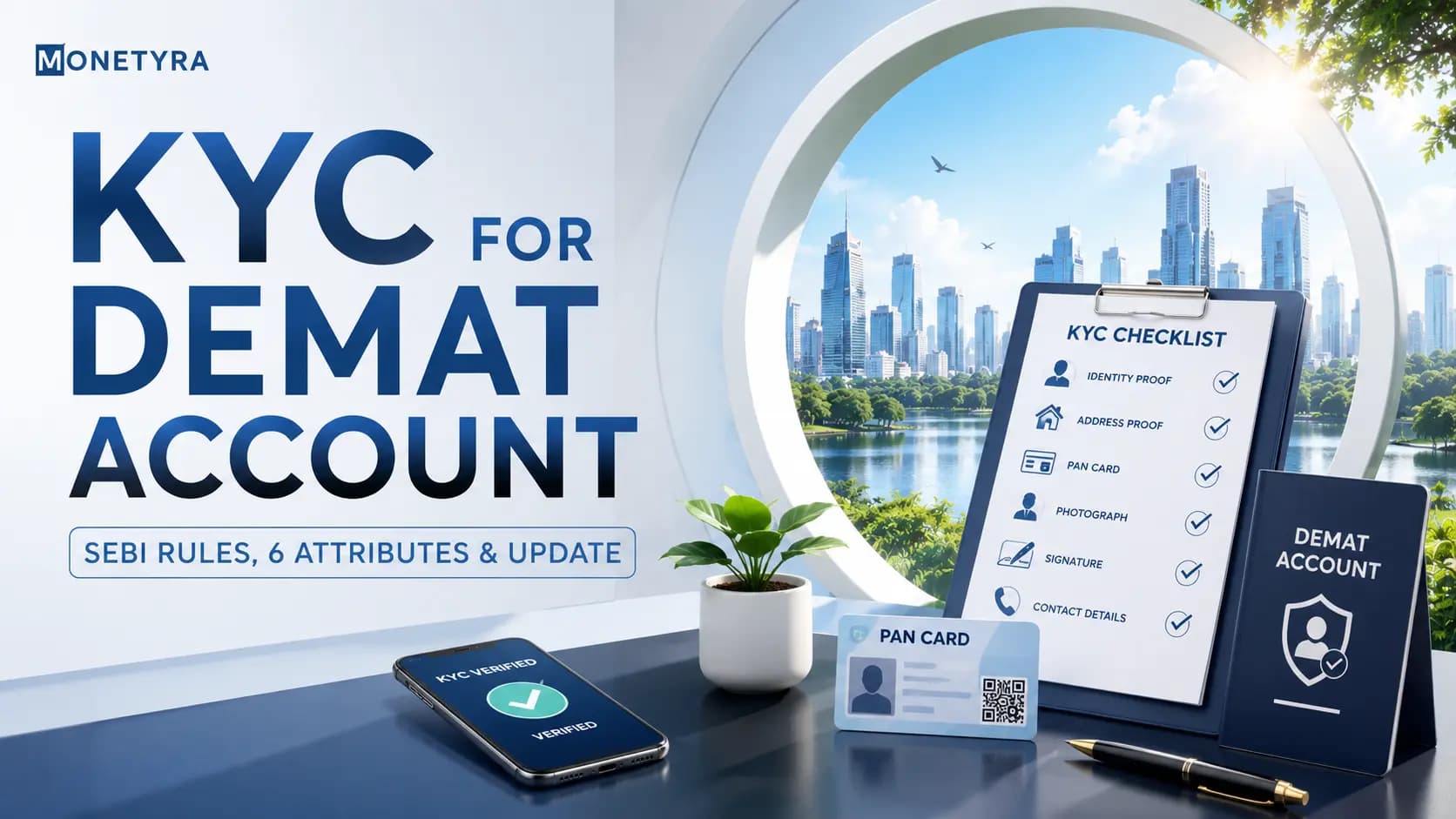
Imagine arriving at an international airport terminal before a major flight. Before security guards allow you to step onto the boarding bridge or enter the departure lounge, official border officers must check your passport and verify your identity ticket. If your documentation is outdated or missing a photo verification stamp, you won’t be permitted to board the aircraft—no matter how valid your airline ticket is.
In Indian equity markets, completing kyc for demat account profiles acts as that essential airport security verification. Enforced by the Securities and Exchange Board of India (SEBI) under anti-money laundering frameworks, verifying your identity ensures your trading profile remains fully active, protecting your investment portfolio from administrative freezes.
Quick Takeaways
- Core Definition: The kyc for demat account process is the statutory identity and address verification framework mandated by SEBI to verify investors and prevent financial fraud in capital markets.
- Primary Mechanism: KYC Registration Agencies (KRAs) like CVL, NDML, and CAMS validate your primary tax identifiers and address records across central depositories like NSDL and CDSL.
- Primary Risk / Limit: While completing KYC grants unhindered access to stock market trading, an active verified Demat account does not shield your investments from equity price volatility or capital losses.
What Is KYC for Demat Account?
The kyc for demat account process is the mandatory identity verification procedure required by Indian market regulators before an individual can hold or trade electronic securities.
When setting up a trading profile or calculating Demat Account Opening Charges, stockbrokers collect official identity credentials to create a Central KYC (CKYC) record under the Prevention of Money Laundering Act. Verified details are registered across licensed KYC Registration Agencies (KRAs) so you do not need to resubmit physical documents every time you join a new financial platform.
- Investor Security: Prevents impersonation, unauthorized share transfers, and illegal money laundering.
- Market Access: Ensures seamless settlement of trades across the National Stock Exchange (NSE) and the Bombay Stock Exchange (BSE).
Tips: You can check your existing CKYC status online by entering your PAN on any official KRA portal (such as CVL KRA or CAMS KRA).
6 Mandatory KYC Attributes for Demat Account
Under updated regulatory guidelines, SEBI enforces mandatory kyc attributes for demat account profiles to ensure no account operates with incomplete information. Missing even a single attribute triggers an automatic account freeze.
- Full Name: Must match your Permanent Account Number (PAN) card records exactly.
- PAN Number: Primary tax identifier seeded directly with your Aadhaar database.
- Residential Address: Validated proof of address using Aadhaar XML, Passport, or Voter ID.
- Mobile Number: Unique active phone number verified through one-time passwords (OTP).
- Email Address: Active personal email required for electronic contract notes and transaction alerts.
- Income Range: Declared annual income bracket ensuring financial suitability for trading derivatives.
Warning: If your registered PAN is not linked with your Aadhaar, your Demat account KYC status will automatically change to ‘Inoperative’ under Indian tax laws.
Understanding KRA Statuses: Validated vs On-Hold
SEBI classifies investor profiles into three distinct KRA status categories, determining your market portability:
- KYC Validated: Your identity and address were verified via Aadhaar XML or DigiLocker. You can trade seamlessly and open new accounts across any SEBI-registered broker without submitting fresh documents.
- KYC Registered: Verified using non-Aadhaar proofs (such as a physical driving license or bank statement). Your existing account remains active, but opening an account with a new broker requires re-verification.
- KYC On-Hold / Rejected: Triggered by unvalidated mobile/email contact details or unlinked PAN-Aadhaar records. All sell transactions and debit transfers are blocked until corrected.
How to Complete Online KYC for Demat Account
Completing an online kyc for demat account registration is entirely paperless and takes under 10 minutes through licensed depository participants.
- Enter Personal Identifiers: Provide your PAN and date of birth on your broker’s official app or portal.
- Fetch Address via DigiLocker: Authenticate your Aadhaar via DigiLocker to import verified address records instantly.
- In-Person Verification (VIPV): Record a short 10-second video or webcam verification showing your face clearly alongside your original PAN card.
- Digital Aadhaar e-Sign: Sign your electronic application form using an Aadhaar OTP verification.
Remember to complete Nomination in Demat Account details during this online onboarding process to secure your beneficiary rights.
| KRA Status | Verification Method | Existing Account Status | New Broker Opening |
|---|---|---|---|
| KYC Validated | Aadhaar XML / DigiLocker | Fully Active | Instant / Seamless |
| KYC Registered | Non-Aadhaar Official Proof | Fully Active | Re-verification Needed |
| KYC On-Hold | Invalid Contact / Unlinked PAN | Debit / Trading Frozen | Blocked Until Update |
KYC Update for Demat Account: Fixing On-Hold Statuses
Executing a kyc update for demat account records is simple if your trading profile gets flagged with an ‘On-Hold’ status.
Log into your broker’s modification portal, update your contact details, re-link your PAN with Aadhaar on the Income Tax portal, and submit an Aadhaar e-KYC re-validation request. Staying compliant with SEBI Regulations ensures your investments remain accessible whenever you decide to trade.
Learn stock market fundamentals, demat account opening, regulatory rules, and trading basics.
FAQs
You need a PAN card (primary identity and tax proof), an Aadhaar card (or Passport/Voter ID for address proof), a bank account statement, and a digital passport-size photograph.
The 6 mandatory attributes mandated by SEBI are your Full Name, PAN Number, Residential Address, Mobile Number, Email Address, and Income Range.
You can complete online KYC by entering your PAN, fetching address records via DigiLocker, completing a short Video In-Person Verification (VIPV), and e-Signing with an Aadhaar OTP.
Visit any official KRA website (such as CVL KRA, NDML KRA, or CAMS KRA), enter your 10-digit PAN, and click submit to view your status as Validated, Registered, or On-Hold.
If your KYC is On-Hold, your stockbroker will freeze sell transactions and debit transfers until you re-validate your Aadhaar or contact details.
Yes, a PAN card is the primary statutory identifier required by SEBI to open and operate a Demat account in India.
Disclaimer: This article was written with the help of AI and reviewed by the Monetyra editorial team. It is for educational purposes only and should not be considered financial, legal, or tax advice. Investing and trading in financial instruments involve significant risk of capital loss. Please consult a licensed professional before making investment decisions.
In India, investor verification and Demat account operations are regulated under SEBI KRA directives. Readers are advised to check their KRA validation status directly on official depository portals.