When Was SEBI Established? History, Structure, and Core Role

The Securities and Exchange Board of India (SEBI) was first established on April 12, 1988, as a non-statutory body, and it later gained statutory powers on January 30, 1992, under the SEBI Act, 1992. Understanding when SEBI established its statutory authority gives you a clear view of why India’s stock and mutual fund markets follow strict investor-protection standards today. Before this single authority existed, oversight across Indian stock exchanges was fragmented, leaving retail participants exposed to price manipulation and settlement delays.
Quick Takeaways
- Two-Stage Creation: The Government of India set up SEBI on April 12, 1988, via an administrative resolution as a non-statutory body, and granted it full statutory authority on January 30, 1992, through the SEBI Act, 1992.
- Headquarters and Oversight: Operating under the Ministry of Finance, SEBI is headquartered in Mumbai and supervises stock exchanges, depositories, brokers, and mutual funds across India.
- Regulatory Boundary: While SEBI enforces transparency and penalizes market fraud, regulatory supervision cannot protect your portfolio against normal market downturns or poor investment decisions.
When Was SEBI Established?
SEBI was established in 1988 as an executive body and empowered as a statutory regulator in 1992.
When readers ask what SEBI is, the simplest answer is that it serves as India’s primary capital market regulator under the administrative domain of the Ministry of Finance. Its establishment happened in two distinct legal phases rather than on a single date:
- Non-Statutory Phase (April 12, 1988): The Indian government created SEBI through an executive resolution to observe market practices and advise on reforms. During these initial four years, SEBI lacked independent legal authority to issue binding penalties or stop fraudulent market activity.
- Statutory Phase (January 30, 1992): To give the regulator real enforcement power, the government promulgated the SEBI Ordinance on January 30, 1992, which Parliament soon enacted as the SEBI Act, 1992. This law made SEBI an autonomous statutory body capable of framing rules, inspecting records, and punishing violators.
Why India Established SEBI in the Early 1990s
India established a statutory regulator because rapid market growth in the late 1980s and early 1990s overwhelmed older oversight laws. Before 1992, capital issues were controlled by the Controller of Capital Issues under the Capital Issues (Control) Act, 1947. That legacy system focused on approving company share prices rather than monitoring daily trading fairness.
As retail participation expanded alongside India’s 1991 economic liberalization, severe structural gaps appeared across local stock exchanges:
- Price Rigging and Insider Trading: Weak enforcement allowed operator cartels to artificially inflate share prices and trade on non-public company news.
- Settlement Delays and Paper Risk: Physical share certificates took weeks to transfer, creating frequent disputes over fake certificates and bad deliveries.
- Lack of Accountability: Without an independent watchdog holding legal powers, stock exchanges struggled to discipline their own broker members.
SEBI Historical Timeline: Key Milestones
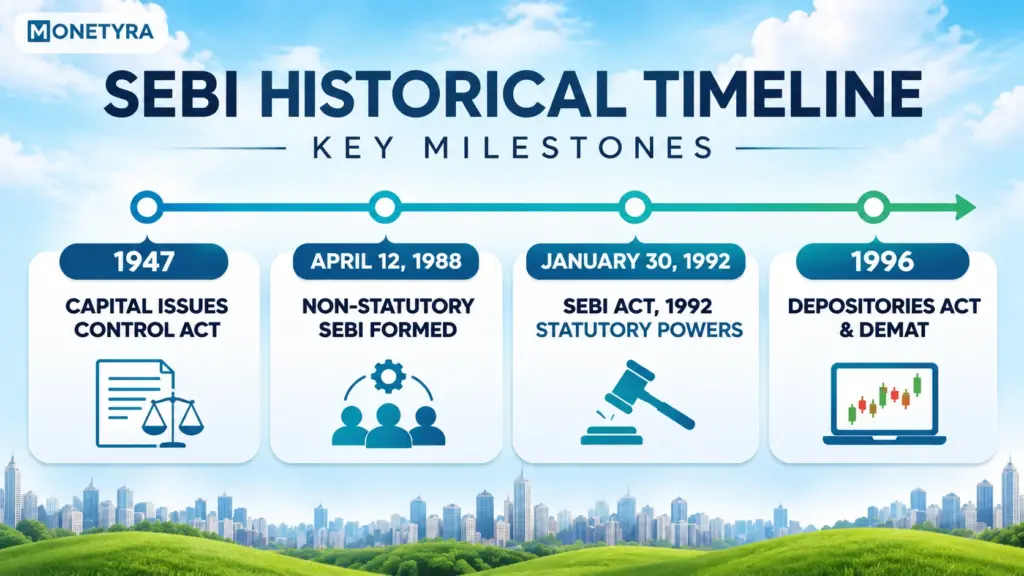
SEBI’s history reflects a step-by-step transition from manual, fragmented trading to a centralized electronic market. Each milestone below marks a major shift in how Indian capital markets are governed:
| Year / Date | Milestone Event | Legal & Market Impact | Source |
|---|---|---|---|
| 1947 | Capital Issues (Control) Act Enacted | Established the Controller of Capital Issues to regulate corporate capital raising before SEBI existed. | SEBI Official (About SEBI) |
| April 12, 1988 | Non-Statutory SEBI Formed | Created by a Government of India resolution as an advisory and monitoring body without enforcement powers. | SEBI Official (About SEBI) |
| January 30, 1992 | SEBI Act, 1992 Comes Into Force | Granted SEBI autonomous statutory powers. The Capital Issues (Control) Act, 1947 was repealed separately in May 1992. | SEBI Official (About SEBI) |
| 1996 | Depositories Act Enacted | Enabled electronic share storage (dematerialization) through NSDL and CDSL under SEBI oversight. | SEBI Official (About SEBI) |
SEBI Structure, Leadership, and Headquarters
SEBI operates as a corporate body with its head office located in Mumbai, Maharashtra—India’s financial capital. To supervise regional trading hubs and assist investors nationwide, SEBI also maintains regional offices in major cities including New Delhi, Kolkata, Chennai, and Ahmedabad, alongside local offices in other states.
The organization is managed by a Board of Members appointed by the Government of India and the Reserve Bank of India (RBI). Under the SEBI Act, 1992, the board consists of a Chairperson, two members from Union Ministries, one member from the RBI, and five other members appointed by the central government (of whom at least three serve as whole-time members).
3 Core Roles of SEBI in Indian Markets
To fulfill the statutory mandate granted when SEBI established in 1992, the board performs three primary roles across exchanges such as the National Stock Exchange (NSE) and the Bombay Stock Exchange (BSE):
- Protective Role: SEBI safeguards retail investors by banning insider trading, curbing unfair price manipulation, and running financial literacy campaigns.
- Regulatory Role: SEBI registers, audits, and enforces compliance rules for stock exchanges, brokers, depositories, and mutual fund asset management companies.
- Developmental Role: SEBI modernizes market infrastructure by promoting paperless electronic trading, shortening settlement cycles, and streamlining digital investor onboarding.
To carry out these roles effectively, the SEBI Act combines three types of authority in one institution: quasi-legislative power (drafting rules), quasi-executive power (conducting inspections and investigations), and quasi-judicial power (passing enforcement orders and levying penalties).
Tip: Before opening a trading or mutual fund account, check the intermediary’s registration number on SEBI’s official website to confirm they are legally authorized to operate.
How SEBI Establishment Connects to Modern Market Rules
Understanding SEBI’s origin explains where today’s market rules get their legal backing, though the specific compliance rules themselves fall under separate frameworks. Since its statutory creation in 1992, SEBI has issued detailed rulebooks covering every participant in the Indian securities ecosystem:
- Ongoing Market Supervision: To see how SEBI applies its legal authority to daily trading, surveillance, and enforcement today, review our guide on core SEBI regulations and current market rules.
- Listed Company Disclosures: Publicly traded companies must follow strict transparency and corporate governance standards set under the SEBI Listing Obligations and Disclosure Requirements (LODR).
- Intermediary Licensing: Professionals who charge fees for financial advice or publish stock recommendations must register as a SEBI Registered Investment Advisor (RIA) or a SEBI Registered Research Analyst (RA).
Warning: SEBI’s regulatory framework reduces the risk of broker fraud and corporate non-disclosure, but it does not insure your capital against stock market losses.
Conclusion
SEBI’s journey from a non-statutory committee in April 1988 to an empowered statutory body in January 1992 transformed India’s capital markets. Created to end price manipulation and fragmented oversight, SEBI now anchors market integrity from its Mumbai headquarters through protective, regulatory, and developmental functions. Knowing how was SEBI established helps you verify licensed intermediaries and understand the legal framework protecting your investments.
Continue Learning Indian Stock Market Basics
Build a solid foundation in demat accounts, exchange rules, and equity investing.
FAQs
1. In which year was SEBI established?
SEBI was first established on April 12, 1988, as a non-statutory body through an executive resolution of the Government of India. It later became an autonomous statutory body on January 30, 1992, when the SEBI Act, 1992 came into force.
2. Why was SEBI established in India?
India established SEBI to protect retail investor interests, curb market malpractices such as price rigging and insider trading, and promote orderly market growth. Before 1992, oversight under the Capital Issues (Control) Act, 1947 was too limited to police rapidly expanding stock exchanges.
3. When did SEBI become a statutory body?
SEBI became a statutory body on January 30, 1992, when the Government of India brought the SEBI Act, 1992 into effect. This legislation granted SEBI independent legal powers to draft regulations, inspect market intermediaries, and impose financial penalties.
4. Where is the headquarters of SEBI located?
SEBI’s head office is located in Mumbai, Maharashtra. To oversee market operations and support retail investors across India, SEBI also operates regional offices in New Delhi, Kolkata, Chennai, and Ahmedabad, along with several local offices.
5. What is the full form of SEBI?
The full form of SEBI is the Securities and Exchange Board of India. Operating under the administrative domain of the Ministry of Finance, it serves as the statutory regulator for securities and commodity derivatives markets in India.
Disclaimer: This article was written with the help of AI and edited by the Monetyra editorial team. It is for educational purposes only and should not be considered financial advice. Trading and investing in financial instruments involve significant risk of loss and are not suitable for all investors. Please consult a licensed financial advisor before making any investment or trading decision.