What Is an At the Money Option? (ATM Explained)
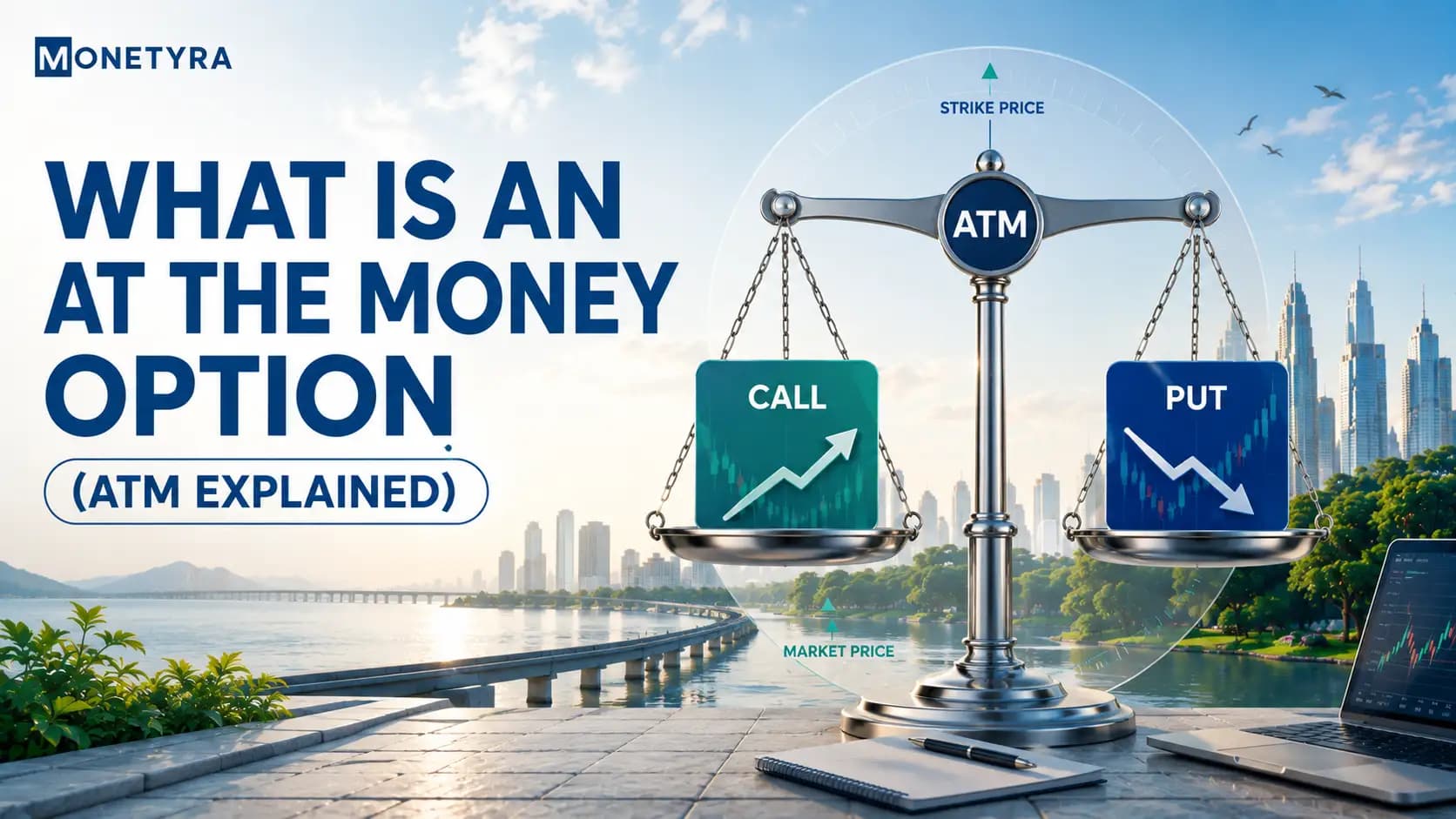
Imagine betting on a football game that is currently tied 1-1 with five minutes left on the clock. The tension is at its peak because the very next move determines everything. In the derivatives market, a similar “tied game” scenario happens every day. When the market price of an asset sits exactly on the starting line of your contract, you are looking at an ATM option. These specific contracts are popular among traders because they react quickly to market moves, but they also carry intense risks as the expiration countdown ticks away.
Quick Takeaways
- An ATM option is a contract where the strike price is exactly equal to the current market price of the underlying asset.
- These options offer high liquidity and maximum sensitivity to sudden price swings, making them a frequent choice for breakout traders.
- Because they consist entirely of time value, holding them exposes you to rapid premium erosion, meaning you can lose your entire investment if the market fails to move in your favor.
What Is an At the Money Option (ATM)?
This contract is a derivative where the strike price is exactly equal to the current market spot price of the underlying asset.
For traders, this state acts as the ultimate tipping point. If the market moves in your anticipated direction, the contract quickly gains real value. If it moves against you, it falls out of favor just as fast.
What is at the money option in simple terms?
When people ask what ATM really means, it helps to view it as an active crossroads. You do not have any built-in profit at this stage; you are simply paying a premium for the potential that the asset will break out from its current exact price before the contract expires.
Key Characteristics of ATM Options
Understanding how these contracts behave requires a brief look at options pricing mechanics, specifically the “Greeks.”
Delta of at the money option
Delta measures how much an option’s premium will change for every ₹1 move in the underlying asset. The delta of an ATM contract is approximately 0.50 for calls and -0.50 for puts. This means if a stock moves up by ₹1, the call option premium will increase by roughly ₹0.50. This 50/50 probability reflects the “tied game” nature of ATM contracts.
Intrinsic value of at the money option
Options premiums are made of two parts: intrinsic value (real, immediate value) and extrinsic value (time value). The intrinsic value of an ATM contract is always zero. Because the strike price and the market price are identical, there is no immediate financial advantage to exercising the contract today. You are paying purely for the time left until expiration.
Difference Between ITM, ATM, and OTM Options
To fully grasp options trading, you must understand moneyness. The difference between itm atm and otm options comes down to where the strike price sits relative to the current market price.

- In the money option (ITM): The option already has intrinsic value (e.g., a call option where the strike is lower than the current price).
- ATM: The strike price equals the current price.
- Out of the money option (OTM): The option has no intrinsic value and requires a large market move to become profitable.
Moneyness Comparison (Call Options)
| Option State | Strike Price vs Spot Price | Intrinsic Value | Premium Cost |
|---|---|---|---|
| ITM | Strike is lower than Spot | Yes | Most expensive |
| ATM | Strike equals Spot | Zero | Moderate |
| OTM | Strike is higher than Spot | Zero | Cheapest |
At the Money Option Example in the Indian Market
To see this in action, let’s look at an ATM example using the Nifty 50 index on the National Stock Exchange (NSE).
Assume the Nifty 50 spot price is currently trading exactly at 24,000.
- If you buy the Nifty 24,000 Call (CE — Call European), you hold an ATM call option.
- If you buy the Nifty 24,000 Put (PE — Put European), you hold an ATM put option.
Because indices rarely sit on perfect round numbers, the closest available strike is treated as ATM. For instance, if Nifty is at 24,020, the 24,000 strike is considered the ATM contract because NSE typically operates with 50-point strike intervals for the Nifty 50.
Pros and Cons of Trading ATM Options
Trading these contracts offers specific structural benefits, but the risks are substantial.
- High Liquidity: ATM options are generally the most heavily traded contracts, ensuring tight bid-ask spreads and easy entry and exit.
- High Sensitivity (Gamma): They respond very quickly to directional market moves.
- Severe Time Decay: Because the premium is 100% time value, you face massive time decay in options (Theta) as expiration nears.
Warning: The biggest risk of buying ATM options is market stagnation. If the underlying asset stays flat and does not move before expiration, the option will expire worthless, resulting in a 100% loss of your premium.
The Securities and Exchange Board of India (SEBI) consistently reminds retail traders of this structural disadvantage. Official risk disclosures note that 9 out of 10 retail traders in the equity F&O segment lose money, largely due to the unforgiving nature of time decay on purchased options.
Conclusion
An ATM contract sits at the precise intersection of the strike price and the current market price. While they offer excellent liquidity and react swiftly to market breakouts, their lack of intrinsic value makes them highly vulnerable to time decay. Traders must accurately predict both the direction and the timing of a price move to succeed.
Ready to explore how time and volatility shape your trading edge?
FAQs
If Reliance Industries is trading at ₹3,000 in the spot market, a call or put option with a strike price of exactly ₹3,000 is considered at the money.
ITM options have a strike price favorable to the current market and hold real intrinsic value. ATM options have a strike equal to the market price. OTM options have a strike price worse than the market price and hold no intrinsic value.
It depends on your strategy. ITM options are more expensive but carry less time-decay risk because they have intrinsic value. ATM options are cheaper and offer higher leverage, but carry a higher risk of expiring worthless if the market does not move.
No. An ATM option consists entirely of extrinsic (time) value. It only gains intrinsic value if the market moves favorably, pushing the contract into the money.
The Delta for an ATM call option is typically around 0.50, and for an ATM put option, it is around -0.50. This reflects a roughly 50% probability that the option will finish in the money.
Disclaimer: This article was written with the help of AI and reviewed by the Monetyra editorial team. It is for educational purposes only and should not be considered financial advice. Trading and investing in financial instruments involve significant risk of loss and are not suitable for all investors, and past performance of any strategy does not guarantee future results. Please consult a licensed financial advisor before making any investment or trading decision.
In India, equity derivatives are regulated by the Securities and Exchange Board of India (SEBI). Readers are advised to verify the regulatory status of their broker and ensure compliance with applicable Indian laws before investing.