Bank Nifty Lot Size: Current NSE Rules and Contract Math
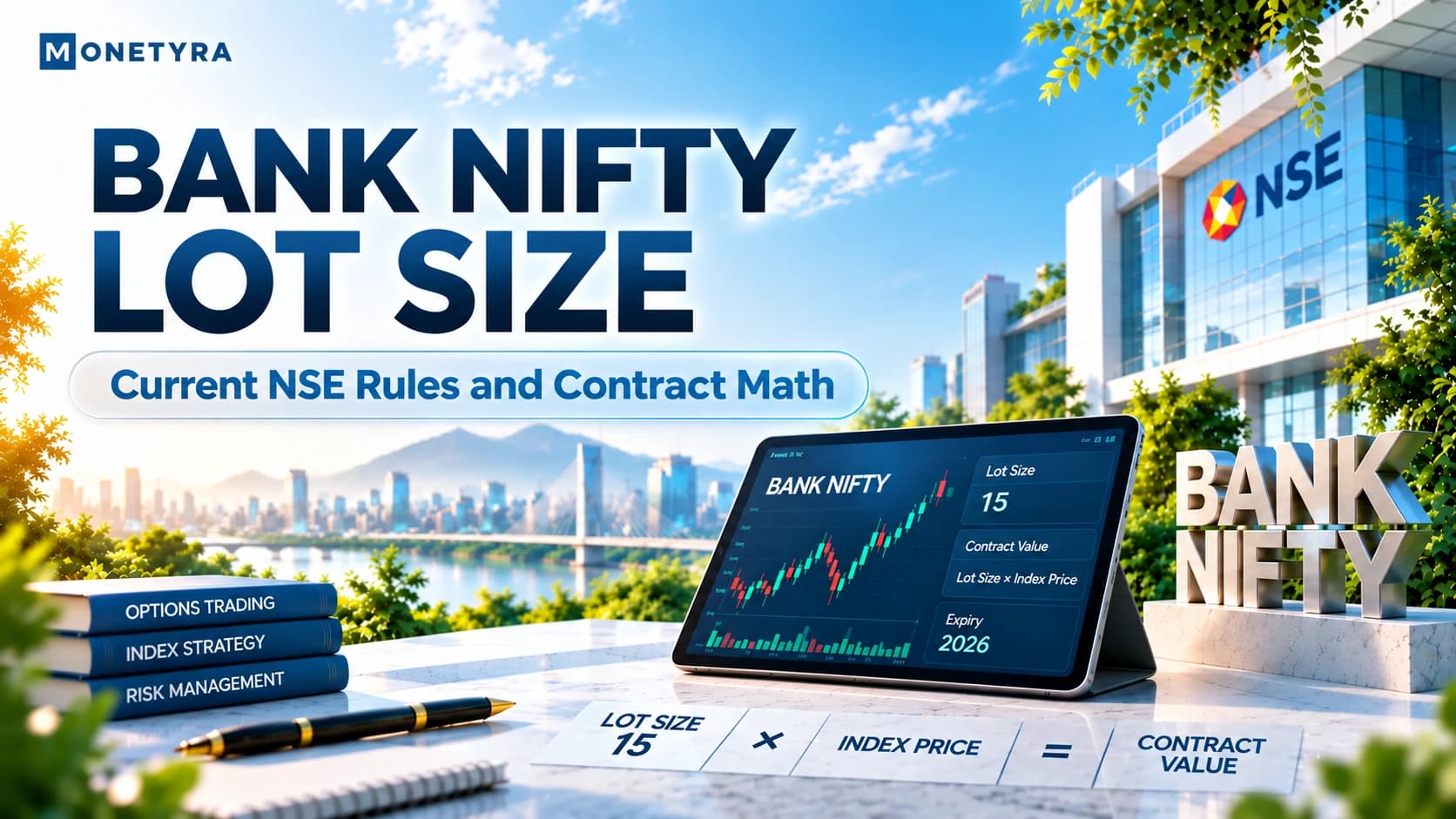
Trading Bank Nifty derivatives without checking the exact contract unit can quickly distort your position risk. Because the index trades at a high point level, a small shift in the standardized multiplier changes your rupee exposure on every single point move.
The current Bank Nifty lot size is 30 units per contract as of November 16, 2026, according to the National Stock Exchange (NSE). Understanding how this 30-unit standard works across futures and options helps you calculate upfront cash needs, margin buffers, and maximum order limits before placing a trade.
Quick Takeaways
- The standardized Bank Nifty lot size is 30 units per contract for both futures and options on the NSE as of November 16, 2026.
- Every 1-point move in a Bank Nifty futures price or an option premium equals ₹30 in profit or loss per lot.
- Bank Nifty contracts expire only on a monthly and quarterly schedule, meaning option buyers pay higher upfront time value per lot than under the old weekly cycle.
What Is the Current Bank Nifty Lot Size?
The official Bank Nifty lot size is 30 units per contract as of November 16, 2026, under National Stock Exchange (NSE) derivatives rules (Circular NSE/FAOP/70616). This 30-unit lot applies uniformly to both Nifty Bank (BANKNIFTY) futures and options contracts, and all exchange orders must be placed in exact multiples of 30 units (such as 30, 60, or 90).
When the exchange adjusts the lot size, your per-point tick exposure shifts immediately. At 30 units per contract, a 1-point price movement in either the underlying futures price or an option premium translates to exactly ₹30 in realized or unrealized P&L for a single lot.
| Contract Parameter | Current Specification (as of Nov 16, 2026) | Practical Impact for Traders |
|---|---|---|
| Underlying Index | Nifty Bank (BANKNIFTY) | Tracks 12 major Indian banking stocks |
| Standard Lot Size | 30 units per contract | Minimum order quantity is 30 units |
| Point Value (Tick Impact) | ₹30 per 1-point move | A 100-point move equals ₹3,000 per lot |
| Expiry Cycle | Monthly and Quarterly only | No weekly options contracts exist |
| Expiry Day | Last Tuesday of the expiry month | Shifts to previous trading day if Tuesday is a holiday |
| Quantity Freeze Limit | 900 units (30 lots) per order | Single orders above 30 lots are rejected automatically |
Bank Nifty Lot Size Revision History
The NSE has revised the BANKNIFTY contract multiplier several times over recent years to keep derivative contract values aligned with regulatory thresholds. Tracking these historical changes prevents position-sizing errors when reviewing older trade logs or backtesting past strategies.
| Announcement Circular | Circular Date | Effective Contract Cycle | Bank Nifty Lot Size | Direction of Change |
|---|---|---|---|---|
| NSE/FAOP/56233 | March 31, 2023 | July 2023 expiry onward | 15 units | Reduced from 25 units |
| NSE/FAOP/64625 | October 18, 2024 | November 20, 2024 onward (new contracts) | 30 units | Increased from 15 units |
| NSE/FAOP/67372 | March 28, 2025 | July 2025 expiry onward | 35 units | Increased from 30 units |
| NSE/FAOP/70616 | October 3, 2025 | January 2026 expiry onward (from Dec 31, 2025) | 30 units | Reduced from 35 units |
These adjustments stem from rules set by the Securities and Exchange Board of India (SEBI) in October 2024, which require index derivative contracts to maintain a notional value within the ₹15 lakh to ₹20 lakh band during periodic reviews. For a complete breakdown of how SEBI calculates these valuation bands, handles multi-month contract transitions, and sets lot sizes for Nifty 50 and other indices, check SEBI’s official circulars.
How Bank Nifty Expiry Rules Affect Lot Sizing
Bank Nifty no longer offers weekly options contracts, leaving only monthly contracts expiring on the last Tuesday of each month alongside quarterly series (Circular NSE/FAOP/68747). Following SEBI’s October 2024 derivative framework limiting each exchange to a single weekly benchmark index, the NSE retained weekly expiries exclusively for Nifty 50 and discontinued weekly series for BANKNIFTY.
This monthly-only structure directly affects how much capital you commit per lot when buying options. Because monthly contracts carry up to four or five weeks of remaining time to expiration, at-the-money (ATM) option premiums carry noticeably more time value than old weekly contracts did.
Even though the lot size stands at 30 units, paying ₹600 or ₹800 per unit for a fresh monthly option requires ₹18,000 to ₹24,000 in upfront cash per lot. You can explore how traders adjust strike selection and holding periods for longer-dated expiries in our guide on Bank Nifty options trading strategies.
Why Bank Nifty Volatility Differs from Nifty 50
A 30-unit lot in Bank Nifty behaves very differently from a standard lot in Nifty 50 because of both index concentration and point level. While Nifty 50 spreads its weight across 50 companies spanning multiple sectors, Bank Nifty concentrates entirely on 12 liquid banking stocks.
Two structural factors drive sharper rupee swings per lot in Bank Nifty:
- Sector Concentration: Heavyweight private and public sector banks dominate the index, meaning Reserve Bank of India (RBI) policy decisions, credit growth updates, or quarterly bank earnings can trigger rapid single-day moves across the entire basket. You can inspect individual constituent weights in our Bank Nifty stock weightage breakdown.
- Higher Index Base: Because Bank Nifty trades at roughly double the numerical point level of Nifty 50, an identical 1% market move generates twice as many index points. In a hypothetical scenario where Bank Nifty sits at 60,000 points, a 1% swing equals 600 points, which translates to an ₹18,000 change on a single 30-unit futures lot.
How to Calculate Bank Nifty Contract Value and Option Premium
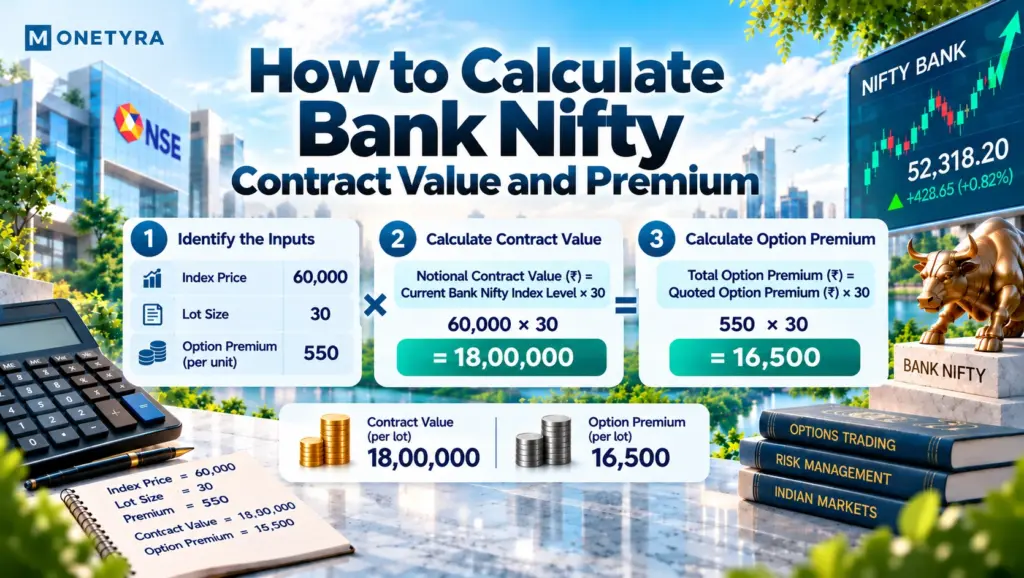
You only need two standard formulas, notional contract value and total option premium, to compute your total market exposure and upfront option cost before submitting an order on your broker terminal.
Notional Contract Value (₹) = Current Bank Nifty Index Level × 30
Total Option Premium (₹) = Quoted Option Premium (₹) × 30
In this hypothetical example, suppose the Bank Nifty index trades at 60,000 points, and a monthly 60,000 Call Option is quoted at a premium of ₹550 per unit:
- Calculate Notional Contract Value: Multiply 60,000 points by 30 units, which equals ₹18,00,000 (₹18 lakh) of underlying index exposure for 1 lot.
- Calculate Option Buyer Outlay: Multiply the ₹550 option premium by 30 units, which equals ₹16,500 in upfront cash required to buy 1 lot (excluding brokerage and statutory taxes).
- Measure Per-Point P&L: If the option premium rises by 40 points to ₹590, your gross gain is ₹1,200 (40 × 30); if it drops by 40 points to ₹510, your gross loss is ₹1,200.
Scaling up from one lot to multiple lots multiplies both your capital commitment and your rupee drawdown at the exact same rate.
| Position Metric (Hypothetical @ 60,000 Index) | 1 Lot (30 Units) | 2 Lots (60 Units) | 5 Lots (150 Units) |
|---|---|---|---|
| Notional Contract Value | ₹18,00,000 | ₹36,00,000 | ₹90,00,000 |
| Cash Outlay (@ ₹550 Option Premium) | ₹16,500 | ₹33,000 | ₹82,500 |
| Gross P&L on a 50-Point Premium Move | ±₹1,500 | ±₹3,000 | ±₹7,500 |
| Gross P&L on a 250-Point Futures Move | ±₹7,500 | ±₹15,000 | ±₹37,500 |
Margin Impact and Position Sizing Discipline
A 30-unit lot size reduces the per-contract notional footprint compared to the previous 35-unit cycle, but margin obligations still differ sharply between option buyers and option sellers. Option buyers pay 100% of the quoted premium upfront, capping their maximum loss at the premium paid plus transaction charges.
Futures traders and option writers (sellers), by contrast, must post upfront SPAN margin (a risk-based deposit) and exposure margin, both calculated by the clearing corporation based on index volatility. Because Bank Nifty carries concentrated banking-sector risk, short option positions can face sudden margin spikes during major policy announcements or earnings weeks.
For high-volume traders, the NSE also enforces a strict quantity freeze limit of 900 units (30 lots) per single order for BANKNIFTY contracts as of November 2, 2026 (Circular NSE/FAOP/77189). Orders exceeding 30 lots in a single ticket are rejected by the exchange system and must be split into smaller tranches, in line with SEBI’s updated F&O trading rules.
Warning: Adding extra lots simply because a smaller lot size lowers per-contract outlay increases your total rupee risk and can trigger rapid account drawdowns during sharp banking-sector swings.
Tip: Define your maximum rupee stop-loss per trade first, then divide that figure by your planned point stop-loss multiplied by 30 to determine how many lots your account can safely carry.
Derivative rules and freeze quantities are reviewed periodically by the exchange, so always verify active contract parameters on the NSE website before executing live orders.
Monetyra’s Take
Setting the Bank Nifty lot size at 30 units keeps individual contract exposure manageable, yet the combination of a high index base and monthly-only expiries still demands strict capital discipline. While a 30-unit multiplier makes position scaling more granular than the earlier 35-unit standard, higher upfront monthly option premiums and concentrated banking-sector swings can catch undercapitalized traders off guard. Treating each 30-unit contract as ₹18 lakh of real market exposure—rather than focusing solely on the option premium cost—helps keep position sizing grounded in actual risk.
Conclusion
The Bank Nifty lot size stands at 30 units per contract on the NSE as of November 16, 2026, setting a clear ₹30 per-point tick value across futures and options. Because Bank Nifty trades exclusively on monthly and quarterly expiry cycles and tracks 12 concentrated banking stocks, each 30-unit contract carries substantial rupee movement per point. Calculating your exact notional exposure, respecting the 30-lot order freeze limit, and sizing trades around a fixed rupee stop-loss will help you manage derivative risk consistently.
Explore Futures and Options Guides
Ready to deepen your understanding of Indian derivatives mechanics, option pricing, and risk controls?
FAQs
1. What is the current lot size of Bank Nifty?
As of November 16, 2026, the official Bank Nifty lot size is 30 units per contract on the National Stock Exchange (NSE). This 30-unit standard applies equally to both BANKNIFTY futures and options contracts, meaning every 1-point movement equals ₹30 per lot.
2. Does Bank Nifty have weekly expiry options?
No, Bank Nifty no longer has weekly expiry contracts. Following SEBI’s derivative market restructuring and NSE Circular NSE/FAOP/68747, Bank Nifty contracts trade only on a monthly cycle expiring on the last Tuesday of each month, alongside quarterly contracts.
3. How do you calculate Bank Nifty contract value?
You calculate Bank Nifty notional contract value by multiplying the current index level by the 30-unit lot size (Index Level × 30). For example, at a hypothetical index level of 60,000 points, one Bank Nifty contract represents ₹18,00,000 in notional market value.
4. What was the Bank Nifty lot size history before 30 units?
Over recent regulatory cycles, the NSE adjusted the Bank Nifty lot size from 25 units down to 15 units in July 2023, raised it to 30 units in November 2024, increased it to 35 units in July 2025, and recalibrated it back to 30 units starting with January 2026 contracts.
5. What is the maximum freeze quantity limit for Bank Nifty orders?
As of November 2, 2026 (NSE Circular NSE/FAOP/77189), the quantity freeze limit for BANKNIFTY derivatives is 900 units, which equals 30 lots per single order. Any single order exceeding 30 lots is automatically rejected by the exchange and must be placed in smaller batches.
Disclaimer: This article was written with the help of AI and edited by the Monetyra editorial team. It is for educational purposes only and should not be considered financial advice. Trading and investing in financial instruments involve significant risk of loss and are not suitable for all investors, and past performance of any strategy does not guarantee future results. Please consult a licensed financial advisor before making any investment or trading decision.