Call and Put Option Meaning: A Beginner’s Guide
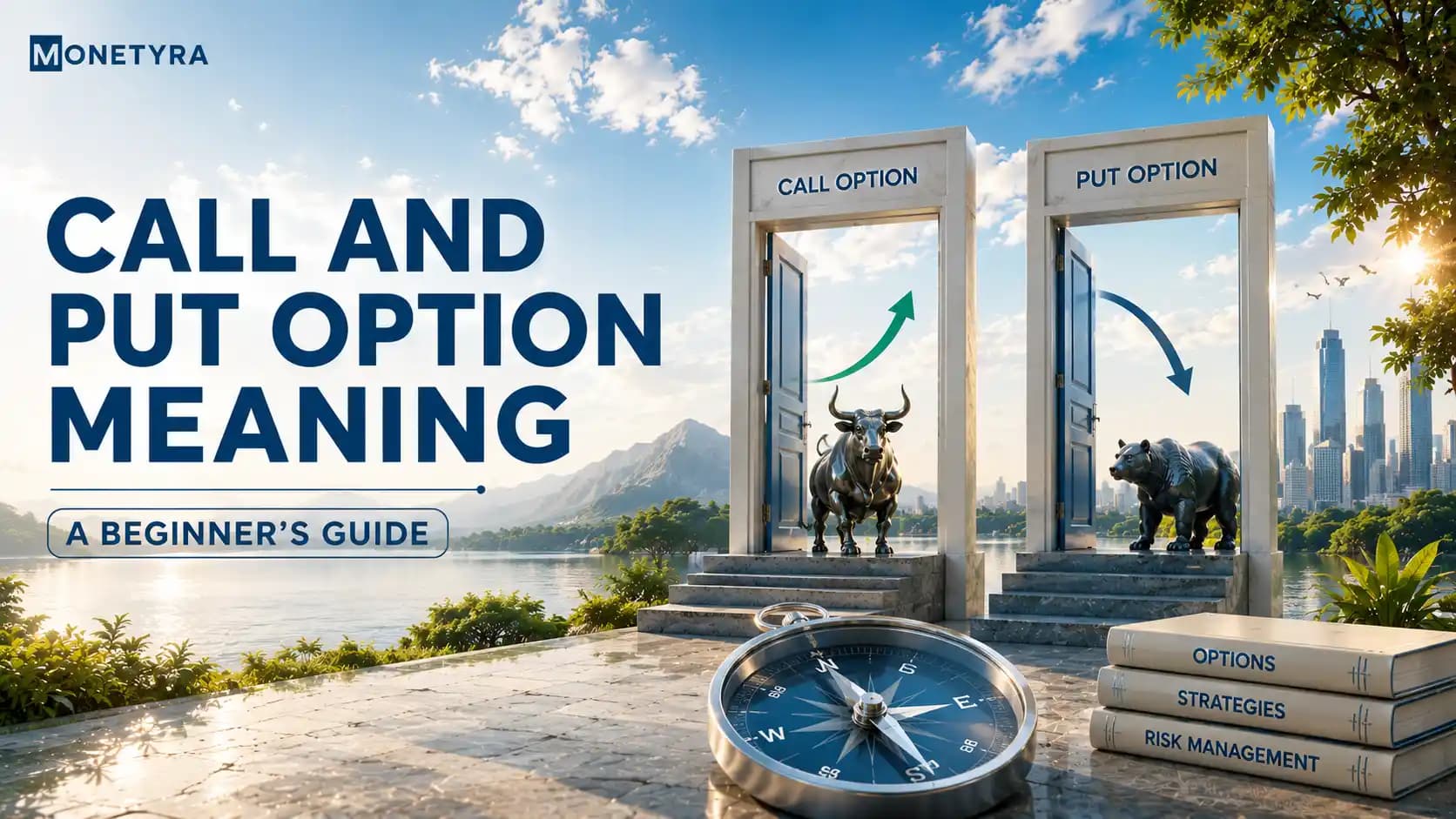
Imagine finding the perfect apartment, but you need time to arrange the funds. You pay the builder a non-refundable token amount to hold the property at today’s price for one month. If property values skyrocket, you still buy at the locked-in price. If they drop, you walk away, losing only your token deposit. This is exactly how options work in the financial markets. For new traders stepping into the derivatives segment, mastering the call and put option meaning is the foundational step. These contracts allow you to control large positions with a small upfront premium, but they come with their own set of strict rules and severe time constraints.
Quick Takeaways
- The call and put option meaning boils down to having the right, but not the obligation, to buy (call) or sell (put) an underlying asset at a pre-agreed price.
- Options allow Indian traders to speculate on market direction or hedge existing portfolios for a fraction of the cost of buying the actual shares.
- Because options have a fixed expiry date, buyers face the constant drag of time decay, meaning the contract loses value every day it doesn’t move in the desired direction.
What Is the Call and Put Option Meaning?
The call and put option meaning refers to derivative contracts that give the buyer the right, but not the obligation, to buy or sell an underlying asset at a specific strike price before a set expiration date.
When asking What Is Futures and Options, options stand out because of this “right without obligation” feature. In the Indian market, these underlying assets can be indices like the Nifty 50 or individual stocks like Reliance. They are called derivatives because they derive their value strictly from the price movements of that underlying asset.
Call Option Meaning (CE)
A call option gives you the right to buy the underlying asset at a predetermined strike price. You would buy a call option when you have a bullish view, expecting the stock or index to rise. In the Indian options market, this is denoted as CE (Call European).
Put Option Meaning (PE)
Conversely, a put option gives you the right to sell the underlying asset at a predetermined strike price. You buy a put option when you have a bearish view, expecting the market to fall, or when you want to hedge your stock portfolio against a potential crash. This is denoted as PE (Put European).
Put and Call Option Meaning: Key Differences
Understanding the exact roles of buyers and sellers is critical to grasping the put and call option meaning. In every transaction, the option buyer pays a non-refundable fee called a “premium” to the option seller (also known as the option writer).

Feature Comparison for Option Roles
- Market View: Call buyers are bullish, while put buyers are bearish. Call sellers are bearish or neutral, and put sellers are bullish or neutral.
- Risk for Buyers: Both call and put buyers have their risk capped strictly at the premium they paid to enter the trade.
- Risk for Sellers: Call sellers face theoretically unlimited risk if the market spikes, while put sellers face substantial risk if the market drops to zero.
Warning: While option buying limits your risk to the premium paid, option selling carries immense risk and requires a substantial margin blocked in your trading account to cover potential losses.
Call Option and Put Option Meaning: Real-World Examples
To make the call option and put option meaning crystal clear, let’s look at how they function in a practical trading scenario.
- Call Example: Suppose the Nifty 50 is trading at 24,000. You expect a breakout and buy a 24,100 CE for a premium of ₹100. Understanding the lot size in options trading is crucial here; since the current Nifty 50 lot size is 65, you pay a total premium of ₹6,500. If Nifty rallies to 24,500 before expiry, your right to buy at 24,100 becomes highly valuable, and you can sell the contract for a leveraged profit. If it stays below 24,100, the option expires worthless, and you lose the ₹6,500.
- Put Example: You hold a large portfolio of banking stocks and fear a sudden market drop. You buy a BankNifty PE contract. If the banking sector crashes, the value of your put option shoots up, offsetting the losses you take in your actual stock holdings.
Options Trading in the Indian Market
In India, derivatives are heavily regulated by the Securities and Exchange Board of India (SEBI) and traded primarily on the National Stock Exchange (NSE) and BSE. Traders can participate in weekly or monthly expiries.
In India, derivatives are heavily regulated by the Securities and Exchange Board of India (SEBI)and traded primarily on the National Stock Exchange (NSE) and BSE. Traders can participate in weekly or monthly expiries.
One of the harshest realities for beginners to learn is time decay in options (Theta). Options are wasting assets. If the market moves sideways, the premium of both calls and puts will slowly bleed away as the expiry day approaches. This means an option buyer can be right about the market direction, but still lose money if the move takes too long to happen.
SEBI mandates a stark risk disclosure for a reason: 9 out of 10 retail traders in the equity F&O segment lose money. The same leverage that makes options attractive can quickly wipe out trading capital if the market gaps against your position.
Conclusion
Mastering the call and put option meaning is essential before taking on the intense leverage of the derivatives market. While calls let you bet on rising prices and puts act as insurance against falling ones, the mechanics of premium pricing and time decay mean they are far riskier than holding plain stocks. Start by observing the option chain meaning to understand how premiums react to market movements before committing real capital.
Ready to dig deeper into strike prices and expiry cycles?
FAQs
A call option gives the buyer the right to buy an asset at a set price, making it a bullish bet. A put option gives the buyer the right to sell an asset at a set price, acting as a bearish bet or portfolio insurance.
You should buy a call option when you strongly expect the underlying asset’s price to go up before the contract expires.
CE stands for Call European, which refers to a call option contract. PE stands for Put European, which refers to a put option contract. In India, options are European style, meaning they can generally only be exercised on the expiry day itself.
They work as contracts between a buyer and a seller. The buyer pays a premium for the right to buy or sell at a fixed strike price, while the seller receives the premium and takes on the obligation to fulfill the contract if the buyer exercises it.
No. When you strictly buy a call or a put option, you cap your maximum possible risk at the total premium you paid to enter the trade.
No. While both are derivatives, a futures contract obligates you to buy or sell at the expiry date, whereas options give you the right, but not the obligation, to do so.
Disclaimer: The Monetyra editorial team wrote this article with the help of AI and reviewed it for accuracy. Please treat it as educational content only, not financial advice. Trading and investing in financial instruments involve significant risk of loss and are not suitable for all investors, and past performance of any strategy does not guarantee future results. Please consult a licensed financial advisor before making any investment or trading decision.
In India, derivatives trading is regulated by the Securities and Exchange Board of India (SEBI). Readers are advised to verify the regulatory status of their broker and ensure compliance with applicable Indian laws before investing.