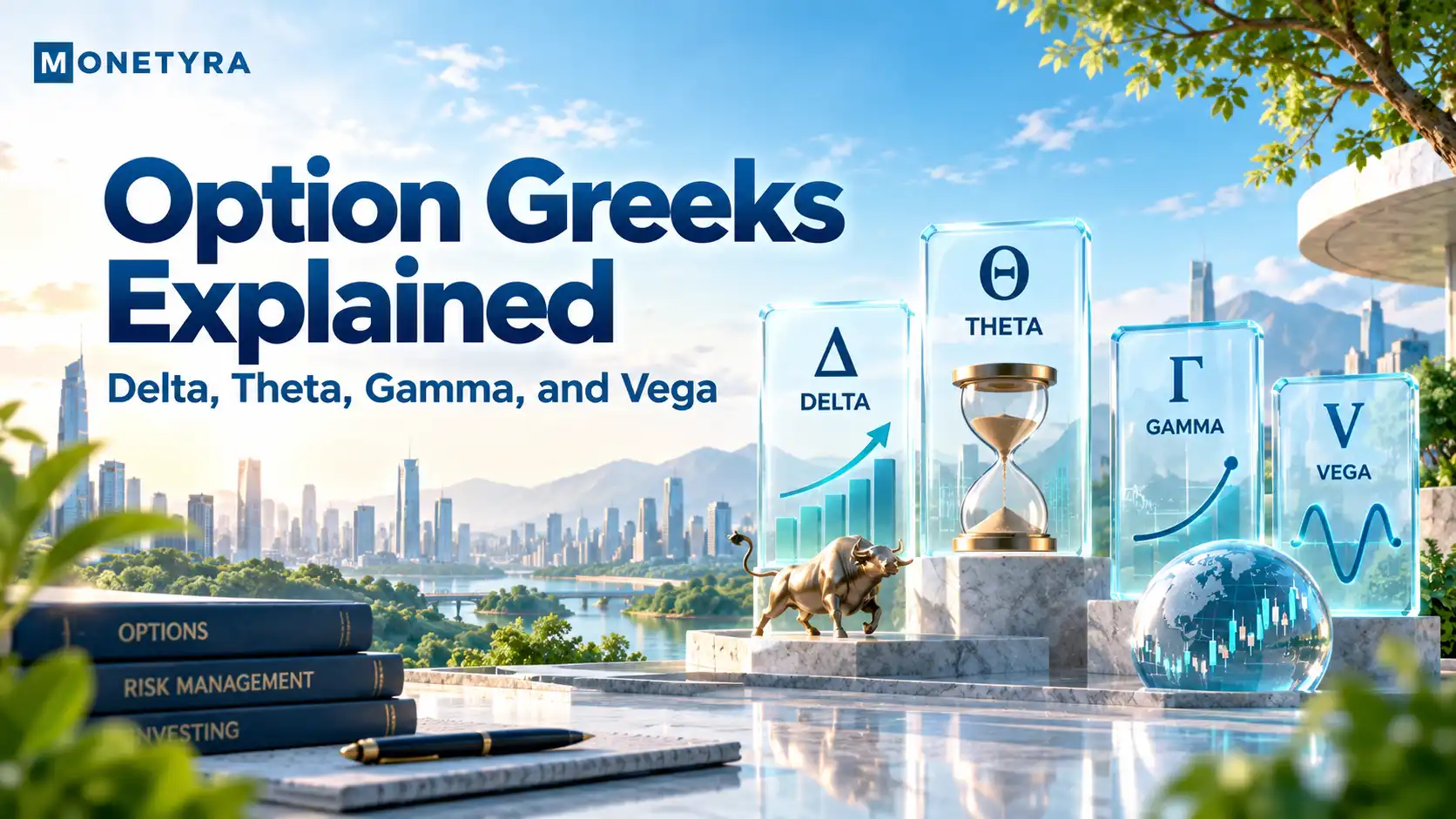
Option Greeks Explained: Delta, Theta, Gamma, and Vega
Many new traders buy a Call option expecting a quick profit when Nifty moves up, only to watch their contract value drop even as the underlying index rises. This confusing outcome happens because option prices do not move on stock direction alone. To understand how options are actually priced, you need to look behind the contract value at the underlying risk factors.
Quick Takeaways
- Option greeks are standardized risk metrics that measure how an option contract’s price changes relative to price movements, time decay, acceleration, and market volatility.
- Trading options without tracking Greeks exposes your portfolio to invisible losses from rapid time erosion and shifts in implied volatility.
- Buying options without calculating Theta decay or volatility shifts can result in complete capital loss even if your directional forecast turns out correct.
What Are Option Greeks?
Option greeks are mathematical risk metrics that measure how sensitive an option contract’s premium price is to changes in the underlying asset price, time decay, volatility, and interest rates.
When you trade options on the National Stock Exchange (NSE), the price of a Call or Put contract is not just a direct reflection of stock movement. Instead, the option premium continuously updates based on four core forces: market direction, time remaining until expiration, rate of price movement, and broad market volatility. Option Greeks provide concrete values for each of these forces so traders can analyze position risk before placing an order.
Delta, Theta, Gamma, Vega Options Explained
Understanding delta theta gamma vega options gives you a clear framework to evaluate every contract on an option chain. Each Greek isolates one specific variable that impacts your trading capital.
Delta (Directional Sensitivity)
Delta measures how much an option’s premium price changes for every ₹1 move in the underlying stock or index price.
- Call Options: Delta ranges from 0 to 1. A Call option with a 0.50 Delta increases by ₹0.50 for every ₹1 gain in the underlying asset.
- Put Options: Delta ranges from 0 to -0.50 to -1. A Put option with a -0.40 Delta increases by ₹0.40 when the underlying asset drops by ₹1.
Tips: You can use Delta as a rough probability gauge. A Delta of 0.30 suggests approximately a 30% chance that the option contract will expire In-The-Money (ITM).
Theta (Time Decay)
Theta measures the rate at which an option loses its value as time passes, assuming all other market variables stay constant. Options are perishable assets; as the expiration date approaches, the time value embedded in the contract erodes faster.
- Option Buyers: Theta is a constant cost because your long contract loses value every single day, even over weekends.
- Option Sellers: Theta works in your favor as you profit from the daily erosion of option premiums.
Gamma (Rate of Delta Change)
Gamma measures the rate of change in an option’s Delta for every ₹1 movement in the underlying stock. Think of Delta as speed and Gamma as acceleration. High Gamma means Delta will change rapidly, causing contract premiums to swing aggressively in response to small market moves. Gamma is highest for At-The-Money (ATM) options that are close to expiration.
Vega (Volatility Sensitivity)
Vega measures how much an option premium changes for every 1% shift in Implied Volatility (IV). When market uncertainty spikes—such as during earnings reports or elections—Vega pushes option premiums higher across the board. Conversely, when market volatility collapses (known as an “IV crush”), option values drop sharply even if the underlying asset price does not move.
| Option Greek | What It Measures | Impact on Buyers | Impact on Sellers |
|---|---|---|---|
| Delta | Price sensitivity relative to asset price movement | Positive for Calls, Negative for Puts | Negative for Calls, Positive for Puts |
| Theta | Premium loss per day due to time decay | Negative (erodes daily contract value) | Positive (builds profit as value erodes) |
| Gamma | Speed/acceleration of Delta movement | Positive (accelerates winning trades) | Negative (increases exposure to sharp swings) |
| Vega | Premium sensitivity to 1% shift in Implied Volatility | Positive (benefits from rising volatility) | Negative (suffers when volatility spikes) |
Warning: Long options exposure carries rapid daily time decay (Theta) and severe downside risk if Implied Volatility drops (Vega crush). Holding positions near expiry exposes traders to accelerated Gamma risk, where sharp index pullbacks can wipe out contract value quickly. Options trading involves significant capital risk; always verify your risk tolerance and position sizing before executing derivative trades.

How Option Greeks Work in Indian Markets
Trading F&O contracts in Indian markets requires factoring in structural rules from regulatory bodies and stock exchanges.
- 🇮🇳 SEBI/NSE Expiry Cycles: The National Stock Exchange (NSE) features weekly and monthly derivative contract expiries for Nifty 50 and Bank Nifty options. Weekly contract expiries dramatically amplify Theta decay and Gamma risks during the final 48 hours before expiration.
- India VIX Shifts: Shifts in the India VIX directly influence Vega pricing. During volatile global events, buying options with high Vega can result in unexpected losses if the VIX drops quickly after the event resolves.
- Taxation Notice: Under Section 43(5) of the Indian Income Tax Act, income from equity futures and options is treated as Non-Speculative Business Income. Traders must track total turnover and gross gains/losses for accurate tax filings under applicable Indian laws.
Warning: Holding long At-The-Money (ATM) weekly options on expiry day exposes you to extreme Gamma risk, where a minor index pullback can wipe out premium value in minutes.
Conclusion
Mastering option Greeks shifts your trading approach from blind speculation to structured risk management. By evaluating Delta for directional speed, Theta for daily time decay, Gamma for rate shifts, and Vega for volatility changes, you gain full visibility into why your contracts gain or lose value. Rather than getting caught off guard by sudden premium erosion near weekly expiry, monitoring these sensitivity metrics gives you the tools to size positions properly and protect your capital.
Master derivative mechanics, execution strategies, and risk controls for Indian financial markets.
FAQs
The four primary option Greeks are Delta, Theta, Gamma, and Vega. Delta tracks price sensitivity, Theta measures daily time decay, Gamma tracks the acceleration of Delta, and Vega measures sensitivity to implied volatility changes.
Delta is generally the most vital Greek for beginners to learn first. It gives you a clear expectation of how much your option contract value will rise or fall relative to a ₹1 change in the underlying stock or index price.
Theta decay accelerates exponentially during the final days of a weekly Nifty options cycle. As the Thursday expiry approaches, an At-The-Money (ATM) option contract can lose a significant portion of its remaining time value every hour, even if Nifty remains range-bound.
Delta measures the direct change in option price for a ₹1 move in the underlying asset. Gamma measures how much Delta itself will change for that same ₹1 move. Delta represents current directional speed, while Gamma represents acceleration.
When market volatility increases, Vega increases the premium of both Call and Put options regardless of price direction. When volatility drops, Vega causes option premiums to contract, which can harm buyers holding long contracts.
Disclaimer: This article was written with the help of AI and reviewed by the Monetyra editorial team. It is for educational purposes only and should not be considered financial advice. Trading and investing in financial instruments involve significant risk of loss and are not suitable for all investors, and past performance of any strategy does not guarantee future results. Please consult a licensed financial advisor before making any investment or trading decision.
In India, derivatives trading is regulated under Securities and Exchange Board of India (SEBI) frameworks. Readers are advised to verify the regulatory status of their broker and ensure compliance with applicable Indian laws before investing.