Vega in Options: A Simple Guide for Beginners
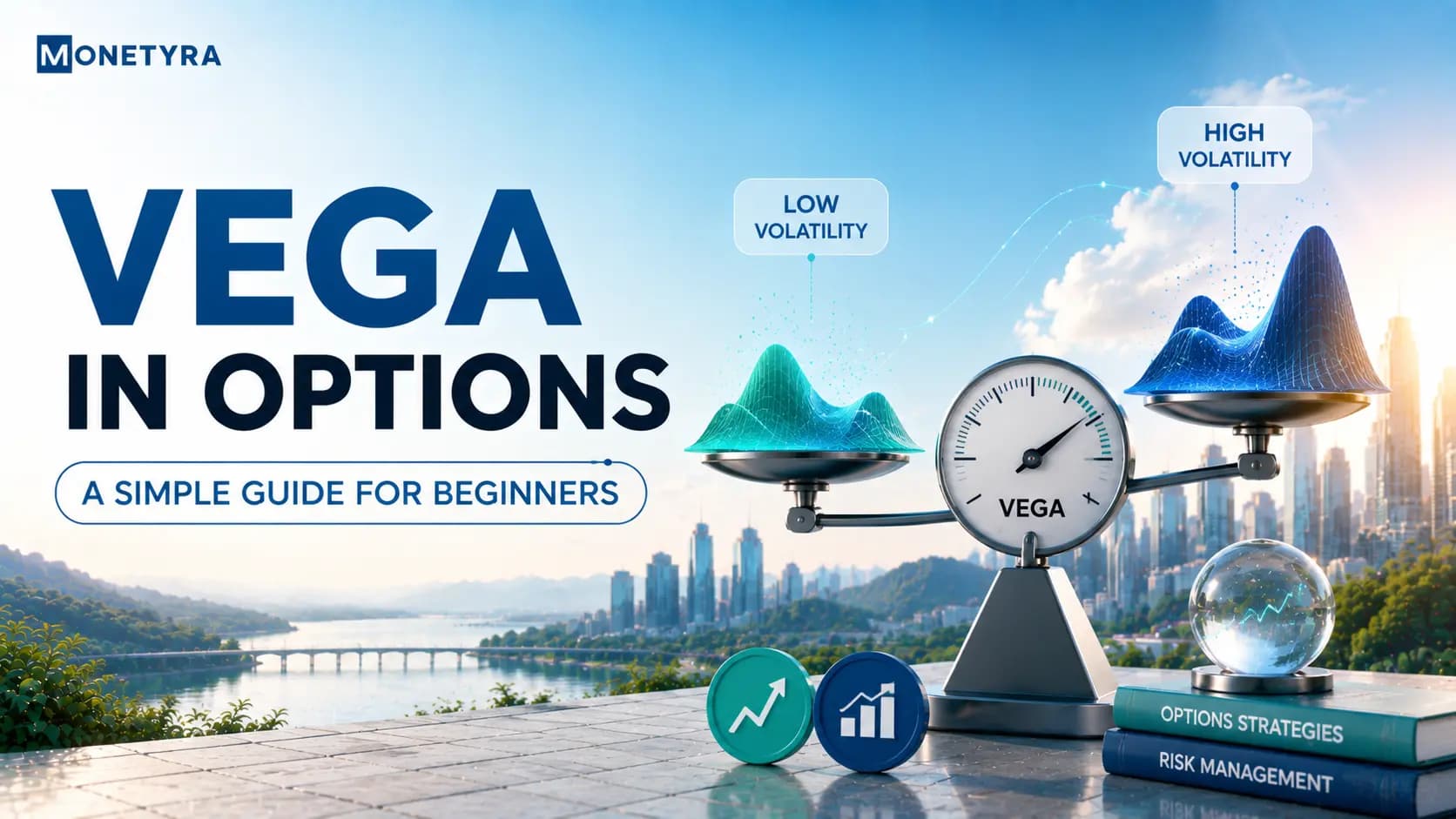
Vega is the option Greek that measures how sensitive an option’s premium is to changes in Implied Volatility (IV). When market uncertainty swells around major events like earnings releases or economic announcements, option premiums rise across the board—and Vega tells you exactly how much your contract will gain or lose for every 1% shift in IV. Understanding Vega allows options traders to measure volatility risk, avoid common traps like the “volatility crush,” and build strategies that profit from shifting market sentiment.
Quick Takeaways
- Vega in options measures how much an option contract’s premium changes for every 1% shift in Implied Volatility (IV).
- Vega is positive for both long Call and long Put options, meaning rising volatility generally increases premiums for option buyers.
- Option premiums can drop sharply when volatility crashes, making it essential to monitor IV shifts alongside price action.
What Is Vega in Options?
Vega in options is an option Greek that measures the change in an option’s premium for every 1 percentage point change in the underlying asset’s Implied Volatility (IV).
Think of Vega as a market uncertainty tax or bonus. When investors expect upcoming turbulence—such as major economic announcements, union budget releases, or quarterly corporate earnings—option premiums rise to reflect that added uncertainty. Vega tells you exactly how many Rupees an option contract will gain or lose when that market uncertainty expands or contracts by 1%.
For example, if a Nifty Call option trades at ₹120 with a Vega of 8, and the Implied Volatility jumps by 1%, the option premium will theoretically rise to ₹128 (₹120 + ₹8). Conversely, if IV drops by 1%, the premium declines to ₹112 (₹120 – ₹8).
Vega vs Implied Volatility (IV)
It is common for new traders to mix up Vega and Implied Volatility:
- Implied Volatility (IV): Represents the market’s forward-looking expectation of price fluctuation. It is expressed as a percentage (e.g., 15% IV).
- Vega: Represents the sensitivity of the option premium to IV. It is expressed as a cash value per 1% change in IV (e.g., 8).
Tips: Implied Volatility is the driver, whereas Vega is the meter that measures how much your contract’s price reacts to that driver.
Understanding the Option Greeks: Where Vega Fits
In options trading, pricing is determined by a suite of risk metrics known as the Option Greeks. Each Greek isolates a specific factor influencing contract value:
- Delta: Measures sensitivity to changes in the underlying stock or index price. (Learn more about What Is Delta In Options).
- Gamma: Measures the rate of change of Delta as the underlying asset moves.
- Theta: Measures the loss of option value due to the passage of time. (Explore Theta In Options).
- Vega: Measures sensitivity to changes in Implied Volatility.
While Delta and Theta deal with direction and time decay, Vega in options Greek models focuses entirely on expected price swings.
How Vega Works in Nifty & Bank Nifty Options
When trading index contracts like Nifty 50 or Bank Nifty on the National Stock Exchange (NSE), understanding Vega is critical for both buyers and sellers.
Vega Impact on Calls and Puts
A core characteristic of Vega is that it is positive for all option buyers and negative for all option sellers:
- Option Buyers (Long Call & Long Put): Rising IV increases the value of both Call and Put contracts. Higher volatility expands the probability of significant price moves, benefiting option buyers.
- Option Sellers (Short Call & Short Put): Rising IV works against sellers by inflating option premiums, making positions more expensive to buy back.
| Position Type | Contract Type | Impact of +1% IV Increase | Impact of -1% IV Decrease |
|---|---|---|---|
| Long Call (Buyer) | CE | Premium Increases (+Vega) | Premium Decreases (-Vega) |
| Long Put (Buyer) | PE | Premium Increases (+Vega) | Premium Decreases (-Vega) |
| Short Call (Seller) | CE | Position Value Drops (-Vega) | Position Value Gains (+Vega) |
| Short Put (Seller) | PE | Position Value Drops (-Vega) | Position Value Gains (+Vega) |
At-The-Money (ATM) Sensitivity
Vega is highest for At-The-Money (ATM) options and decreases as contracts move deep In-The-Money (ITM) or deep Out-Of-The-Money (OTM). ATM options contain the maximum time value and uncertainty, making their pricing highly sensitive to shifting volatility expectations.
How Time to Expiry Impacts Vega
Options with longer time horizon to expiration carry significantly higher Vega than near-expiry or weekly contracts. A Nifty option with 30 days left to expiry has more time for volatility to unfold than an option expiring tomorrow, resulting in a higher Vega reading.

Managing Volatility Risk in Options Trading
Trading option contracts without accounting for Vega can expose traders to unexpected losses, even if they guess the direction of the underlying market correctly.
Understanding Volatility Crush
A common trap for retail options buyers occurs around high-profile news events, such as quarterly earnings reports or national election results.
Leading up to the event, Implied Volatility spikes due to market uncertainty, bidding up option premiums. Once the news breaks, uncertainty evaporates, causing IV to drop rapidly. This sudden collapse in IV—known as a volatility crush—can shrink option premiums instantly, causing option buyers to lose capital even if the spot price moves in their anticipated direction.
Warning: Buying options when IV is at historic highs creates steep Vega risk if volatility normalizes quickly after an anticipated event.
- Measure IV percentile: Check historical IV levels before entering long option positions.
- Balance time and volatility: Remember that long-dated contracts carry larger Vega values than short-dated contracts.
- Account for Theta decay: Volatility gains can be offset by daily time decay as options approach expiration.
Conclusion
Understanding what is vega in options allows retail traders to measure how market volatility shapes contract premiums. By evaluating Vega alongside Delta and Theta, investors gain a complete picture of risk, helping them navigate changing market environments on the NSE.
Learn options fundamentals and trading concepts built for Indian retail markets.
FAQs
Vega is an option Greek that measures how much an option contract’s premium changes for every 1 percentage point shift in Implied Volatility.
Yes, Vega is positive for both long Call options and long Put options, meaning an increase in volatility generally boosts premiums for option buyers regardless of option type.
When Implied Volatility rises, a high positive Vega causes option premiums to increase, while a drop in Implied Volatility causes premiums to decline.
Implied Volatility is the market’s expected percentage price fluctuation of the asset, while Vega is the measurement of how many Rupees an option’s price will change per 1% move in that Implied Volatility.
You calculate the price change using the formula: New Option Premium = Current Premium + (Vega × Change in Implied Volatility %)
Disclaimer: This article was written with the help of AI and reviewed by the Monetyra editorial team. It is for educational purposes only and should not be considered financial advice. Trading and investing in financial instruments involve significant risk of loss and are not suitable for all investors, and past performance of any strategy does not guarantee future results. Please consult a licensed financial advisor before making any investment or trading decision.
In India, options trading is regulated by the Securities and Exchange Board of India (SEBI). Readers are advised to verify the regulatory status of their broker and ensure compliance with applicable Indian laws before investing.