What Is the Difference Between Futures and Options?
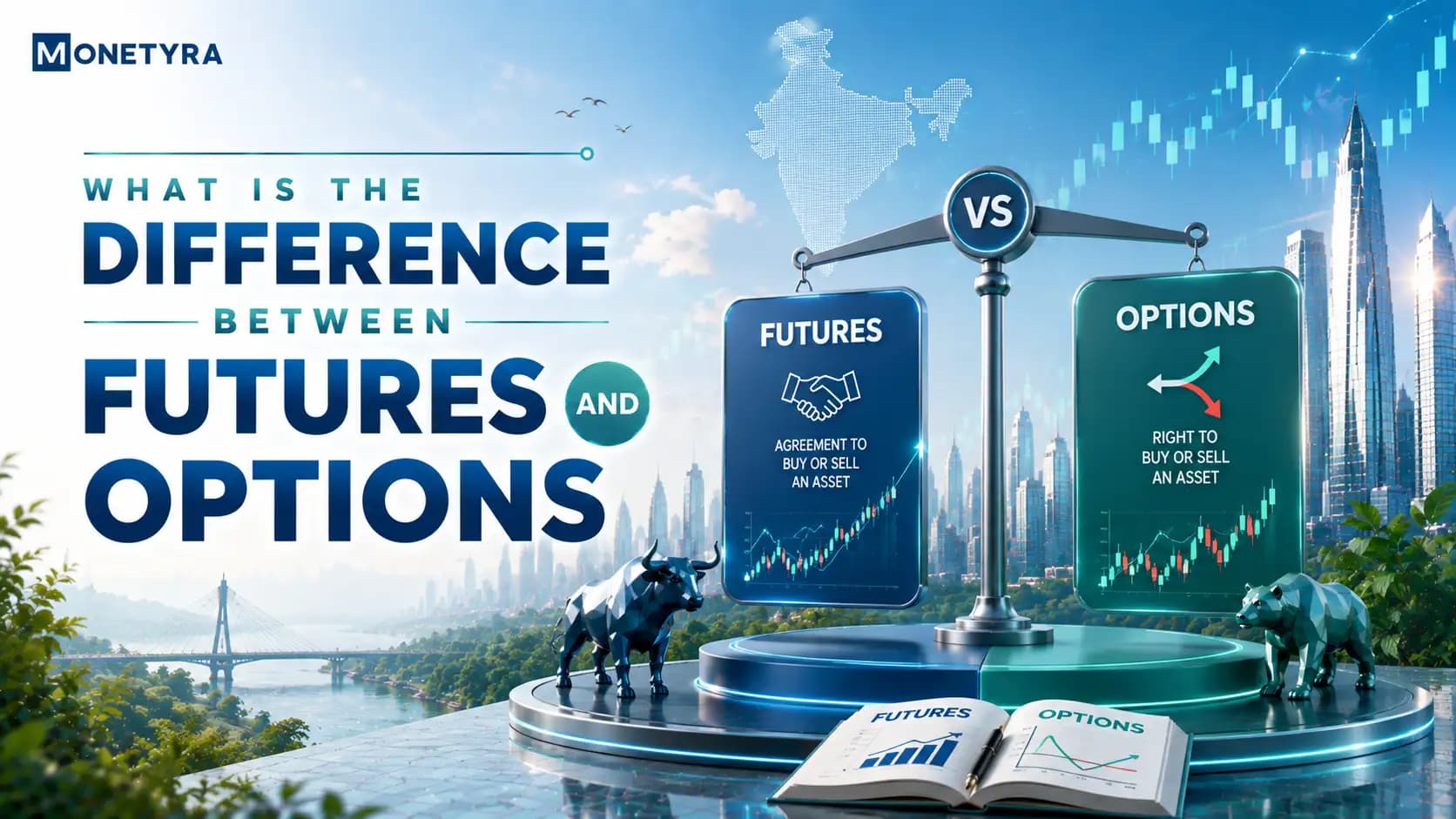
When stepping beyond cash stock buying on Indian stock exchanges, active market participants quickly encounter financial derivatives. Derivatives derive their value from underlying assets like company shares or stock market indexes like the Nifty 50.
The two most widely traded derivative contracts are futures and options. While both allow traders to participate in price movements without taking physical delivery of underlying shares immediately, their underlying legal contracts, margin requirements, and risk profiles operate under entirely different rules.
Quick Takeaways
- Core Definition: The key distinction between these two derivative contracts lies in trade obligations: futures mandate both parties to complete the trade, while options grant the buyer the discretionary right—without forcing an obligation—to execute the transaction.
- Primary Mechanism: Futures require both long and short traders to deposit margin capital and maintain mark-to-market positions, whereas option buyers pay a fixed upfront premium fee to option writers for price protection or directional exposure.
- Primary Risk / Limit: Futures expose traders to unlimited downside risk if market prices move against their positions, whereas retail F&O trading carries high loss risk overall; official SEBI studies indicate approximately 90% of individual retail derivative traders incur net losses.
What Is the Difference Between Futures and Options?
Understanding what is the difference between futures and options comes down to recognizing legal obligations versus flexible rights on the National Stock Exchange (NSE) and Bombay Stock Exchange (BSE).
- Futures Contract: A binding agreement to buy or sell an underlying financial asset at a predetermined price on a future expiration date. Both buyer and seller must settle the position regardless of where the market price moves.
- Options Contract: An agreement offering the buyer the right, but not the obligation, to buy (Call Option) or sell (Put Option) an underlying asset at a fixed strike price before or on expiration day.
Understanding broader foundational derivative definitions, such as what is futures and options, helps beginner investors contextualize how these instruments interact within portfolio hedging strategies.
Tips: Think of a futures contract like a mandatory sale agreement for property, while an options contract acts like paying a non-refundable token fee that gives you the choice to buy later if prices remain favorable.
Futures vs Options: Key Structural Differences
To evaluate how these two derivative contracts behave during market hours, investors compare their core operational parameters.
| Contract Attribute | Futures Contracts | Options Contracts (Buyer Perspective) |
|---|---|---|
| Legal Obligation | Mandatory obligation for both long and short positions | Discretionary right to execute; no obligation to trade |
| Upfront Capital Required | Initial and SPAN margin required (regulated by SEBI) | Limited to the option premium fee paid upfront |
| Downside Risk Profile | Potentially unlimited if prices move sharply against you | Strictly capped at the maximum premium fee paid |
| Upside Profit Potential | Unlimited as long as the market trends in your direction | Unlimited for Call buyers; capped for Put buyers |
| Impact of Time Decay | Not subject to time decay (prices track spot directly) | Extrinsic value decays over time (Theta erosion) |
Margin Requirements and Capital Costs on Indian Exchanges
On Indian exchanges, margin rules established by the Securities and Exchange Board of India (SEBI) create distinct capital entries for futures holders and option market participants.
- Futures Margins: Futures traders must deposit initial SPAN and Exposure margins before opening a trade. Positions undergo daily mark-to-market (MTM) settlement, meaning profits or losses are debited or credited to the trading account daily based on closing prices.
- Option Buyer Premiums: Option buyers only pay the total premium (Strike Premium × Lot Size). They are not subject to daily MTM margin calls, ensuring their maximum financial risk is locked from the start.
- Option Writer Margins: Selling (writing) options involves short obligations similar to futures, requiring full margin deposits because downside risk for option writers is theoretically unlimited.
Warning: Holding leveraged futures positions overnight exposes accounts to margin calls if sudden global market gaps occur before the domestic market opens.
Risk Profiles and Time Decay Impact
Beyond margin structure, options and futures react differently to passage of time and volatility shifts.
- Time Decay (Theta) Factor: Options are decaying assets. Even if the underlying stock price stays flat, an option contract loses value each day as expiration approaches. Futures contracts do not suffer from Theta decay; their prices align directly with the spot market basis.
- Symmetric vs Asymmetric Risk: Futures feature symmetric risk—every 1-rupee move in the underlying asset results in a corresponding gain or loss. Options feature asymmetric risk for buyers—losses stop at zero premium, while gains can expand if the underlying stock moves significantly past the strike price.
Traders often evaluate broader market valuation parameters using metrics like the Nifty PE Ratio to gauge whether derivative market pricing is elevated.
Risk Management and SEBI Disclosures for Retail Investors
While derivative contracts provide capital efficiency for hedging institutional equity portfolios, unhedged speculation carries severe financial hazards.
SEBI mandates prominent risk disclosures across broker platforms to inform retail participants:
- High Retail Loss Statistics: SEBI empirical research reveals that approximately 9 out of 10 individual retail traders in the equity F&O segment incur net financial losses.
- Transaction Costs: Statutory charges, Securities Transaction Tax (STT), brokerage fees, and GST add friction that impacts net trading outcomes.
Investors track overall market sentiment using third-party tools like Tickertape’s Market Mood Index (MMI) and stay alert to what a market correction typically signals for broader market shifts.
Conclusion
Understanding these two derivative contracts helps retail investors choose instruments aligned with their risk tolerance and trading objectives. While futures offer linear price tracking with mandatory trade obligations, options give buyers capped risk flexibility at the cost of time decay. Retail traders should prioritize risk management, avoid excessive leverage, and build a strong educational foundation before entering derivative markets.
Master equity valuation, derivative mechanics, and portfolio risk management.
FAQs
Futures bind both parties to complete a trade at expiration, whereas options give the buyer the right, but no obligation, to execute the transaction.
For buyers, options are generally considered safer because maximum potential loss is strictly capped at the upfront premium, whereas futures carry unlimited loss potential.
The main advantage of buying options is capped risk; you can participate in upside market trends while strictly limiting your downside loss to the premium paid.
Yes, because futures require only a fraction of initial margin capital, adverse price moves can result in losses exceeding your initial deposit.
Not necessarily; while buying options caps maximum financial loss, options traders must accurately predict market direction, timing, and time decay (Theta) simultaneously.
Disclaimer: This article was written with the help of AI and reviewed by the Monetyra editorial team. It is for educational purposes only and should not be considered financial advice. Trading and investing in financial instruments involve significant risk of loss and are not suitable for all investors, and past performance of any strategy does not guarantee future results. Please consult a licensed financial advisor before making any investment or trading decision.
In India, equity trading and derivative exchange operations are regulated by SEBI. Readers are advised to verify contract specifications, lot sizes, and margin guidelines on official exchange portals before trading.