Grid Trading: How It Works, Risks, and Rules in India

Trying to guess the exact top or bottom of a currency pair or stock is exhausting, especially when prices bounce sideways for weeks. Instead of predicting one big direction, grid trading sets up a structured ladder of buy and sell orders across a chosen price range.
This approach aims to capture small, repeated gains from normal up-and-down price swings. When the market stays inside your chosen boundaries, routine volatility works in your favor rather than testing your patience.
Quick Takeaways
- Core Mechanism: Grid trading places automated buy and sell limit orders at fixed price intervals above and below a central base price to capture routine market swings.
- Best Market Fit: The approach performs best during sideways consolidation when prices bounce repeatedly between clear support and resistance levels.
- Primary Caveat: A strong one-way trend breakout can trigger multiple losing orders at once, creating heavy floating losses (unrealized losses on open positions) if you skip a total-grid stop-loss.
What Is Grid Trading and How Does It Work?
Grid trading is a rule-based trading method that places incremental buy and sell limit orders at fixed price intervals around a set base price.
Rather than relying on forecasts, the setup turns sideways price movement into a mechanical cycle. It pairs naturally with a range-bound trading strategy because every order triggers automatically when price touches a preset level.
Here is how you set up and run a basic grid step by step:
- Choose the Base Price and Range: Pick a central reference price along with an upper ceiling and a lower floor where the asset usually trades.
- Set the Grid Spacing: Decide the fixed distance between each order line, such as ₹0.20 on a currency contract or ₹2 on an equity share.
- Place Pending Limit Orders: Set buy limit orders at each interval below the base price and sell limit orders at each interval above it.
- Automate the Reset Cycle: When price drops to hit a buy order, the system places a matching sell order one level higher to lock in the difference once price rebounds.
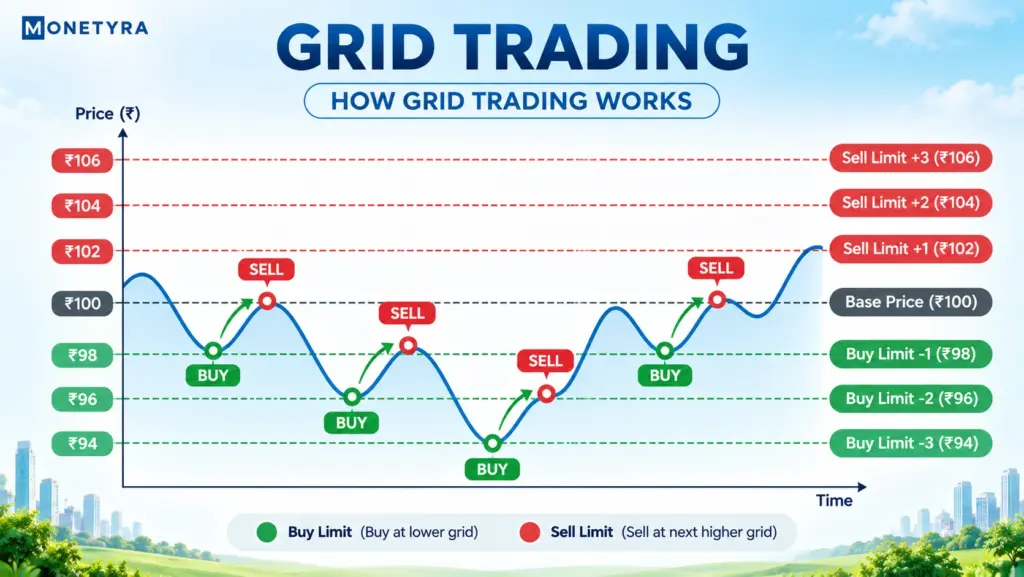
To see the math clearly, consider a hypothetical example of an Indian stock trading near ₹100 with a ₹2 grid spacing and 10 shares per level.
| Grid Level | Price (₹) | Order Type | Action When Triggered | Gross Gain Per Cycle (10 Shares) |
|---|---|---|---|---|
| Grid +3 | ₹106 | Sell Limit | Opens 10 shares short (sells first); sets buy at ₹104 | ₹20 |
| Grid +2 | ₹104 | Sell Limit | Opens 10 shares short (sells first); sets buy at ₹102 | ₹20 |
| Grid +1 | ₹102 | Sell Limit | Opens 10 shares short (sells first); sets buy at ₹100 | ₹20 |
| Base Price | ₹100 | Reference | Starting midpoint | — |
| Grid -1 | ₹98 | Buy Limit | Opens 10 shares; sets sell at ₹100 | — |
| Grid -2 | ₹96 | Buy Limit | Opens 10 shares; sets sell at ₹98 | — |
| Grid -3 | ₹94 | Buy Limit | Opens 10 shares; sets sell at ₹96 | — |
In this hypothetical example, if the price dips from ₹100 to ₹98 and bounces back to ₹100, you earn ₹20 gross (₹2 × 10 shares) before brokerage and taxes. Notice that if your grid spacing is too narrow, transaction charges can wipe out that small gain.
Types of Grid Trading Strategies
Traders generally organize grid setups into two main styles depending on whether the market is moving sideways or trending.
- Classic Range Grid: This neutral setup places buy limit orders below the current price and sell limit orders above it. It assumes prices will stay within a horizontal channel and profits from repeated reversals.
- Trend-Following Grid: This directional setup places buy stop orders above the current price during an uptrend, or sell stop orders below it during a downtrend. As momentum builds, new positions open in the direction of the move.
Beginners often confuse a classic grid with a Martingale strategy, which doubles position size after every loss. A standard grid keeps the order size equal at every level, which avoids exponential lot growth during a losing streak.
Key Risks of Grid Trading in Trending Markets
While automated grids remove emotional hesitation, they expose your capital to severe strain when a market stops ranging and enters a strong one-way trend.
- Runaway Trend Drawdown: If an asset breaks below your lowest buy level and keeps falling, every open buy order stays underwater simultaneously. Floating losses stack up quickly while no rebound occurs to close them.
- Rapid Margin Exhaustion: Each triggered level locks up additional margin in your account. Learning how to avoid a margin call matters deeply here because a steep directional move can deplete free margin and force your broker to liquidate all open positions at a loss.
- Accumulating Holding Costs: Holding multiple derivative or currency positions overnight incurs daily rollover or funding charges, which steadily reduce net returns if prices stall near one edge of your grid.
Warning: Running a grid system without a hard account-level stop-loss can wipe out your entire trading capital during an unexpected breakout.
Risk Management Rules for Grid Traders
Strict guardrails might help keep a temporary price dip from turning into a much larger account loss, although fast-moving markets can still gap past your stop-loss level.
- Enforce a Total-Grid Stop-Loss: Set a maximum dollar or rupee loss limit for the entire grid—for example, 3% to 5% of your account equity—so all orders close automatically if price breaks past your outer boundary.
- Divide Your Position Size: Decide your maximum total exposure first, then split that volume equally across all planned grid levels instead of trading a full standard lot on every line.
- Size Spacing With Volatility: Check the Average True Range (ATR) indicator before setting intervals so your spacing reflects normal daily movement rather than random noise.
- Watch Pair Overlap: Avoid running separate grids on two pairs that move in lockstep; understanding currency correlation helps prevent double exposure to the exact same macro shock.
Tip: Test your grid spacing and total capital requirement on a demo account first to see how much margin is used when every level triggers at once.
Forex and Grid Trading Rules in India
Indian retail traders must follow strict domestic regulations before deploying any grid system on currency pairs. Under the Foreign Exchange Management Act (FEMA) and guidelines issued by the Reserve Bank of India (RBI), resident individuals may only trade permitted currency derivatives on recognized domestic exchanges such as the National Stock Exchange (NSE) and BSE.
Permitted onshore currency pairs are anchored to the Indian Rupee—specifically USD/INR, EUR/INR, GBP/INR, and JPY/INR—alongside approved cross-currency contracts offered on domestic exchanges. Trading non-INR pairs or funding offshore retail forex platforms through unauthorized channels violates Indian foreign exchange rules.
Additionally, RBI guidelines require retail participants in exchange-traded currency derivatives to maintain valid underlying foreign exchange exposure beyond specified position thresholds, limiting pure speculative trading.
If you use automated scripts or broker APIs to execute grid orders on Indian exchanges, your setup must also comply with algorithmic trading circulars and peak-margin rules (upfront margin requirements monitored through the trading day) enforced by the Securities and Exchange Board of India (SEBI).
Monetyra’s Take
Grid trading might work well as a mechanical way to try to monetize sideways markets, but it is far from a passive “set-and-forget” income machine. While small, repeated gains feel steady during range-bound weeks, a single unexpected macro breakout can turn a stack of open buy orders into a steep drawdown. In India, strict SEBI peak-margin rules and RBI currency derivative restrictions might make it risky for retail traders to run wide, high-leverage grids on a small account. Treat grid trading as a tactical range-bound tool rather than an all-weather strategy: keep your grid spacing wider than typical transaction costs, cap your maximum risk with a hard account-level stop-loss, and test your margin requirements on a demo account before going live.
Conclusion
Grid trading offers a structured, rule-based method for trading sideways market volatility without guessing the next price direction. However, the approach depends heavily on calm market conditions and fails quickly during strong trends. By keeping position sizes equal across levels, setting a strict total-grid stop-loss, and sticking to regulated Indian exchange contracts, you can manage downside risk responsibly.
Explore Forex Academy Guides
Build your core trading knowledge step by step with plain-English risk management and currency guides.
FAQs
1. What is a grid trading strategy?
A grid trading strategy is a rule-based method that places multiple buy and sell limit orders at fixed price intervals above and below a central base price. It aims to earn small, repeated profits as prices bounce up and down within a defined sideways range.
2. How does grid trading work in practice?
You select an upper ceiling, a lower floor, and a fixed price interval between orders. When the market drops to a buy level, a purchase triggers, and a new sell order is placed one interval higher to capture the rebound.
3. Is grid trading profitable for beginners?
Grid trading can generate steady small gains during calm, range-bound markets, provided trading fees stay lower than the profit per grid step. However, strong trends cause rapid losses, so beginners should practice on a demo account and use strict stop-loss limits.
4. What are the biggest risks of grid trading?
The main danger is a strong one-way trend breakout, which triggers multiple losing positions at the same time and creates severe floating drawdown. Other risks include rapid margin consumption, potential margin calls, and overnight holding charges.
5. Can Indian residents use grid trading in forex?
Yes, Indian residents can apply grid logic to permitted currency derivatives—such as USD/INR, EUR/INR, GBP/INR, and JPY/INR—on recognized domestic exchanges like NSE and BSE. Automated API execution must follow SEBI algorithmic trading rules, and offshore forex platforms are prohibited.
Disclaimer: This article was written with the help of AI and edited by the Monetyra editorial team. It is for educational purposes only and should not be considered financial advice. Trading and investing in financial instruments involve significant risk of loss and are not suitable for all investors. Please consult a licensed financial advisor before making any investment or trading decision.