Deep in the Money Option: Guide for Beginners
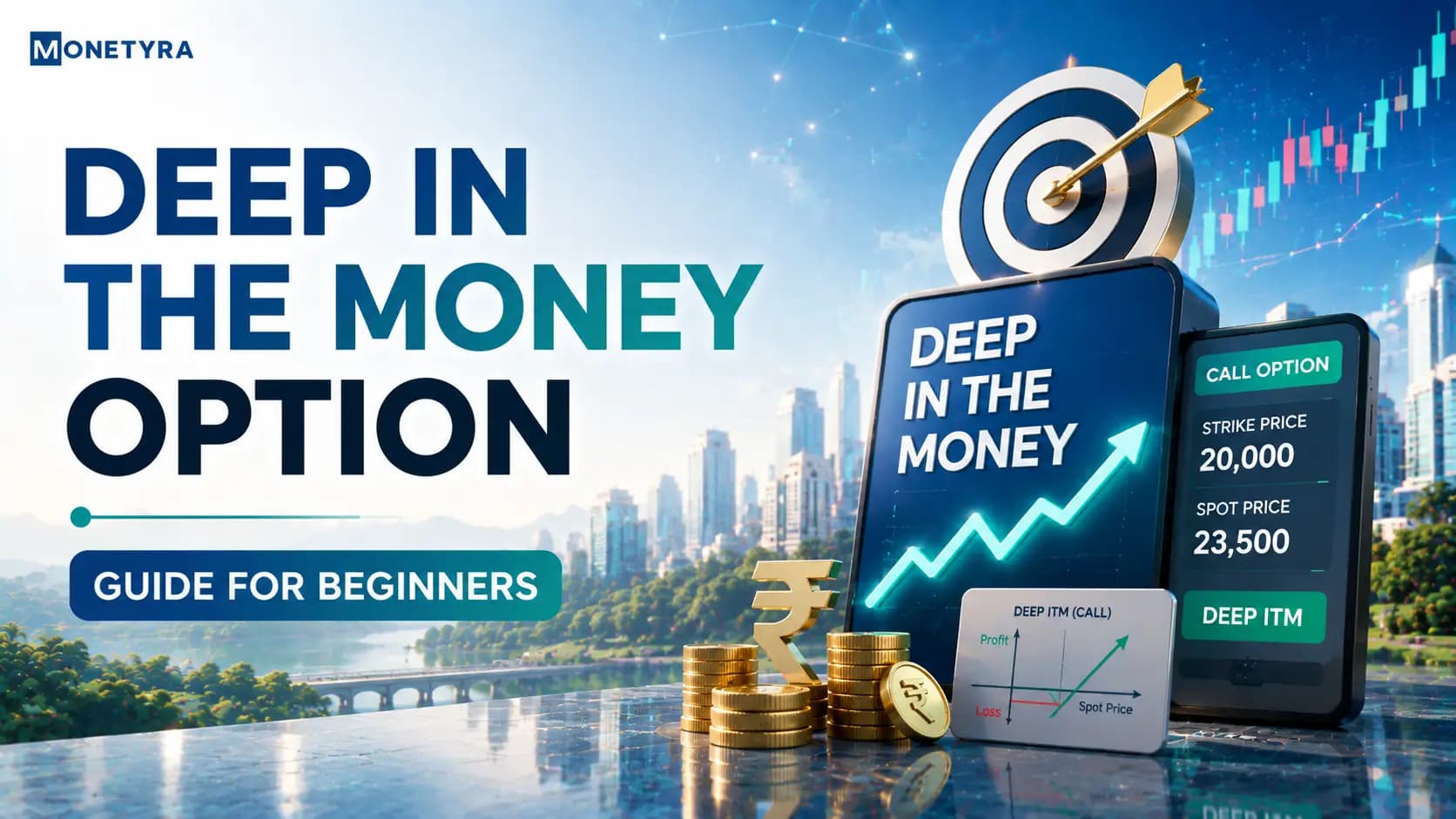
A Deep In-The-Money (ITM) option is a call or put contract whose strike price is significantly favorable compared to the current market price of the underlying asset. Consisting almost entirely of intrinsic value, Deep ITM options exhibit exceptionally high Delta and minimal time decay (Theta) risk. This makes them ideal for position traders looking for stock-replacement strategies, higher probability of profit, and reduced sensitivity to Implied Volatility (IV) drops.
Quick Takeaways
- A deep ITM option is an option contract whose strike price sits far below (for Calls) or far above (for Puts) the current market spot price.
- These contracts carry a high Delta value close to 1.0, meaning their market price moves almost identically to price shifts in the underlying asset.
- While deep ITM options offer capital efficiency and minimal time decay, illiquid strikes on stock exchanges can lead to wide bid-ask spreads and severe execution slippage.
What Is a Deep in the Money Option?
This contract type is an option whose strike price sits significantly past the current spot market price of the underlying asset, causing the contract premium to consist almost entirely of intrinsic value.
To understand where this contract sits, it helps to compare it to standard moneyness categories on the National Stock Exchange (NSE):
- In The Money Option: Possesses real intrinsic value because the strike price is favorable relative to the current spot price.
- At The Money Option: Possesses a strike price equal or extremely close to the current spot price.
- Out Of The Money Option: Has zero intrinsic value and consists entirely of extrinsic or time value.
Delta Mechanics of Deep ITM Contracts
Delta measures how much an option premium changes for every 1-point move in the underlying asset.
While At-The-Money options carry a Delta near 0.50, a deep ITM option carries a high Delta ranging between 0.85 and 0.98. If Nifty 50 moves up by 10 points, a deep ITM Call option with a 0.90 Delta will gain approximately 9 points in premium value.
Intrinsic Value Dominance vs Extrinsic Decay
Two components make up every option premium: intrinsic value and time value (extrinsic value).
For a deep in the money contract, the Intrinsic Value Of Option accounts for almost the entire premium. Because the price carries very little time value, these options experience significantly lower time decay (Theta) than At-The-Money options do.
- ATM Options: Highly sensitive to time decay; option buyers lose value rapidly if the market consolidates.
- Deep ITM Options: These carry minimal time value to lose; directional moves in the spot price drive almost all of the price movement.
Tips: Because deep ITM options have very little time value, buyers do not suffer heavy daily Theta losses while waiting for a directional market move to unfold.
Deep In The Money Call Option vs Put Option
The strike placement determining whether a contract is “deep” depends on whether you are trading Call options or Put options.
- Deep In The Money Call Option: Formed when the strike price is far below the current spot market price. For example, if Nifty 50 is trading at 24,000, a 23,200 Call option is considered deep in the money.
- Deep In The Money Put Option: Formed when the strike price is far above the current spot market price. If Nifty 50 is trading at 24,000, a 24,800 Put option is considered deep in the money.
| Option Type | Strike Placement | Delta Range | Intrinsic Value Share | Primary Sensitivity |
|---|---|---|---|---|
| Deep ITM Call | Far Below Spot Price | +0.85 to +0.98 | > 90% of Premium | Underlying Spot Upside |
| Deep ITM Put | Far Above Spot Price | -0.85 to -0.98 | > 90% of Premium | Underlying Spot Downside |

Why Traders Use Deep ITM Options as Stock Substitutes
Retail traders often buy deep ITM options as an alternative to purchasing spot shares or stock futures contracts.
- Capital Efficiency: A trader can control the price movement of an expensive stock with high Delta exposure while paying a fraction of the total cash capital required for spot shares.
- Capped Maximum Risk: Unlike stock futures, where adverse market moves create open-ended mark-to-market liabilities, the maximum loss on a deep ITM option is strictly capped at the total premium paid.
Risks of Trading Deep ITM Options in India
What are the risks of trading deep ITM options in India? While high Delta options mirror stock movement, execution and liquidity traps on domestic exchanges present real hazards for retail accounts.
Execution & Liquidity Traps on the NSE
The primary operational risk for deep ITM options is illiquidity. Most retail option trading volume concentrates around At-The-Money and near Out-Of-The-Money strikes.
- Wide Bid-Ask Spreads: Because fewer market participants place orders at far ITM strikes, the difference between the buying price (bid) and selling price (ask) can be very wide.
- Execution Slippage: When attempting to exit a position, traders may be forced to accept unfavorable market order fills, cutting into realized profits.
STT and Physical Delivery Rules
Stock option contracts in India are subject to physical delivery requirements upon expiry under regulations established by the Securities and Exchange Board of India (SEBI).
- Physical Settlement: In-The-Money stock options that expire un-squared require mandatory delivery of the underlying shares — there is no cash-settlement alternative for stock options in India.
- Securities Transaction Tax (STT): Exercising ITM options at expiration triggers STT on the total contract value, which can create unexpected tax burdens for unprepared retail accounts.
Warning: Entering market orders on illiquid deep ITM options can result in severe slippage due to wide bid-ask spreads on the exchange option chain.
Conclusion
A deep ITM option provides retail investors with a capital-efficient tool to trade directional price moves with high Delta sensitivity and minimal time decay. However, managing trade execution requires careful attention to liquidity volumes and option chain bid-ask spreads to avoid unexpected trading costs.
Master options fundamentals, Greek mechanics, and market execution built for Indian retail traders.
FAQs
This refers to an option contract whose strike price sits far past the current spot market price, giving it high intrinsic value and a Delta near 1.0.
The Delta of a deep ITM option typically ranges between 0.85 and 0.98, meaning its price moves almost point-for-point with the underlying asset.
Traders buy deep ITM options to achieve stock-like Delta sensitivity with lower upfront capital while capping their total maximum risk to the premium paid.
Deep ITM options lose very little time value (Theta) compared to ATM options because their premium consists almost entirely of intrinsic value.
For option buyers, a deep in the money Call has positive Gamma, but the Gamma value is very low because Delta is already near its upper limit of 1.0.
The main risks include low trading volume liquidity leading to wide bid-ask spreads, execution slippage, and physical delivery or STT liabilities on expiring stock options.
Disclaimer: This article was written with the help of AI and reviewed by the Monetyra editorial team. It is for educational purposes only and should not be considered financial advice. Trading and investing in financial instruments involve significant risk of loss and are not suitable for all investors, and past performance of any strategy does not guarantee future results. Please consult a licensed financial advisor before making any investment or trading decision.
In India, equity options and futures trading are regulated by the Securities and Exchange Board of India (SEBI). Readers are advised to verify regulatory rules regarding physical settlement and margin requirements before trading.