Delta Hedging in Options: Mechanics, Gamma, and Costs
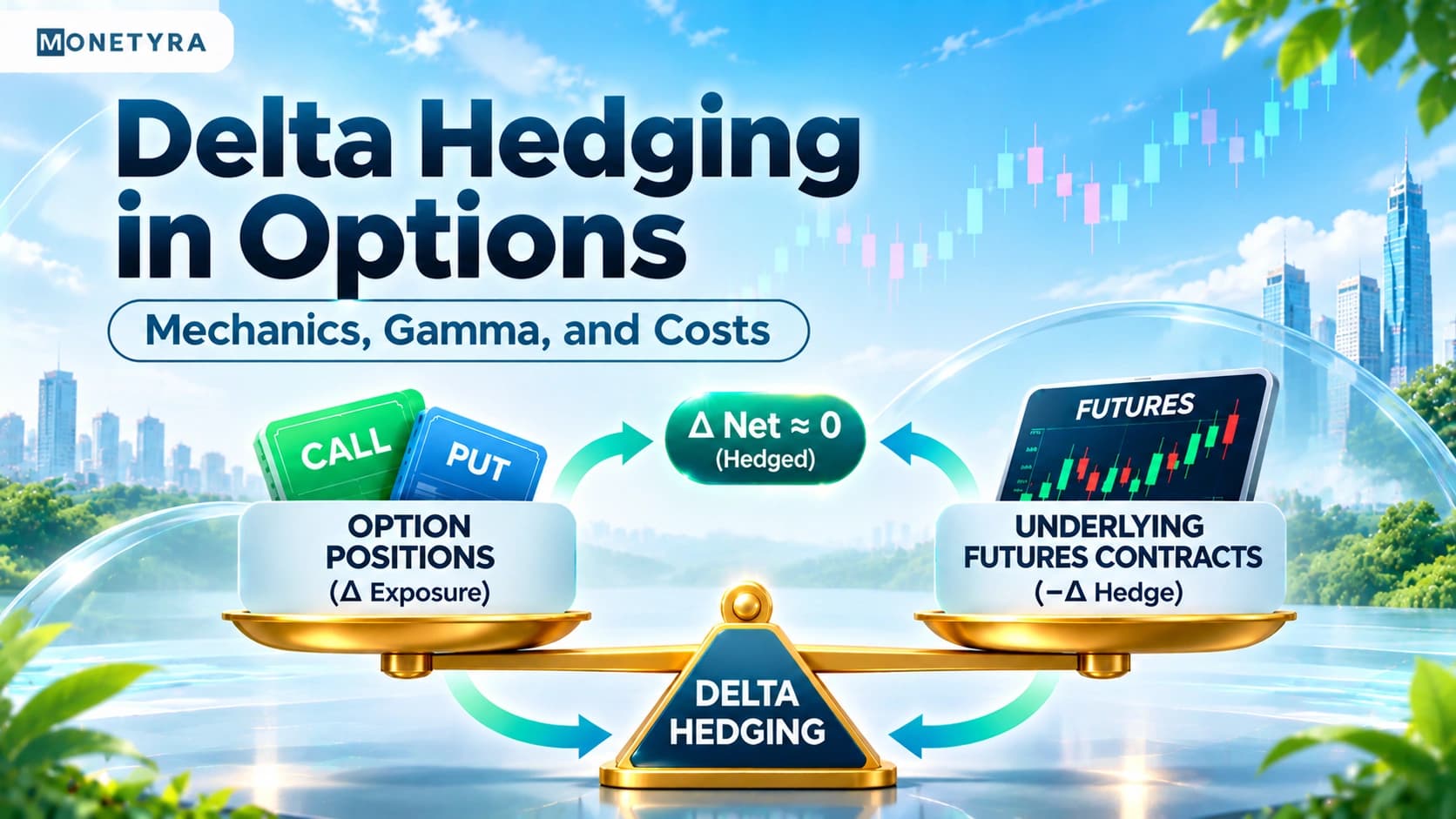
Options trading lets you take positions based on price direction, volatility, or time decay. Yet holding unhedged option contracts exposes your capital to rapid price swings in the underlying index or stock.
To manage this directional exposure, institutional desks and derivatives traders use delta hedging to keep their net market sensitivity near zero while isolating other option variables.
Quick Takeaways
- Delta hedging neutralizes directional price risk by pairing option contracts with an opposing position in underlying shares or futures.
- Because option sensitivity shifts continuously as market prices move, keeping a portfolio neutral requires periodic rebalancing.
- Frequent adjustments generate brokerage fees, Securities Transaction Tax (STT), and slippage that can outweigh theoretical gains in retail accounts.
What Is Delta Hedging and Why Do Options Traders Use It?
Delta hedging is an options risk-management technique that offsets directional price exposure by taking an opposing position in the underlying asset or its futures contracts.
Delta measures how much an option’s premium changes for every ₹1 move in the underlying asset, ranging from 0.00 to +1.00 for call options and 0.00 to -1.00 for put options. You can read more about how Delta measures option price sensitivity before building a multi-leg hedge.
When you combine options and underlying futures so their combined Delta equals zero, you create a Delta-neutral portfolio. Small price movements in either direction then produce offsetting gains and losses across your legs.
Traders and institutions apply this setup for three practical reasons:
- Market-Maker Inventory Control: Liquidity providers continuously buy and sell options to retail participants. When they sell call options, they accumulate negative Delta and immediately purchase underlying futures to remove directional risk while capturing the bid-ask spread.
- Isolating Implied Volatility: Derivatives traders running non-directional option trading strategies, such as short straddles, use Delta-neutral setups to profit from volatility contraction or time decay without betting on market direction.
- Portfolio Downside Protection: Fund managers holding large equity baskets hedge against broad index drops by pairing protective puts with dynamic futures adjustments.
Warning: A Delta-neutral position only protects against small, immediate price moves; larger market swings alter Delta itself and create unhedged exposure.
How to Calculate the Delta Hedge Ratio
You determine the exact hedge size by multiplying each contract’s Delta by the total number of underlying units and taking the opposite side.
Hedge Position Units = -1 × (Option Delta × Number of Contracts × Contract Lot Size)
Where Number of Contracts is positive for long options and negative for short options.
A positive result means you must buy underlying shares or futures, while a negative result means you must sell or short them. The table below shows how the formula applies across standard option positions on the National Stock Exchange (NSE), using the Nifty 50 lot size of 65 units as of November 19, 2026 (effective for January 2026 contracts).
| Option Position | Lot Size (Units) | Hypothetical Option Delta | Position Delta Exposure | Required Hedge Action |
|---|---|---|---|---|
| Long 1 Call Contract | 65 | +0.60 | +39.00 | Short 39 underlying units |
| Short 1 Call Contract | 65 | +0.60 | -39.00 | Long 39 underlying units |
| Long 1 Put Contract | 65 | -0.40 | -26.00 | Long 26 underlying units |
| Short 1 Put Contract | 65 | -0.40 | +26.00 | Short 26 underlying units |
Step-by-Step Delta Hedging Example with Nifty Options
To see how the numbers work in practice, consider a hypothetical example using Nifty 50 options and futures on the NSE, where one lot equals 65 units.
Suppose the Nifty 50 index is trading at 24,000, and you buy 2 lots (130 units) of an At-The-Money (ATM) call option carrying a Delta of +0.50.
- Calculate Initial Position Delta: Multiply your total units by the option Delta: 130 units × (+0.50) = +65.00 Delta. Your position gains ₹65 for every 1-point rise in Nifty and loses ₹65 for every 1-point drop.
- Establish the Offsetting Hedge: To bring net Delta to zero, you need -65.00 Delta. Since one short Nifty futures lot carries a Delta of -1.00 per unit (-65.00 total), you short 1 lot (65 units) of Nifty futures at 24,000.
- Verify Immediate Price Neutrality: Your combined portfolio Delta is now +65.00 + (-65.00) = 0.00.
The table below shows how this hypothetical portfolio behaves during an immediate 100-point move before Delta changes substantially.
| Hypothetical Index Move | Long 2 Call Lots Impact (+65 Delta) | Short 1 Futures Lot Impact (-65 Delta) | Net Portfolio Value Change |
|---|---|---|---|
| Nifty rises 100 points to 24,100 | +₹6,500 | -₹6,500 | ₹0 |
| Nifty drops 100 points to 23,900 | -₹6,500 | +₹6,500 | ₹0 |
Rebalancing After a Larger Market Move
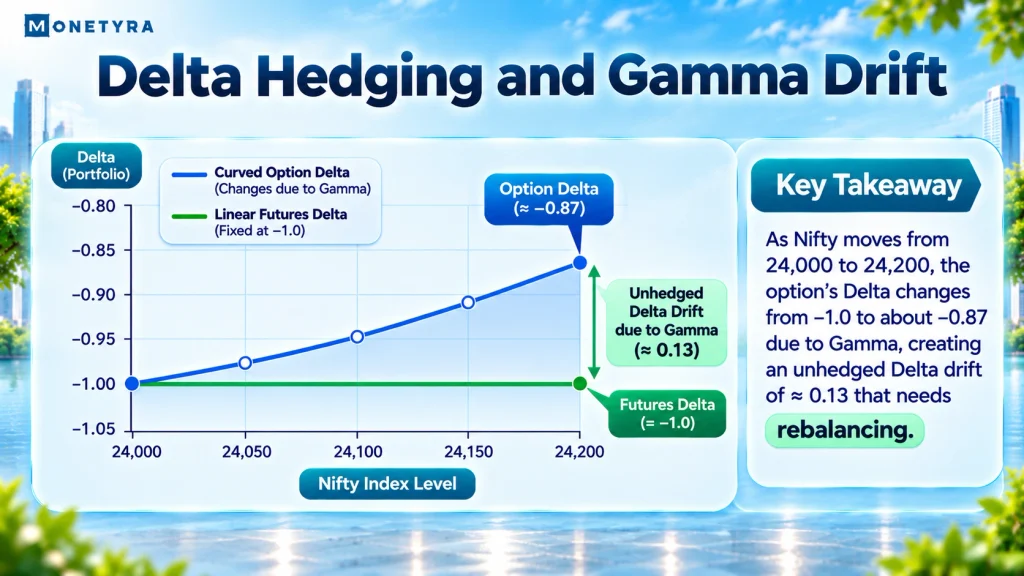
Suppose Nifty rallies 200 points during the session to 24,200. Your ATM call options move In-The-Money (ITM), and their Delta climbs from +0.50 to +0.75.
- Updated Call Delta: 130 units × (+0.75) = +97.50 Delta.
- Existing Futures Delta: -65.00 Delta (futures Delta stays constant at -1.00 per unit).
- Unhedged Net Delta: +97.50 + (-65.00) = +32.50 Delta.
Your portfolio is no longer neutral and now carries bullish directional exposure equal to 32.50 units. To restore neutrality, you would need to short an additional 32.50 underlying units—or wait until net Delta reaches ±65.00 before shorting a second futures lot.

How Gamma Affects Dynamic Rebalancing
Gamma is the primary reason a Delta-neutral portfolio drifts out of balance whenever the underlying price moves.
Gamma measures the rate at which an option’s Delta changes for every ₹1 movement in the underlying asset, sitting highest for ATM options near expiry. For a full breakdown of curvature and expiry behavior, explore Gamma in options trading alongside the other core Option Greeks.
In practical rebalancing, Gamma dictates both the size and direction of your adjustments:
- Long Option Positions (Positive Gamma): When the market rises, your call Delta increases, forcing you to sell futures at higher prices to stay neutral. When the market falls, your Delta drops, prompting you to buy back futures at lower prices.
- Short Option Positions (Negative Gamma): When the market rises, your short call Delta becomes more negative, forcing you to buy futures at higher prices. When the market falls, you must sell futures at lower prices—a pattern that locks in realized losses during choppy sessions.
Tip: Most active desks rebalance based on fixed Delta thresholds (such as ±0.25 lot equivalents) or scheduled time intervals rather than chasing every minor tick.
Rebalancing Costs and Practical Limits in Indian F&O Markets
In theory, hedging models assume you can trade any fractional size at no cost, but on Indian exchanges you face fixed lot sizes and recurring transaction costs.
When running dynamic adjustments in India, four practical constraints affect your net outcome:
- Minimum Lot Granularity: Index futures on the NSE trade only in fixed lot multiples (such as 65 units for Nifty 50). If your unhedged exposure is +32.50 Delta, you cannot short half a futures lot; you must either accept residual directional risk or use liquid equity shares for single-stock options.
- Securities Transaction Tax (STT) and Charges: Effective April 1, 2026, the Union Budget 2026–27 raised STT on futures sales to 0.05% of trade value and STT on options sales to 0.15% of the option premium, alongside brokerage, GST, and SEBI turnover fees. Frequent intraday rebalancing compounds these statutory charges quickly.
- Slippage During Fast Moves: Rebalancing during sharp volatility spikes or wide bid-ask spreads causes orders to fill at worse prices than modeled, eroding the small volatility edge you aim to capture.
- Margin and Tax Rules: Under Securities and Exchange Board of India (SEBI) peak margin rules, hedged option-and-futures spreads receive margin benefits, though you still need sufficient buffer capital for mark-to-market futures swings. Under the Income-tax Act, 2025, which replaced the 1961 Act on April 1, 2026, and is administered by the Income Tax Department, F&O gains and losses on recognized exchanges are treated as non-speculative business income, allowing you to deduct documented brokerage and STT expenses against trading revenue.
Advantages and Limitations of Delta Hedging
Evaluating both sides of this framework helps clarify when dynamic hedging fits a trading plan and when execution friction outweighs its benefits.
| Advantages | Limitations |
|---|---|
| Isolates Non-Directional Variables: Removes immediate directional price risk so traders can focus on implied volatility shifts or time decay (Theta). | High Transaction and Tax Drag: Frequent rebalancing multiplies brokerage fees, bid-ask slippage, and STT liabilities on every adjustment leg. |
| Scalable Institutional Risk Control: Allows market makers and multi-leg option sellers to neutralize large directional exposure using liquid index futures. | Imperfect Lot Sizing for Retail Accounts: Fixed index lot sizes prevent exact fractional hedging on smaller option positions. |
| Structured Margin Offsets: Pairing opposing option and futures legs typically lowers overall SPAN and exposure margin requirements under SEBI rules. | Overnight Gap and Gamma Risk: Sudden opening price gaps can move the underlying index past your hedge before you can place a rebalance order. |
Monetyra’s Take
Delta hedging works well for institutional desks and large multi-lot volatility traders who can absorb statutory costs and rebalance in exact lot increments. If you run one or two lots on the NSE, rigid lot sizes and the 2026 STT rates on derivatives can often turn frequent rebalancing into a net drag. In smaller accounts, defined-risk option spreads usually manage directional exposure more efficiently than continuous futures hedging.
Conclusion
Delta hedging gives you a clear, math-based way to neutralize directional price risk by pairing options with opposing positions in underlying shares or futures. While this approach isolates implied volatility and time decay, maintaining neutrality requires ongoing adjustments as Gamma shifts your exposure. In Indian F&O markets, balancing rebalancing frequency against STT, slippage, and minimum lot sizes determines whether a hedged setup remains practical.
Explore More Derivatives Mechanics and Risk Frameworks in Our Main Trading Hub
FAQs
1. What is delta hedging and how does it work?
Delta hedging is a risk-management method that offsets the directional exposure of option contracts by taking an opposing position in the underlying stock or futures. When the positive and negative Deltas across all legs sum to zero, small price movements in the underlying asset have minimal net impact on total portfolio value.
2. How do you calculate delta hedging for options?
Multiply the option’s Delta by the number of contracts and the contract lot size, then multiply that figure by -1 to find the required underlying hedge units. For example, holding 2 lots (130 units) of a Nifty call option with a +0.50 Delta equals +65.00 Delta, which requires shorting 65 units (1 lot) of Nifty futures to reach zero net Delta.
3. How does Gamma affect delta hedging?
Gamma measures how fast an option’s Delta changes when the underlying price moves by ₹1. Because Gamma causes Delta to rise or fall continuously during market swings, a hedge that starts at zero net Delta will drift out of balance and require periodic buying or selling of underlying futures to restore neutrality.
4. Is delta hedging profitable for retail traders?
Delta hedging itself removes directional risk rather than generating standalone profits; returns depend on capturing implied volatility shifts or option time decay. For retail traders on the NSE, fixed lot sizes, brokerage fees, and Securities Transaction Tax can erode potential gains if the position is rebalanced too frequently.
5. What are the costs of delta hedging in India?
Executing and rebalancing a delta hedge in India incurs brokerage commissions, Securities Transaction Tax (0.05% on futures sales and 0.15% on options sales since the Union Budget 2026–27 revisions took effect on April 1, 2026), exchange transaction charges, SEBI turnover fees, GST, and bid-ask slippage during volatile market sessions.
Disclaimer: This article was written with the help of AI and edited by the Monetyra editorial team. It is for educational purposes only and should not be considered financial advice. Trading and investing in financial instruments involve significant risk of loss and are not suitable for all investors, and past performance of any strategy does not guarantee future results. Please consult a licensed financial advisor before making any investment or trading decision.
In India, derivatives trading is regulated by SEBI. Readers are advised to verify the regulatory status of their broker and ensure compliance with applicable Indian laws before executing F&O strategies.